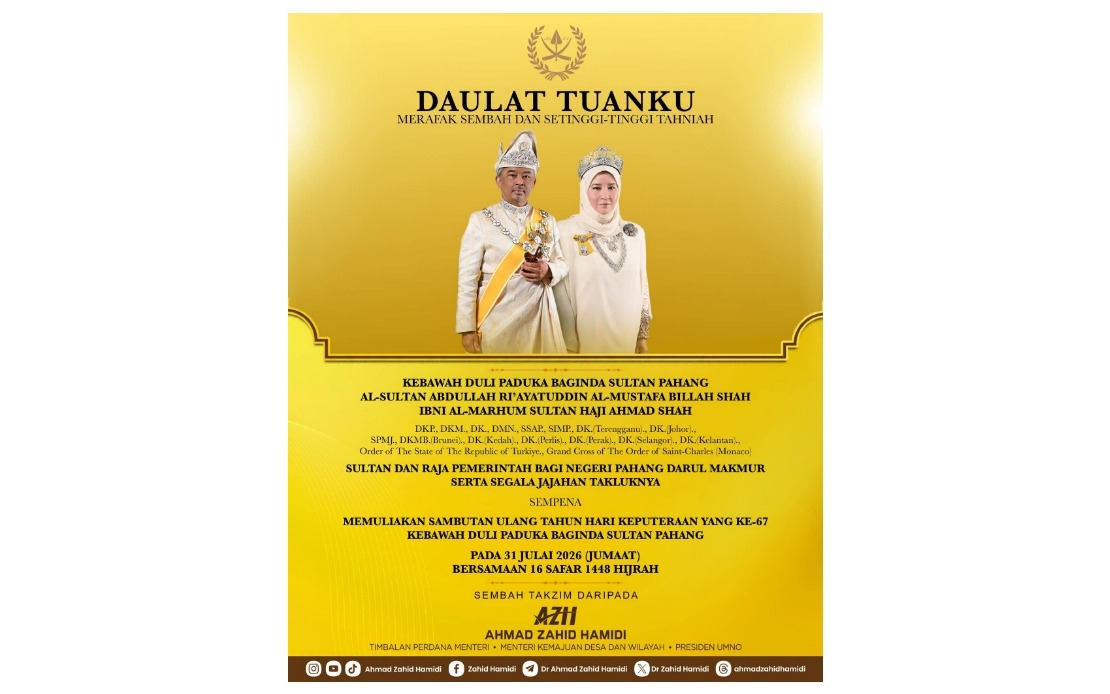
Malaysia's Deputy Prime Minister Datuk Seri Dr Ahmad Zahid Hamidi and Communications Minister Datuk Seri Fahmi Fadzil have publicly expressed their warm wishes and prayers for the Sultan of Pahang, Al-Sultan Abdullah Ri'ayatuddin Al-Mustafa Billah Shah, who celebrates his 67th birthday on July 31, 2026, coinciding with the 16th day of Safar in the Islamic calendar.
Ahmad Zahid used his official Facebook platform to relay his heartfelt message of appreciation and congratulations to the reigning monarch of Pahang. In his statement, the Deputy Prime Minister invoked blessings upon the Sultan, expressing hope that His Royal Highness would continue to enjoy good health and remain under divine protection as he carries out his constitutional duties.
The Deputy Prime Minister's birthday message carried particular significance, as it reflected the close ceremonial ties maintained between the federal government and Malaysia's state rulers. Ahmad Zahid's words emphasised the Sultan's continued role in ensuring the prosperity and development of Pahang Darul Makmur, a traditional appellation that underscores the state's historical importance within the Malaysian federation.
Fahmi Fadzil, speaking on behalf of the Ministry of Communications and the Office of the Lembah Pantai Member of Parliament, separately conveyed his ministerial team's collective wishes to the Sultan of Pahang. His public message extended beyond the Sultan himself, encompassing the entire Pahang Royal Family, reflecting the Malaysian tradition of honouring both the reigning monarch and the extended royal household during such occasions.
The timing of these public greetings highlights the ceremonial calendar that structures relations between Malaysia's political leadership and its constitutional monarchs. Both officials utilised the traditional phrase 'Daulat Tuanku', a respectful exclamation meaning 'long live the King', which underscores the reverence accorded to the institution of monarchy in Malaysia's constitutional framework.
The birthday celebration of state rulers holds broader significance within Malaysia's system of constitutional monarchy. While executive power rests with the Prime Minister and federal government, state sultans retain important ceremonial, custodial, and symbolic roles within their respective jurisdictions. The public acknowledgement of such occasions by federal ministers reinforces the integrative function of the monarchy across Malaysia's federal structure.
Ahmad Zahid's position as Deputy Prime Minister adds additional weight to his birthday wishes, as he functions as the second-highest ranking member of the federal executive. His engagement in such protocol matters demonstrates the consistent practice of federal leadership in maintaining formal relations with state rulers, a tradition that has characterised Malaysian governance since independence.
The communications between federal and state leadership, while appearing ceremonial on the surface, operate within a carefully maintained constitutional and cultural framework. These public expressions of goodwill serve to reinforce institutional bonds and demonstrate respect for Malaysia's hierarchical structure of governance, where both federal and state administrations coexist within a unified political system.
Pahang itself holds considerable strategic importance within Malaysia, being the largest state on Peninsular Malaysia and possessing significant natural resources and economic potential. The Sultan's governance of this substantial territory makes occasions of national and state significance relevant to broader discussions of Malaysian federalism and regional development priorities.
The practice of senior government officials publicly acknowledging royal birthdays reflects Malaysia's cultural emphasis on proper protocol and respect for established institutions. Such gestures, while routine in nature, contribute to the maintenance of harmony between the three branches of Malaysia's governance structure: the monarchy, the executive, and the legislative bodies that operate across both federal and state levels.
Fahmi Fadzil's additional invocation of 'Dirgahayu Tuanku', another traditional expression of good wishes, demonstrated the depth of ceremonial language employed in official communications with the monarchy. These linguistic choices are not merely formulaic but represent genuine adherence to Malaysia's constitutional conventions regarding the status and honour due to reigning sultans.

