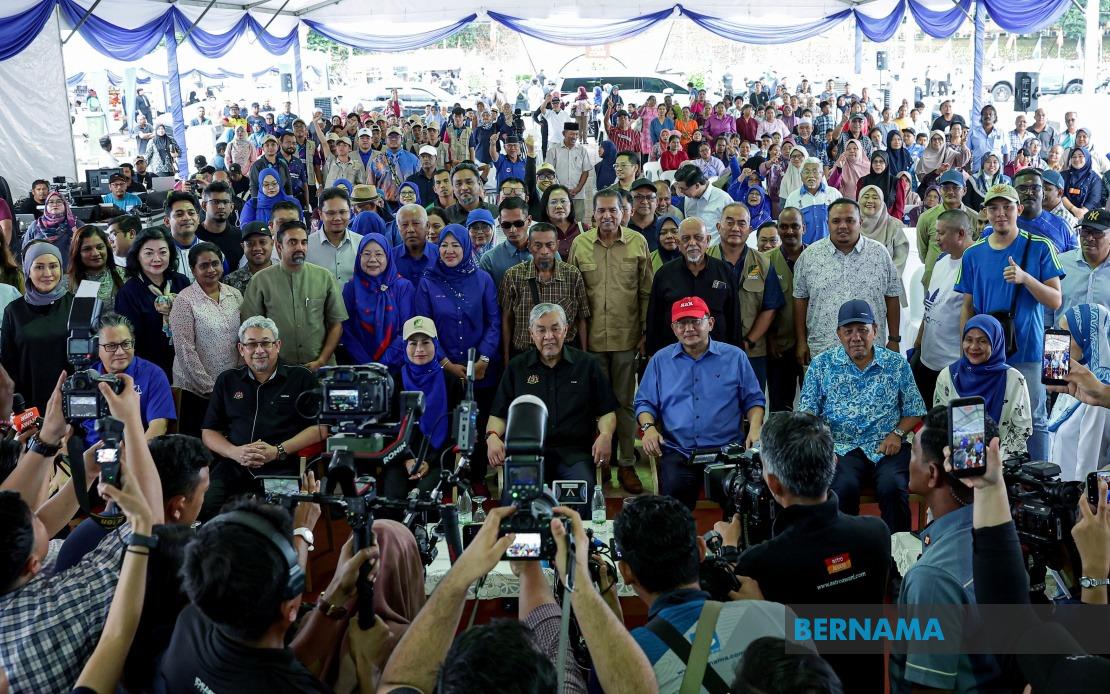
Deputy Prime Minister Datuk Seri Dr Ahmad Zahid Hamidi has made a formal appeal to all political parties participating in the 16th Negeri Sembilan State Election to keep divisive social issues away from their campaign strategies. Speaking in Kuala Pilah on July 25, the Barisan Nasional chairman stressed that electoral contests should centre on substantive policy discussions rather than matters tied to race, religion, cultural identity, or socioeconomic background.
The call reflects growing concerns about campaign conduct in Malaysia's state elections, where heated political competition has occasionally spilled into sensitive terrain. Ahmad Zahid's intervention as both deputy PM and BN chairman carries significant weight, signalling that the federal coalition intends to set the tone for a more restrained and issues-focused election period. His remarks come at a time when state elections have become increasingly important platforms for testing voter sentiment ahead of potential federal ballots.
In his address, Ahmad Zahid emphasised that political leaders at all levels—whether national, state, or local—bear a responsibility to uphold professional standards and ethical conduct. He argued that the spirit of unity that characterises the federal government's MADANI coalition should extend to state-level campaigns, even where competition is fierce and policy disagreements genuine. This framing suggests an attempt to elevate the tone of political discourse beyond personality-driven contests toward substantive debates about governance and development priorities.
The deputy PM acknowledged that the 16th Negeri Sembilan State Election presents numerous complex issues requiring serious management and debate. Rather than using these policy challenges as ammunition for attacks on rival leaders—current or former—Ahmad Zahid contended that parties should address them through constructive dialogue. He suggested there exists a proper, principled manner in which political opponents can articulate their differences without resorting to inflammatory rhetoric or identity-based appeals.
Ahmad Zahid also reaffirmed Barisan Nasional's commitment to supporting Prime Minister Datuk Seri Anwar Ibrahim's administration throughout its current term. He explicitly ruled out any attempts by the BN to destabilise the federal government through hidden political manoeuvres, a statement designed to reassure both coalition partners and the electorate about political stability at the national level during state election campaigns.
In a related development, UMNO vice-president Datuk Seri Mohamed Khaled Nordin sought to clarify the nature of arrangements between Barisan Nasional and Perikatan Nasional in the Negeri Sembilan contest. Speaking at a party delegates' meeting in Johor, Mohamed Khaled emphasised that cooperation between the two coalitions represents a limited political understanding intended to minimise contested seats rather than a deeper merger or fundamental realignment. He stressed that this tactical coordination should not create confusion about the parties' broader political objectives or alter perceptions of their relationships.
The clarification appears necessary given speculation about the implications of BN-PN cooperation for Malaysia's evolving political landscape. By characterising the arrangement as purely seat-sharing pragmatism, Mohamed Khaled sought to prevent the narrative from suggesting either a formal coalition or a wholesale shift in allegiances. This distinction matters for grassroots members and supporters who might otherwise question their parties' strategic direction, particularly in an environment where political configurations remain fluid.
The Negeri Sembilan election represents a significant test for state-level politics in the region. As one of Malaysia's smaller states by population, Negeri Sembilan nonetheless holds symbolic importance in the broader political narrative. The election is scheduled with early voting on July 28 and general polling on August 1, providing a relatively compressed campaign period during which Ahmad Zahid's ethical appeals will face real-world testing.
For Malaysian and Southeast Asian observers, these interventions highlight the ongoing tension between competitive politics and national cohesion in a plural society. Ahmad Zahid's call essentially asks parties to voluntarily constrain their campaign strategies during a contest where emotional appeals around identity and belonging could potentially mobilise voters more effectively than dry policy discussion. The success of this appeal will offer insights into whether Malaysian political culture has matured sufficiently to sustain substantive electoral competition without recurring to divisive identity politics.
The deputy PM's role in articulating these standards is itself significant, given his position spanning both federal executive authority and party leadership. His intervention suggests that the federal government views the Negeri Sembilan election as an opportunity to model the conduct it expects from political players nationwide. As Malaysia continues to navigate complex questions about representation, governance, and inter-community relations, the ability of political leaders to maintain ethical standards during competitive elections becomes central to broader democratic health and social stability.

