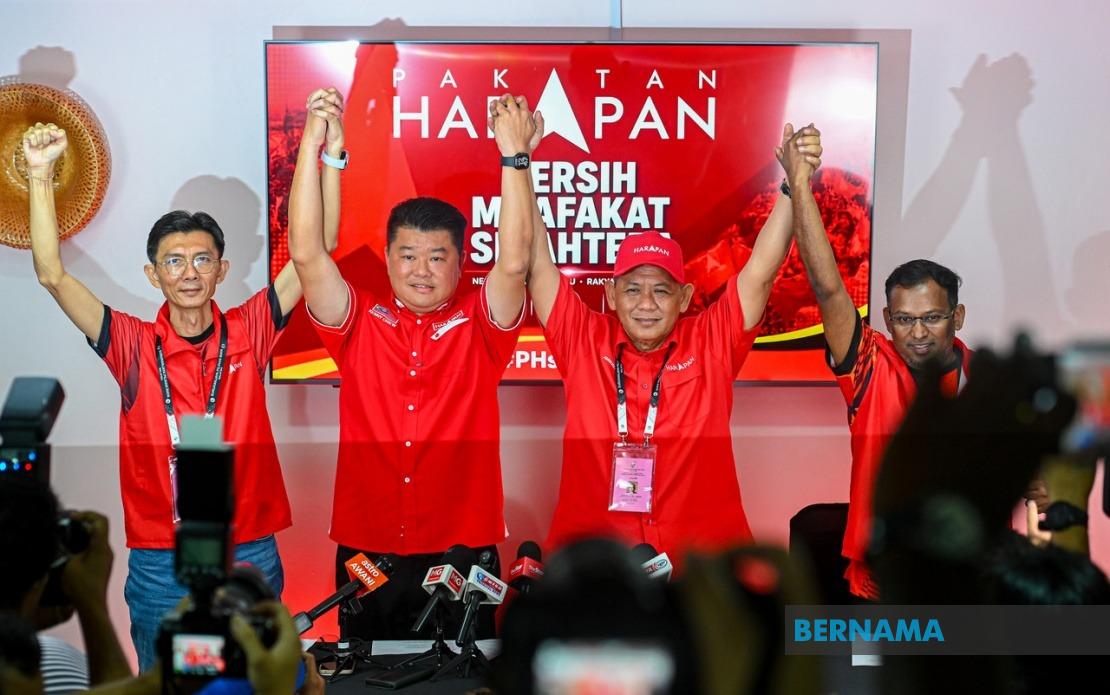
Negeri Sembilan Pakatan Harapan chairman Datuk Seri Aminuddin Harun has sought to firmly shut down mounting speculation about divisions within the coalition's ranks, insisting that internal cohesion remains intact as campaigning intensifies for the upcoming state election. Speaking during a press conference in Port Dickson on July 20, the menteri besar and State PKR chairman emphasized that leadership structures and electoral machinery across the five state constituencies falling within the Port Dickson parliamentary seat have been functioning harmoniously, with all parties committed to delivering victories for PH-backed candidates.
The reassurance appears directed at addressing undercurrents of tension that surfaced following the re-nomination of incumbent assemblyman Datuk Yew Boon Lye for the Chuah seat. Social media speculation had suggested discord within party ranks, with particular focus on Port Dickson PKR deputy division chief Datuk Kenny Chiew Chi Kin, who had not secured nomination for the upcoming contest. The situation threatened to become a public relations flashpoint for PH as election day approached, potentially undermining the coalition's messaging about organisational unity.
Aminuddin moved swiftly to contain the narrative, disclosing that any friction stemming from the candidate selection process had been resolved through internal dialogue. He characterised the matter as a routine aspect of the nomination process and rejected suggestions that unresolved grievances festered within party structures. By framing the resolution as complete and amicable, the menteri besar sought to demonstrate that PH's decision-making machinery, while sometimes contentious, ultimately functioned according to established protocols and remained subordinate to coalition strategy.
Centrally, Aminuddin revealed that Chiew had publicly committed to throwing his full weight behind all PH candidates contesting the state election. This personal pledge carries symbolic weight in Malaysian politics, where factional loyalty and the public alignment of defeated aspirants can significantly influence voter perceptions of party cohesion. Aminuddin explicitly credited Chiew's prior service to PKR and acknowledged his efforts in developing the Port Dickson division despite missing out on candidacy, effectively positioning the deputy chief as a mature, party-first operator.
The Port Dickson MP also articulated a broader strategic concern, arguing that speculation about internal divisions had been deliberately seeded by opponents seeking to portray PH in an unfavourable light. This framing positions the coalition as a victim of coordinated narrative manipulation rather than as an organisation grappling with genuine structural tensions. By attributing negative reporting to external bad-faith actors, Aminuddin redirected attention away from the mechanics of PH's candidate selection process and toward the motives of rival political entities.
Among the five state seats targeted by PH under the Port Dickson parliamentary constituency are Chuah, Lukut, Sri Tanjung, Bagan Pinang, and Linggi. Aminuddin himself is contesting the Linggi seat as PH's candidate, meaning his political fortunes are directly tied to coalition performance across the region. This personal stake underscores the genuine premium he places on presenting a united front to voters, as a broader PH collapse in Port Dickson would tarnish his own electoral credentials.
The contest for Chuah carries particular electoral significance given Yew's prior performance. In the 2023 state election, the incumbent PKR assemblyman secured the seat with a commanding 6,298-vote majority, defeating Perikatan Nasional candidate Tang Jay Son. This earlier victory demonstrated local appeal and established Yew as an effective campaigner, yet Barisan Nasional's decision to field Pau Jeou Ching as its challenger suggests the Opposition believes the seat remains competitive. Yew's re-nomination thus reflects both confidence in his track record and recognition that holding the seat cannot be taken for granted.
The electoral timeline compounds pressure on PH to maintain visible unity. Early voting is scheduled for July 28, meaning the campaign period is foreshortened compared to federal contests. Polling takes place on August 1, leaving a narrow window for candidates to consolidate support and for party machinery to execute on-ground operations. Any perception of internal weakness during this compressed timeframe could prove magnified, potentially translating into swing votes for rival coalitions capitalising on perceived organisational fractures.
For Malaysian voters and regional political observers, the Negeri Sembilan contest serves as a barometer of PH's capacity to maintain coalition discipline while navigating the inherent tensions within multi-party alliances. The Port Dickson parliamentary region, spanning five state constituencies, represents sufficiently significant electoral territory that outcomes here will influence broader assessments of PH's organisational health and electoral competitiveness heading into future contests. Aminuddin's explicit rebuttal of rift claims signals the coalition's determination to project operational stability, yet the fact that such denials required public articulation itself underscores the persistence of internal pressures within PH's ranks that periodically threaten to surface.

