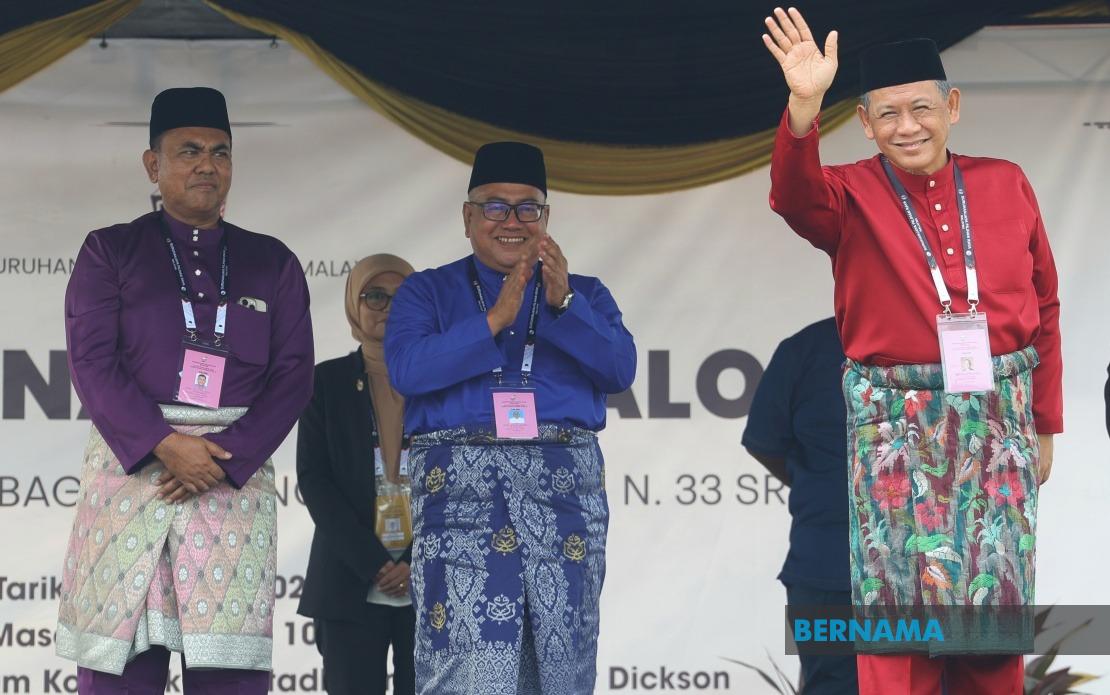
Negeri Sembilan's incumbent Menteri Besar, Datuk Seri Aminuddin Harun of Pakatan Harapan, must navigate a crowded field to retain his Linggi seat in the state election on August 1, facing competition from both Barisan Nasional and a Bersatu challenger. The nomination process concluded this week at the Port Dickson District Administration Complex, revealing a complex electoral landscape that will test PH's grip on the state after winning in 2018 with a reform mandate. Aminuddin will contend with incumbent Datuk Mohd Faizal Ramli representing the traditional BN coalition and Datuk Zamri Md Said running on the Bersatu ticket, a configuration that potentially fragments opposition votes while creating unpredictability in a traditionally competitive seat.
The three-cornered contest in Linggi reflects broader fractures in Malaysia's opposition camp, where Bersatu's presence as a splinter force has complicated electoral mathematics across multiple states. Bersatu's decision to field candidates independently rather than cooperate with BN or PH signals the party's determination to establish itself as a significant player despite its modest parliamentary footprint. For Aminuddin, who has led the state since the PH victory in 2018, the Linggi contest represents both a test of his personal standing in the constituency and a barometer of PH's resilience in retaining control of Negeri Sembilan. The outcome will carry implications beyond the state, as PH seeks to demonstrate electoral viability ahead of any potential federal realignment.
Across other constituencies, the state election will feature similarly competitive matchups. In Sri Tanjung, PH incumbent Dr G. Rajassekaran defends against both BN's A. Achutan and Bersatu's Leevineshwaraan Murugan, suggesting that the three-way pattern is becoming systemic rather than isolated to Linggi. The Lukut seat presents a different dynamic, with PH incumbent Choo Ken Hwa confronting Perikatan Nasional candidate Sathes Kumar Nilameham and independent Teo Seng Lee, indicating that PN's influence persists despite its reduced parliamentary presence nationally. In Bagan Pinang, PAS incumbent Abd Fatah Zakaria, representing the Islamic party's traditional stronghold in Negeri Sembilan, will defend against PH's Nasir Raman and Bersatu's Sheikh Junaidy Jamaludin, a configuration that complicates communal and religious voting patterns.
The Chuah seat offers PH an opportunity to simplify the contest, as it will feature only a straight fight between PH incumbent Yew Boon Lye and BN's Pau Jeou Ching. This binary contest may allow the incumbent to consolidate anti-BN sentiment without the complicating factor of a third alternative, potentially serving as a model for how PH performs in head-to-head matchups. The variation in contest formats across constituencies suggests that no single electoral narrative will dominate the campaign, requiring both PH and BN to tailor messaging and mobilization strategies seat-by-seat rather than pursuing unified state-level campaigns.
The Election Commission has registered 889,490 eligible voters in Negeri Sembilan, comprising 867,151 ordinary voters supplemented by 16,884 military personnel and their spouses alongside 5,455 police personnel and their spouses. This electorate size places Negeri Sembilan in the middle tier of Malaysian states by population, large enough for results to influence national political discourse yet small enough that campaign dynamics can shift quickly through targeted constituency-level organizing. The inclusion of military and police voters, constituencies traditionally inclined toward the ruling coalition, provides BN with a structural advantage that PH must overcome through mobilizing non-uniformed voters more effectively.
The Election Commission has designated July 28 for early voting, allowing uniformed personnel and other eligible voters to cast ballots before the main polling date of August 1. This two-stage voting schedule reflects procedural commitments to ensuring security and administrative personnel can participate while maintaining normal operations during the election. Early voting also provides campaigns with preliminary data on turnout patterns, allowing organizations to adjust their final-week strategies based on which constituencies have demonstrated stronger participation in the initial phase.
For Malaysian observers, the Negeri Sembilan election serves as an important test of whether the three-coalition fragmentation that characterizes national politics is cementing itself at state level or whether pragmatic electoral cooperation might reassert itself. The Linggi contest between Aminuddin, Mohd Faizal, and Zamri encapsulates this broader tension: each candidate represents a distinct coalition or party, yet all three claim to advance legitimate alternative visions for governance. The outcome will reveal whether Malaysian voters perceive Bersatu as a meaningful choice distinct from BN's conservative approach and PH's reformist agenda, or whether the party remains marginal despite its ballot presence.
Aminddin's re-election prospects depend partly on consolidating PH's 2018 victory margins while managing the complication of Bersatu's challenge. In 2018, PH swept Negeri Sembilan comprehensively, suggesting strong voter appetite for change at that moment. Whether that enthusiasm persists after five years of PH governance—marked by federal coalition instability and the interim period of PH-BN cooperation following Muhyiddin's departure—remains uncertain. Aminuddin has focused on state-level development initiatives and maintaining relatively stable governance, but broader national dynamics beyond his control may influence how voters assess his performance and prospects.
The BN strategy appears predicated on regaining ground lost in 2018 by presenting Mohd Faizal as an established administrator capable of returning Negeri Sembilan to traditional coalition governance. Bersatu's entry complicates this binary narrative, potentially allowing PH to portray BN as a divided opposition itself or creating space for strategic voting where reformist-minded voters might defect to Bersatu if they believe it offers a more authentic anti-establishment alternative than PH. The campaign period ahead will clarify how each coalition positions these competing narratives.
Regionally, Malaysia's state elections often generate spillover effects, with victories or losses in one state influencing momentum and donor confidence for parties contesting simultaneously in other jurisdictions. The Negeri Sembilan results will be reported closely by analysts monitoring PH's electoral resilience and BN's capacity to recover in states outside its traditional strongholds. For Southeast Asia's broader democratic context, where coalition politics and multi-party competition have become increasingly sophisticated, the Linggi three-cornered fight exemplifies the complex strategic calculations that parties must navigate in regionally competitive systems.

