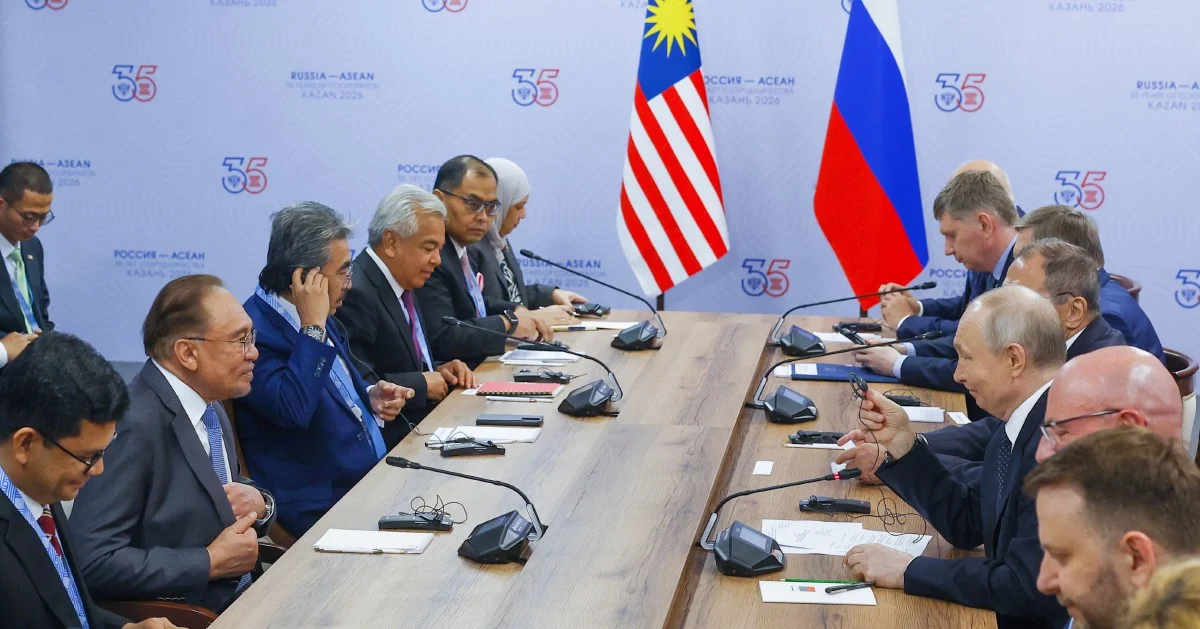
Prime Minister Datuk Seri Anwar Ibrahim seized a diplomatic occasion in Kazan to publicly acknowledge Russian President Vladimir Putin's support for expanding energy partnerships between Malaysia and the state-owned oil and gas giant Petroliam Nasional Bhd (Petronas). The expression of gratitude underscores Malaysia's determination to deepen its energy footprint across international markets and strengthen ties with major petroleum-producing nations during a period of significant global energy transition challenges.
The timing of Anwar's remarks reflects Malaysia's strategic positioning within a shifting geopolitical landscape where energy security and economic cooperation have become increasingly intertwined. As nations compete for access to reliable hydrocarbon supplies and investment opportunities, Malaysia's traditional role as an energy producer and exporter—both of oil and liquefied natural gas—places it at an important juncture. Russia's willingness to support such collaborations with Petronas suggests Moscow views Malaysia as a valuable partner in maintaining influence within Asia's energy markets, particularly as Western sanctions limit Russia's access to other trading networks.
Petronas, as the cornerstone of Malaysia's energy strategy, has long pursued international expansion and joint ventures to sustain its competitive position. The company's operations span exploration, production, refining, and trading across multiple continents, making partnerships with major energy producers strategically significant. Russian support for these endeavours indicates recognition of Petronas's technical capabilities and market standing, while also potentially opening new avenues for bilateral energy projects, technology sharing, and investment flows between the two countries.
For Malaysia, cultivating energy partnerships with Russia carries both economic and diplomatic implications. The relationship diversifies Malaysia's energy supply chains and investment sources beyond traditional Western markets, reducing over-reliance on any single geopolitical sphere. This diversification becomes increasingly crucial as Malaysia navigates the complex intersection of global energy demand, climate commitments, and domestic economic requirements. The country must balance its status as a fossil fuel exporter with regional and international pressures to transition toward renewable energy sources—a tension that sophisticated partnerships can help ease through technology transfer and joint research initiatives.
The Kazan meeting also reflects broader Malaysian foreign policy that emphasizes pragmatic engagement with all major powers. Under Anwar's administration, Malaysia has sought to maintain equidistant relationships with traditional allies and rising powers, ensuring the country benefits from economic and technological cooperation across the board. This measured approach allows Malaysia to preserve strategic autonomy while maximising opportunities in energy, trade, and investment—sectors that directly impact national development and citizen welfare.
Russia's interest in strengthening energy cooperation with Petronas extends beyond simple commercial transactions. It represents an effort to secure long-term partnerships in Asia's rapidly growing energy markets and to counter the effects of international isolation through conventional diplomatic channels. For Malaysia, accepting such overtures demonstrates confidence in independent foreign policy decision-making and recognition that energy security transcends traditional bloc alignments. Petronas's involvement ensures that partnerships are evaluated on merit and market fundamentals rather than ideology.
The energy sector remains central to Malaysia's economic strategy despite long-term transition efforts toward technology and services-based industries. Oil and gas revenues have historically funded infrastructure development, education, and healthcare—critical areas where capital accumulation directly translates to improved living standards. Sustaining Petronas's profitability and operational capacity therefore carries significance beyond corporate performance metrics; it underpins the government's ability to fund social programmes and maintain investor confidence in Malaysia's economic stability.
From a regional perspective, Malaysia's strengthened energy partnerships with global players like Russia contribute to Southeast Asia's energy security architecture. The region depends heavily on reliable hydrocarbon supplies and investment in exploration and infrastructure development. When a major ASEAN economy like Malaysia expands its energy cooperation networks, it creates spillover benefits for neighbouring countries and demonstrates the region's collective capacity to engage with multiple international partners simultaneously. This dynamic enhances Southeast Asia's strategic independence and makes the region more attractive to investors and technology providers seeking diversified market access.
Looking forward, the extent to which Russian-Malaysian energy cooperation materialises will depend on several factors: the sustainability of Petronas's operational efficiency in increasingly competitive global markets, the regulatory environment in both countries, and the evolution of international energy markets amid the transition to renewable sources. Nevertheless, Anwar's public expression of appreciation signals Malaysia's commitment to pragmatic engagement and its determination to leverage every avenue for advancing national energy interests. Whether through exploration partnerships, technology collaborations, or investment arrangements, the foundation appears set for meaningful economic engagement in one of Malaysia's most strategically important sectors.

