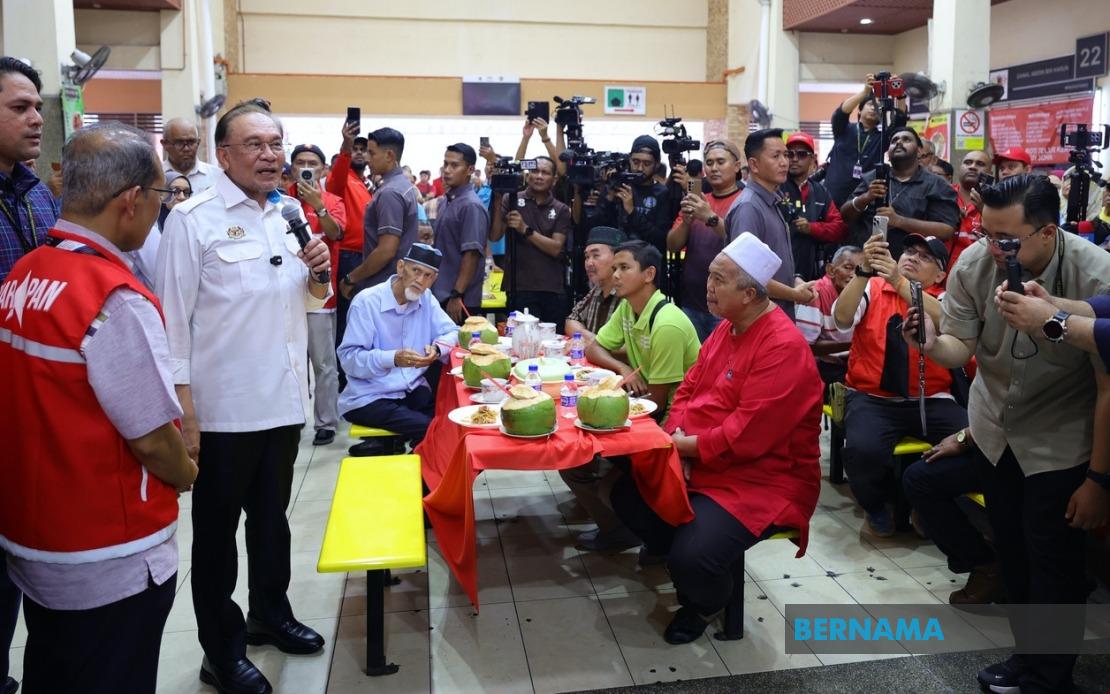
Prime Minister Datuk Seri Anwar Ibrahim travelled to Seremban on July 22 to make an impassioned pitch to Negeri Sembilan voters, urging them to grant Pakatan Harapan (PH) a fresh electoral mandate. Speaking as both head of government and chairman of the coalition, Anwar framed the upcoming state election not merely as a local contest but as a referendum on continued stability and coordinated policymaking across Malaysia's administrative tiers. His message reflected a broader coalition strategy to consolidate support in the final fortnight before voters head to the polls on August 1.
Anwar's central argument rested on the premise that political continuity directly facilitates effective delivery of services and development projects. A strong PH victory would allow the state government and federal administration to operate in synchrony, he suggested, preventing the friction and delays that often characterise misaligned administrations. This framing carries particular resonance in Negeri Sembilan, a state of roughly one million people that has historically served as a bellwether for national political sentiment. The Prime Minister's presence signalled that the coalition views the contest as consequential beyond state boundaries, with implications for the broader coalition's credibility heading into a potential general election cycle.
The stability narrative also served to defend the track record of Menteri Besar Datuk Seri Aminuddin Harun, who has led Negeri Sembilan for three years under PH governance. Anwar credited cooperation among various political actors for maintaining an orderly state administration, though he stopped short of claiming flawlessness. Instead, he pivoted toward a pragmatic appeal: voters should provide the coalition's candidates another opportunity to serve, knowing that constructive feedback would drive incremental improvements. This softer messaging—acknowledging imperfection while requesting continued trust—represents a subtle shift from triumphalism toward humility, potentially designed to address voter frustration with unfulfilled campaign promises or bureaucratic shortcomings.
Anwar's remarks came as PH prepared to contest all 36 state assembly seats in the election. The coalition's candidate allocation reflected its internal power-sharing arrangement, with the People's Justice Party (PKR) fielding 16 candidates, the Democratic Action Party (DAP) putting forward 11, and the National Mandate Party (Amanah) contributing nine. This distribution underscores the continuing importance of coalition discipline and balance in PH's electoral calculations. For Malaysian observers, the seat allocation also signals which parties the coalition leadership views as possessing stronger organisational capacity or local ground presence in particular constituencies.
The timing of the Negeri Sembilan election itself merits scrutiny within the Malaysian electoral calendar. Scheduled for August 1 with early voting on July 28, the contest arrives at a moment when the federal government has built some momentum through economic stabilisation efforts and infrastructure projects. However, it also occurs amid persistent cost-of-living pressures affecting household budgets across the country. Voters in states like Negeri Sembilan, which includes mix of urban, semi-urban, and rural communities, may weigh both macro-economic performance and hyperlocal service delivery when making their choices at the ballot box.
From a strategic perspective, a PH victory in Negeri Sembilan would provide psychological and numerical lift to the coalition ahead of the next general election, which must be held by October 2025. Conversely, losses or reduced margins would embolden opposition parties—particularly the Perikatan Nasional bloc—and create pressure within PH itself, potentially triggering recriminations about candidate selection or campaign execution. This elevated stakes environment explains why Anwar personally invested campaign energy in the state, a move that also burnished his image as an active, ground-engaging political leader rather than one confined to federal administration.
The Prime Minister's acknowledgment that not all PH policies have proven effective revealed an interesting rhetorical choice. Rather than defending specific decisions, he essentially invited voters to view the election as an iterative process in which parties respond to public sentiment. This framing presupposes a level of voter agency and influence over policymaking that may or may not reflect political reality in Malaysia's Westminster-derivative system. Yet it also reflects contemporary voter expectations, particularly among younger and urban demographics, that elected representatives should remain responsive and adaptive rather than ideologically rigid.
For Southeast Asian political observers, the Negeri Sembilan election exemplifies broader regional patterns around coalition governance. Multi-party coalitions such as PH face perpetual tensions between internal unity and external credibility. Overemphasising harmony risks appearing complacent to voters seeking change; overstating disagreement invites claims of instability. Anwar's remarks attempted to thread this needle by presenting PH as united in purpose while remaining open to corrective feedback. Whether this messaging proves persuasive to voters remains an open question, particularly in constituencies where local grievances have accumulated.
The Election Commission's scheduling of early voting on July 28 also carries procedural significance. Early voting provisions typically benefit voters unable to cast ballots on election day itself—including those working in essential services, travelling, or managing family commitments. The four-day window between early and general voting provides scope for campaign developments or unexpected news cycles to influence final voter sentiment. Both PH and opposition parties would calibrate their final messaging phases accordingly, possibly intensifying focus on late-moving or undecided voters in marginal constituencies.
Anwar's campaign visit underscored that Negeri Sembilan, despite its modest size relative to larger states like Selangor or Penang, occupies a strategically important position in PH's political calculus. A swing state capable of shifting political control, Negeri Sembilan has voted for different ruling coalitions in successive elections, indicating a volatile or discerning electorate. Maintaining PH's grip on the state requires not merely taking voters for granted but actively persuading them of continued relevance and competence. The Prime Minister's direct intervention signalled that the coalition would not attempt a passive reelection strategy, instead placing the legitimacy and necessity of PH governance directly before the public.
The broader context of Malaysian federalism also informed Anwar's emphasis on state-federal coordination. Malaysia's constitutional structure mandates significant state government autonomy over land, agriculture, and certain revenue sources. PH's narrative of unified governance implicitly promised synergies from aligned administrations—federal funds flowing more readily to PH-governed states, policy coherence across sectors managed at different governmental levels, and reduced institutional friction. Whether voters perceive tangible benefits from such alignment, however, depends partly on economic conditions and service delivery outcomes beyond any single state government's direct control.
As Negeri Sembilan's election drew closer following Anwar's campaign appearance, the state emerged as a potential bellwether for deeper questions about PH's electoral durability and coalition cohesion. The composition of the new state assembly would send signals about which communities viewed PH as addressing their concerns, which demographic groups remained persuadable by opposition messaging, and whether the coalition could maintain the voting shifts that brought it to power nationally in 2018. For Malaysian political observers and Southeast Asian analysts tracking regional trends around coalition governance, the Negeri Sembilan result would merit careful examination as an indicator of broader political currents.

