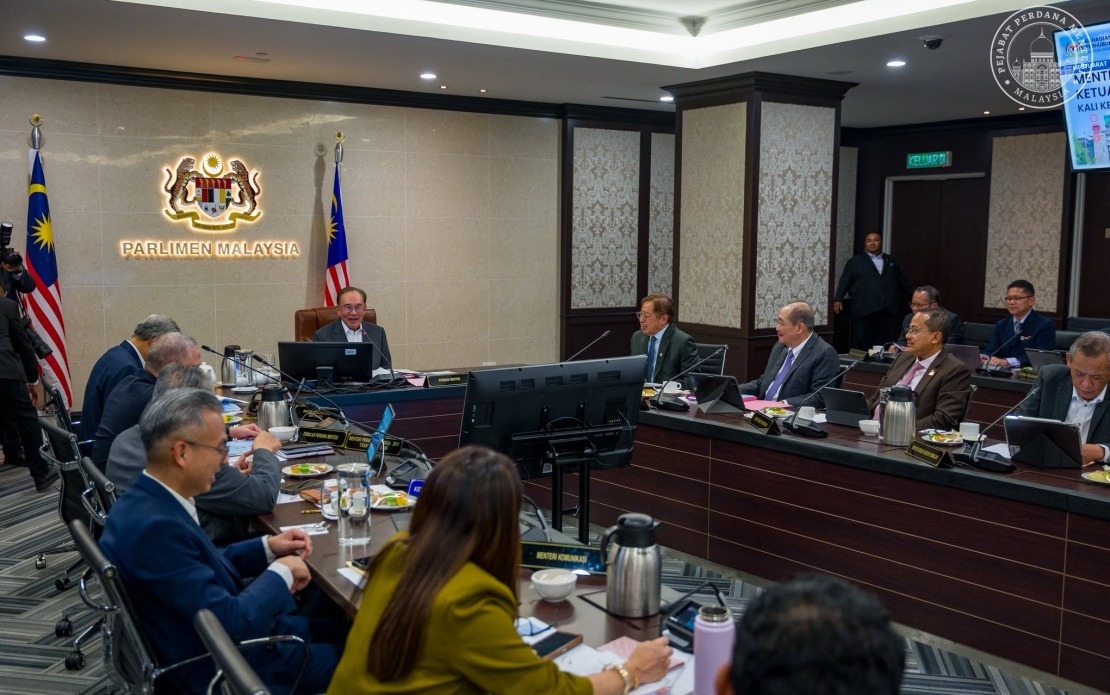
Prime Minister Datuk Seri Anwar Ibrahim has convened the nation's Menteris Besar and Chief Ministers for their 149th assembly, positioning the gathering as a critical juncture for aligning federal and state strategies on economic fortification during an increasingly turbulent global environment. The Parliament Building session brought together Malaysia's most senior regional administrators to tackle interconnected challenges ranging from external trade pressures to climate adaptation, underscoring the administration's commitment to collaborative governance across the federation's thirteen states and three federal territories.
The geopolitical dimension loomed large over proceedings, with participants examining how ongoing conflicts in West Asia continue to reverberate through international supply chains, commodity prices, and investor confidence. The ramifications extend beyond Malaysia's immediate trading relationships; the instability affects regional financial markets, currency valuations, and the flow of foreign direct investment into Southeast Asia more broadly. For a nation whose economic health depends significantly on global commerce and manufacturing networks, such external shocks demand proactive coordination between Putrajaya and state governments to mitigate localised economic disruptions and safeguard employment across sectors.
Beyond geopolitical turbulence, the assembly devoted substantial attention to Malaysia's vulnerability to the El Niño phenomenon, which meteorological experts anticipate will intensify during the coming months. This climate pattern poses multifaceted threats to Malaysia's economic and social fabric, potentially constraining water availability across urban and agricultural regions, disrupting food production capacity, and elevating the incidence of heat-related health complications and transboundary haze. State governments, which oversee water management, agricultural policy, and emergency services within their jurisdictions, bear critical responsibility for implementing adaptive measures and early-warning systems to cushion their populations against these environmental hazards.
Anwar emphasised that the meeting prioritised a fundamental reorientation of governance methodology, demanding that every government initiative undergo scrutiny to ensure it reflects integrated planning, operational efficiency, and genuine responsiveness to citizen needs. This people-centric framework aims to counteract fragmented implementation patterns where federal and state efforts proceed in parallel rather than synergy, often resulting in duplicated expenditure, conflicting regulations, or gaps in service delivery. By insisting on coherent policy architecture, the Prime Minister signalled intent to extract greater developmental returns from taxpayer resources and enhance the tangible impact of government programmes on household welfare.
Economic competitiveness featured prominently as a substantive theme, reflecting recognition that Malaysia cannot rely indefinitely on its traditional advantages of cost and geographic location. The assembly examined mechanisms for attracting quality foreign investment—particularly in higher-value manufacturing, technology, and research-intensive sectors—whilst ensuring such inflows translate into sustainable employment, skills development, and technology transfer rather than transient capital seeking quick arbitrage. State governments possess considerable levers to influence investment climate through infrastructure quality, regulatory predictability, and human capital development, necessitating their active participation in crafting investment propositions.
The consensus-building atmosphere that permeated the gathering reflects a deliberate political strategy to reinforce collaborative federalism, especially given Malaysia's complex constitutional division of powers between national and state authorities. When Menteris Besar and Chief Ministers operate as a cohesive force, they amplify their collective voice in shaping national policy, whilst simultaneously ensuring that state-specific circumstances receive adequate consideration in federal planning. This institutional arrangement, when functioning optimally, prevents the centre from imposing one-size-fits-all solutions on regions with divergent demographics, economic structures, and development priorities.
For Malaysian citizens, the implications of this high-level coordination extend beyond abstract governance principles. More effective federal-state collaboration should yield tangible improvements in infrastructure delivery, faster resolution of inter-agency bottlenecks that delay project implementation, and more consistent application of standards across regions. Whether regarding healthcare access, educational quality, environmental protection, or business registration processes, citizens typically experience government services filtered through state-level institutions, making state administrative performance integral to overall satisfaction with governance.
The regional dimension deserves particular consideration for Southeast Asian observers. Malaysia's economic fortunes remain intertwined with those of its neighbours through the Association of Southeast Asian Nations framework, intra-ASEAN supply chains, and Singapore's role as financial hub for the wider region. When Malaysia strengthens internal economic resilience and improves governance efficiency, it contributes to broader regional stability and competitive positioning vis-à-vis other economies vying for investment and market access. Conversely, internal fragmentation or policy inconsistency across Malaysian states can ripple outward, undermining ASEAN's collective economic performance.
The El Niño preparedness component reflects a maturing recognition within Malaysian policymaking circles that climate variability poses genuine economic risk requiring integrated response architectures. Agricultural sectors in Peninsular Malaysia, Sabah, and Sarawak face distinct vulnerabilities depending on rainfall patterns, elevation, and existing irrigation infrastructure. State-level agencies, often possessing superior ground-level intelligence on local hydrological conditions and farming practices, must work in concert with federal agricultural and water authorities to calibrate drought mitigation strategies, crop insurance mechanisms, and emergency relief protocols. This climate adaptation imperative will likely feature with increasing prominence in future inter-governmental assemblies as extreme weather events grow more frequent.
Anwar's emphasis on ensuring comprehensive benefit distribution across Malaysian communities carries implicit acknowledgment that development gains have not always reached all population segments equitably. Regional disparities in income, employment opportunities, and service quality persist across Malaysia, with certain states and districts remaining economically marginalised. By insisting that policy and initiatives prioritise inclusive outcomes, the administration signals commitment to narrowing such divides, though translating this aspiration into sustained implementation remains a perennial governance challenge.
Looking forward, the success of this 149th assembly will ultimately be measured not by the diplomatic cordiality evident during the Parliament Building session, but by the extent to which federal-state coordination produces measurable improvements in economic growth rates, inflation management, employment generation, and climate resilience. The framework established through such high-level meetings must cascade downward through bureaucratic hierarchies, translating into modified operational procedures, aligned budget allocations, and synchronised programme timelines. For Malaysia's continued prosperity amid an uncertain global environment, such integrated governance architecture represents not luxury but necessity.

