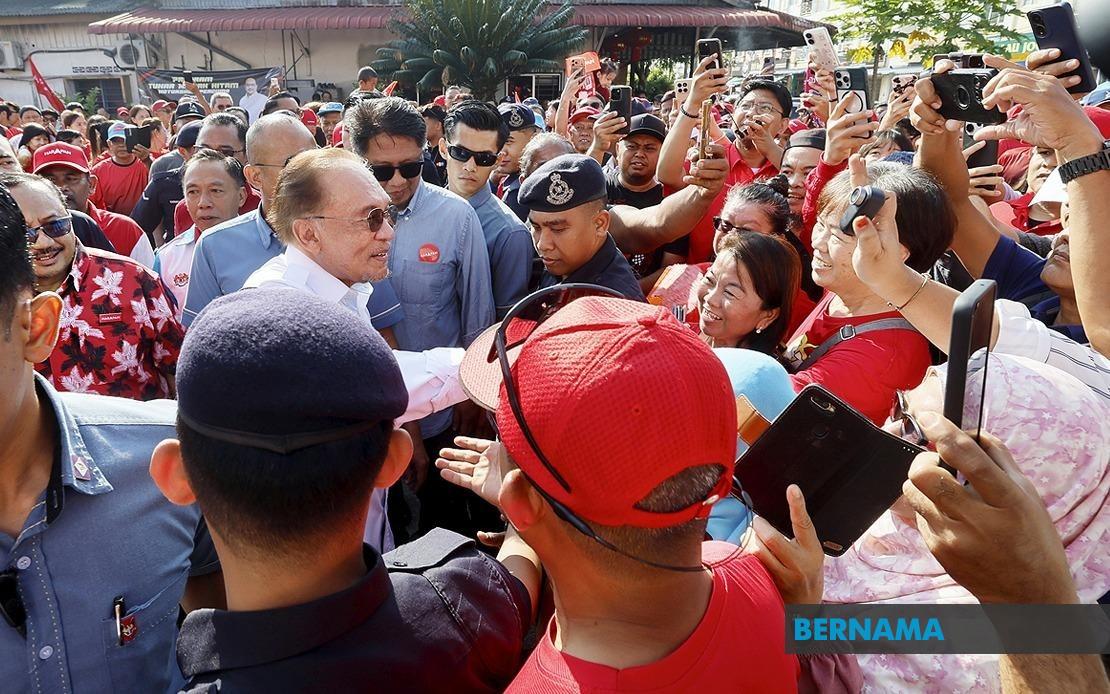
Prime Minister Datuk Seri Anwar Ibrahim has pushed back against suggestions that the Federal Government shows political bias in allocating development resources, insisting that his administration treats all Malaysian states with equal impartiality regardless of which coalition or party controls them at state level. Speaking in Batu Pahat during a campaign rally for the 16th Johor state election, Anwar positioned the government's track record as evidence of this commitment to inclusive development across the nation.
The Prime Minister, who doubles as chairman of the Pakatan Harapan coalition, argued that the government's actions since taking federal office substantiate its pledge to advance public welfare across all regions. Rather than limiting assistance to states governed by allied parties, Anwar suggested the government has embarked on significant infrastructure and development schemes spanning multiple states, including states with different political leanings such as Johor, Kelantan and Kedah. This framing appears designed to counter perceptions that federal resources are channelled preferentially based on political allegiance.
Anwar cited the Johor-Singapore Special Economic Zone as a flagship project demonstrating federal commitment to the state's economic development. The JS-SEZ represents a major regional initiative intended to boost trade and investment flows across the Malaysia-Singapore border, positioning both nations to capture emerging economic opportunities. Such mega-infrastructure projects typically require substantial federal coordination and funding, and the Prime Minister presented it as evidence of his government's investment in Johor's economic future.
Beyond major economic zones, Anwar highlighted the substantial financial commitments the Federal Government has made toward flood mitigation in Johor's vulnerable areas. The government has approved billions of ringgit for flood control and prevention measures in Segamat and Muar, which have historically experienced recurring inundation during monsoon seasons. These investments address immediate public safety concerns while improving long-term infrastructure resilience in flood-prone districts, reflecting how federal resources address localized challenges regardless of state-level political composition.
The Prime Minister's remarks directly countered a common political narrative in Malaysian elections, where opposition parties frequently accuse the incumbent federal government of discriminating against states they do not control. By pointing to concrete projects and financial commitments, Anwar attempted to demonstrate that his administration separates electoral politics from development administration. This distinction matters significantly to voters evaluating whether their state will continue receiving federal support regardless of electoral outcomes.
Anwar's comments came during a campaign event styled as 'Yok! Meriahkan Johor! Undi Harapan', part of the broader Pakatan Harapan campaign push for the 16th Johor state election. The event brought together senior coalition figures including Communications Minister Datuk Fahmi Fadzil, who serves as PH communications director. The presence of coalition candidates for the Senggarang, Semerah and Penggaram constituencies underscored the context of electoral competition, even as the Prime Minister articulated a narrative transcending partisan divisions.
The timing of these statements reflects the delicate political dynamics in Johor, a state that has historically alternated between different political coalitions. Johor's electoral history demonstrates that state-level control can shift, and voters evaluating their choices consider whether federal support will continue if their preferred state government changes. By explicitly committing to impartial federal development support, Anwar sought to reassure voters that their choice at state level would not jeopardize access to federal resources and projects.
Anwar's pledge against election-season promises reflects broader concerns about political credibility in Malaysia, where governments sometimes concentrate promises and announcements during campaign periods, only to deprioritize them afterward. By emphasizing that his government has implemented projects throughout its tenure rather than merely making campaign pledges, the Prime Minister attempted to establish a record of follow-through. This positioning matters for voters assessing whether political commitments translate into tangible improvements in their communities.
The inclusion of substantive examples—the JS-SEZ and multi-billion ringgit flood mitigation packages—distinguishes these remarks from generic political rhetoric. Such specific references allow supporters to identify and track progress, while simultaneously providing the government with measurable indicators against which to assess its performance. For Malaysian voters in competitive states like Johor, the ability to point to ongoing federal projects represents concrete evidence of governmental engagement beyond election cycles.
The Federal Government's approach to development across states with varying political compositions carries implications for federal-state relations in Malaysia's constitutional framework. The Prime Minister's assertions suggest a commitment to technocratic allocation of resources based on need and strategic importance, rather than purely partisan considerations. This principle, if consistently applied, could strengthen institutional norms around resource distribution and reduce perceptions of political weaponization of federal funding.
For Southeast Asian observers, Malaysia's federal system and the tensions between federal and state-level governance reflect patterns seen across the region. Questions about whether central governments treat opposition-controlled territories fairly remain politically sensitive across democracies in the region. Anwar's explicit commitment to impartial treatment, combined with documentary evidence through major projects, positions Malaysia as a system attempting to balance competitive democracy with institutional fairness—a challenge many regional governments navigate imperfectly.
Looking forward, the credibility of such assertions depends on consistent implementation. Voters will evaluate whether states receive proportionate federal support regardless of electoral outcomes in future contests. Johor specifically, given its size, economic importance, and political volatility, serves as a test case for whether the Federal Government maintains these principles when political control changes at state level. The stakes are substantial, as continued federal-state cooperation remains essential for delivering major infrastructure projects that benefit all Malaysians.

