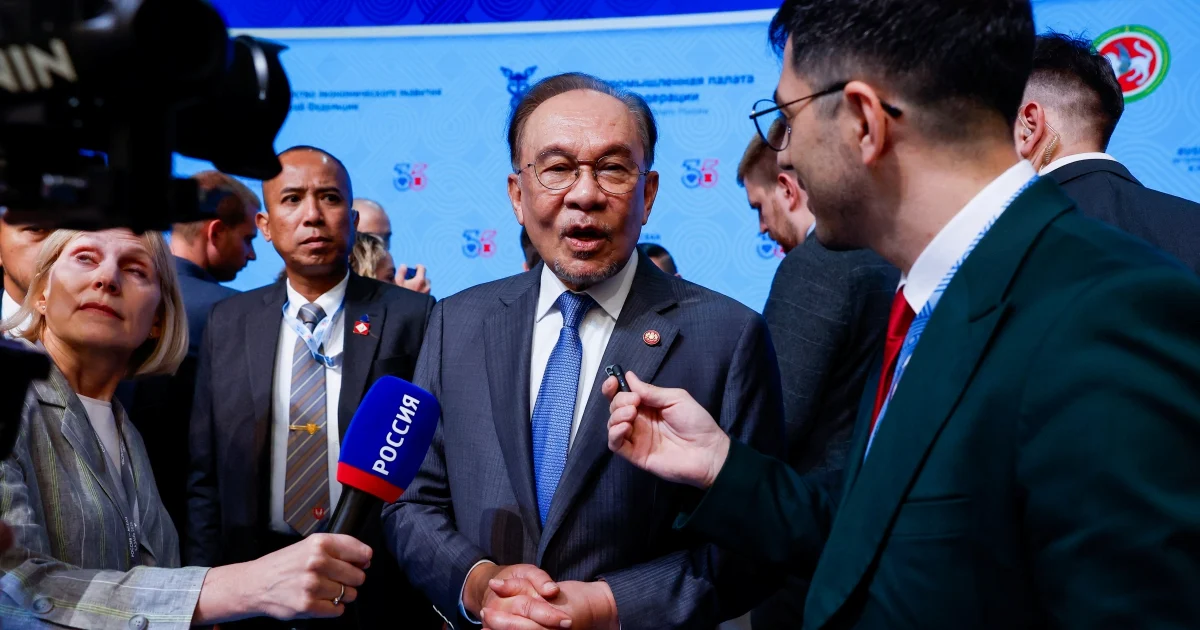
Prime Minister Datuk Seri Anwar Ibrahim has underscored the importance of cultural exchange in international relations, sharing his personal enjoyment of Russian music and literature during remarks in Kazan. The disclosure offers a window into the Prime Minister's broader vision for strengthening Malaysia's ties with Russia, suggesting that artistic and intellectual engagement can be as consequential as traditional trade and investment channels in forging lasting diplomatic bonds.
Anwar's remarks reflect a diplomatic approach that extends beyond the conventional framework of bilateral relations. By publicly articulating his appreciation for Russian cultural expressions, the Prime Minister signals Malaysia's openness to engagement across multiple dimensions of society. This perspective aligns with contemporary diplomatic practice, where soft power—encompassing cultural, educational, and artistic influence—has emerged as a critical complement to hard power in international affairs.
The significance of Anwar's comments lies in their timing and context. Malaysia, as a Muslim-majority nation with considerable economic and strategic interests across the Middle East and Asia-Pacific, maintains a delicate balancing act in international relations. Russia, meanwhile, has increasingly sought to deepen its engagement with Southeast Asian partners amid evolving geopolitical tensions. By emphasising cultural commonalities and mutual intellectual appreciation, both nations can cultivate goodwill that transcends transactional economic relationships.
Russian literature has long wielded considerable influence across the global intellectual landscape, with works by figures such as Dostoevsky and Tolstoy exploring profound philosophical and moral questions that resonate across cultural boundaries. Similarly, Russian music—ranging from classical compositions to contemporary genres—represents a sophisticated artistic tradition. Anwar's familiarity with these cultural products suggests a cosmopolitan worldview and an appreciation for intellectual pursuits beyond policy and governance.
The practical implications of prioritising cultural exchange extend to multiple sectors. Educational partnerships, for instance, can facilitate knowledge transfer and build networks of individuals who carry positive impressions of their respective countries throughout their careers. Artist and performer exchanges enrich domestic cultural scenes while fostering mutual understanding. Academic collaborations in literature and music can yield scholarly insights that benefit both societies. These mechanisms operate beneath the political surface, quietly building reservoirs of goodwill that can sustain diplomatic relationships during periods of economic uncertainty or geopolitical tension.
For Malaysia specifically, cultivating closer cultural ties with Russia presents opportunities to diversify its international partnerships. While Malaysia maintains strong economic relationships with China, the United States, and other major powers, its engagement with Russia has historically been less developed. Deepening cultural connections can establish a foundation for expanded cooperation in other spheres, including technology, energy, and education. This approach also demonstrates Malaysia's commitment to a multipolar world where relationships are not confined to regional blocs or Cold War alignments.
The emphasis on literature and music also carries implications for public diplomacy. When political leaders openly discuss their appreciation for another nation's cultural output, it legitimises such interests within their own societies and encourages broader segments of the population to engage with foreign cultures. This can generate grassroots enthusiasm for international understanding that complements official diplomatic initiatives. In Malaysia's context, where cultural and religious considerations shape public discourse, a Prime Minister's endorsement of Russian arts might encourage greater Malaysian engagement with Russian cultural institutions and creators.
From Russia's perspective, such recognition from a Southeast Asian leader reinforces the country's effort to expand its soft power influence in the region. Southeast Asia represents a strategically important area, and developing cultural ties provides Moscow with additional tools to strengthen its presence beyond economic and military dimensions. The appreciation demonstrated by prominent Malaysian figures helps elevate Russian culture's profile in a region where Western and East Asian cultural influences have traditionally dominated.
Anwar's comments also implicitly challenge the notion that engagement with other nations must be purely instrumental. In an era where bilateral relationships are often reduced to trade statistics and investment figures, a reminder that meaningful international relations encompass shared appreciation for art, literature, and music offers a humanising perspective. This approach acknowledges that nations are ultimately composed of individuals who share universal aesthetic and intellectual experiences regardless of borders or political systems.
Moving forward, Malaysia and Russia could formalise cultural cooperation through mechanisms such as cultural centres, exchange programmes, and collaborative cultural events. Such initiatives would translate Anwar's expressed appreciation into tangible initiatives that deepen public-to-public connections. Libraries and cultural institutions in both countries could feature expanded collections of Russian literature in Malay translation and Malaysian works in Russian, facilitating broader access to each nation's intellectual heritage.
The Prime Minister's remarks ultimately reflect a sophisticated understanding of contemporary international relations, where soft power and cultural influence operate alongside traditional diplomatic and economic tools. By articulating personal appreciation for Russian artistic traditions, Anwar positions Malaysia as a nation that values the broader human dimensions of international engagement. This approach not only strengthens bilateral ties with Russia but also reinforces Malaysia's image as a culturally sophisticated nation committed to meaningful cross-cultural dialogue across diverse geographies and traditions.

