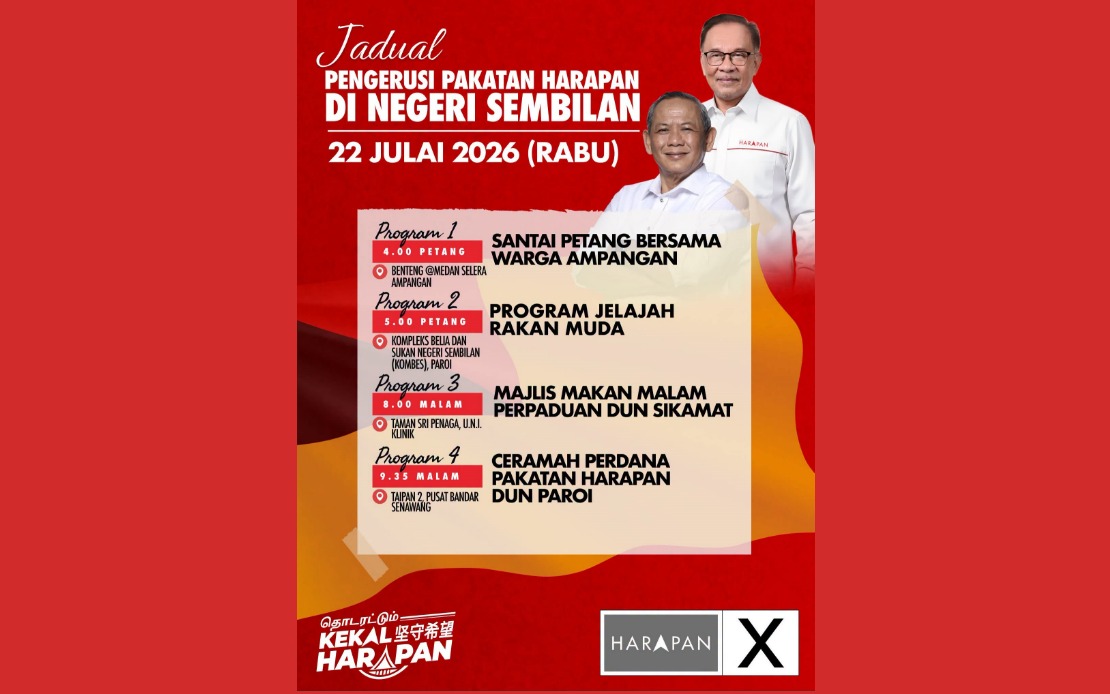
Prime Minister Datuk Seri Anwar Ibrahim is set to launch an intensive campaign schedule across Negeri Sembilan on the fifth day of the state election campaign, signalling Pakatan Harapan's determination to hold onto the state administration following the coalition's manifesto launch earlier this week.
Anwar's campaign itinerary encompasses visits to the Ampangan, Paroi, Sikamat and Senawang constituencies, where he will engage directly with residents, young people and party members through a series of community interactions and a major public rally. His participation underscores the strategic importance PH places on retaining Negeri Sembilan, where the coalition currently governs under Datuk Seri Aminuddin Harun's leadership. The prime minister's high-profile presence is intended to consolidate voter support and energise grassroots party machinery ahead of polling day on August 1.
The schedule begins at 4 pm with a casual engagement session at Benteng @ Medan Selera Ampangan, designed to create an informal atmosphere for residents to interact with the PH chairman. This approach reflects a broader campaign strategy emphasising direct, accessible leadership presence in communities rather than traditional hierarchical political messaging. By structuring events around everyday meeting spaces such as food courts and youth centres, PH aims to present itself as responsive to ordinary Malaysians' concerns and accessible to dialogue.
Following the Ampangan session, Anwar will attend the "Jelajah Rakan Muda" programme at the Negeri Sembilan Youth and Sports Complex in Paroi at 5 pm, specifically targeting younger voters. Youth engagement has emerged as a critical battleground in Malaysian politics, with both major coalitions competing aggressively for generational support. The programme's timing and venue selection suggest PH recognises that young voters require distinct messaging channels and engagement styles compared to older demographics.
Later in the evening, Anwar will attend a unity dinner in the Sikamat constituency, a traditional format for bringing together party workers, community leaders and supporters to strengthen internal cohesion. These private or semi-private gatherings often generate important intelligence about local concerns and help coordinate party machinery at the grassroots level. Such events also provide opportunities for one-on-one conversations with influential local figures whose networks can substantially amplify campaign reach.
The day's activities culminate in a PH mega public rally at Pusat Bandar Senawang, where Anwar will address supporters gathered for what is typically the coalition's highest-profile campaign event. These large-scale ceramah sessions serve multiple strategic functions: they generate media coverage, create visual impressions of momentum and popular support, allow for crafted messaging to multiple audience segments simultaneously, and provide the primary platform for articulating PH's vision and policy commitments to the broader electorate.
PH's campaign message centres on a ten-point manifesto unveiled earlier this week, which promises enhanced development and greater inclusivity across Negeri Sembilan. The manifesto appears designed to address perceived governance gaps under the previous administration while signalling continuity and stability under current PH leadership. For Malaysian voters, such pledges typically address quality-of-life issues including infrastructure development, educational facilities, healthcare access, employment creation and social welfare programmes. The specificity and local relevance of these commitments remain crucial to their credibility and electoral impact.
PH is contesting all 36 state seats in the Negeri Sembilan election, with seat distribution reflecting the coalition's internal power structure. The 16 PKR candidates, 11 DAP candidates and nine Amanah candidates demonstrate the proportional bargaining that occurs within the coalition, with PKR claiming the largest share reflecting Anwar's party dominance. This configuration ensures that PH's campaign simultaneously reflects multiple parties' grassroots presence while maintaining unified messaging from the coalition leadership level.
The Election Commission has scheduled early voting for July 28, with the main polling day set for August 1. This timeline provides PH roughly a week to consolidate its campaign messaging following Anwar's constituency visits. Early voting procedures typically favour certain voter demographics including essential workers, security personnel and those unable to vote on the main polling date, making early voting site engagement an increasingly important campaign component that analysts expect will receive intensified attention in the final campaign week.
For Negeri Sembilan specifically, retaining state government control holds particular significance for PH's broader political positioning ahead of potential federal political shifts. State governments serve as laboratories for policy experimentation and provide crucial patronage networks that sustain coalition cohesion. A loss in Negeri Sembilan would constitute a significant symbolic and material setback, making Anwar's personal campaign involvement a calculated deployment of his political capital and time at a critical juncture.
The campaign's emphasis on inclusivity and development reflects PH's attempt to broaden its appeal beyond core urban, middle-class constituencies that traditionally supported the coalition. Negeri Sembilan, containing both developed areas and rural communities, requires messaging addressing diverse economic interests and developmental priorities. Anwar's grassroots engagement activities appear calibrated to demonstrate that PH's national leadership remains connected to local realities and responsive to community-level concerns.
Regionally, the Negeri Sembilan election carries implications for Southeast Asian observers monitoring Malaysia's democratic health and coalition stability. Strong PH performance would reinforce the coalition's claim to represent a viable long-term governing alternative, while losses might trigger internal reassessments about coalition structure and leadership dynamics. For Malaysian businesses and investors, state electoral outcomes influence local governance stability, regulatory environments and development pipeline certainty, making campaign developments worthy of careful monitoring.

