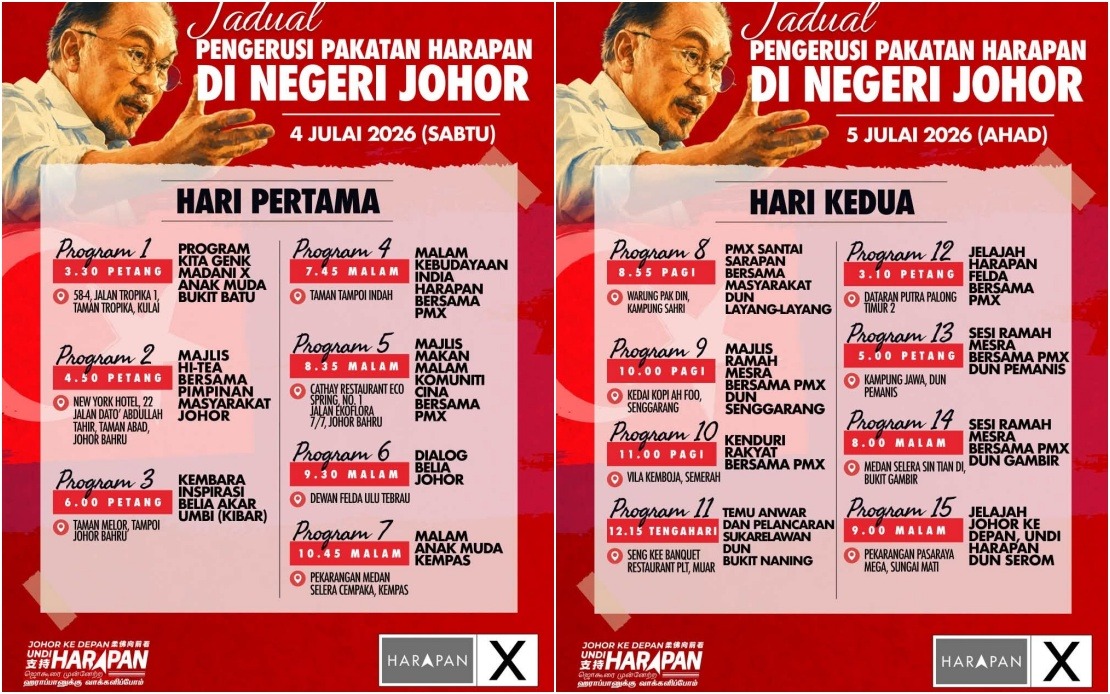
Pakatan Harapan chairman Datuk Seri Anwar Ibrahim is embarking on a marathon campaign blitz across Johor this weekend, attending 15 distinct programmes to energise PH supporters and consolidate backing for 56 coalition candidates ahead of the 16th Johor state election on July 11. The intensive schedule underscores the critical importance PH places on reclaiming ground in Malaysia's second-largest state and demonstrates the personal commitment of the coalition's top leadership to determining the outcome of a poll that will shape the political landscape of the southern region.
Through a Facebook posting, Anwar extended a broad invitation to all Johor voters to participate in the weekend's campaign activities, signalling PH's determination to broaden its appeal beyond traditional support bases. His message, "Insya-Allah, I'll be in Johor tomorrow and Sunday to support the candidates and HARAPAN machinery. I invite everyone in Johor to join us," reflects the coalition's strategy of framing the election as a mobilisation effort requiring grassroots participation rather than a top-down political exercise. This rhetorical approach attempts to position PH as a movement grounded in community engagement rather than merely an electoral apparatus seeking votes.
The Saturday itinerary commences with the Kita Genk MADANI x Anak Muda Bukit Batu programme in Kulai at mid-afternoon, followed by consecutive engagements with community leaders and youth groups across multiple constituencies. This back-to-back scheduling demonstrates how modern election campaigns compress leadership visibility into concentrated time blocks, maximising media coverage and social media amplification across dispersed geographical zones. The rapid succession of appearances also serves a practical campaign function—reaching diverse demographic segments within the space of a single day, from business and professional communities to youth and ethnic-specific constituencies.
Notably, the Saturday evening agenda incorporates culturally-targeted programmes, including the Harapan Indian Cultural Night and a Chinese Community Dinner, both featuring PMX (an apparent reference to party machinery representatives). This deliberate segmentation reflects PH's recognition that Johor contains substantial minority communities whose political preferences remain fluid. By allocating dedicated events to specific ethnic constituencies rather than addressing them within generic rallies, the coalition signals respect for community identity whilst attempting to build confidence that PH governments actively address community-specific concerns and cultural aspirations.
The compressed schedule extends into late evening, with the Anak Muda Kempas Night scheduled for 10.45 pm, illustrating the demanding physical and organisational requirements of contemporary election campaigning. Such extended schedules place considerable strain on political leaders whilst simultaneously communicating dedication to candidates and supporters. The late-night programming also reflects campaign strategists' calculations about optimal times to reach younger voters who may attend events after working hours or other commitments, ensuring demographic representation across the candidate slate.
Sunday's agenda begins early with a constituency breakfast in Layang-Layang, continuing the pattern of diversified programming designed to touch different voter segments across the state's geography. The Meet-and-Greet with PMX at Dewan Undangan Negeri Senggarang and the subsequent Kenduri Rakyat Bersama PMX in Semerah maintain the dual focus on political machinery engagement and direct voter interaction. These morning and mid-day events typically attract different audiences than evening programmes, potentially capturing working professionals, retirees, and family units whose schedules preclude evening attendance.
The launch of Bukit Naning Volunteers at 12.15 pm serves a strategic campaign function beyond the immediate event itself. Volunteer mobilisation represents a critical infrastructure for contemporary electoral contests, with volunteer networks handling ground-level canvassing, voter contact, and logistical support that professional campaign staff cannot adequately manage. By providing a formal platform to recognise and energise volunteer organisations, PH signals investment in the human capital necessary to convert campaign rhetoric into actual vote accumulation across polling stations.
Sunday afternoon and evening activities expand beyond single-location events to encompass the Jelajah Harapan Felda Bersama PMX programme and meeting sessions at Pemanis and Gambir constituencies, maintaining the momentum of direct leader engagement across diverse areas. The Felda element specifically targets rural constituencies dependent on palm oil production, a demographic that can determine election outcomes in states like Johor where rural voters represent a substantial portion of the electorate. PH's deliberate inclusion of Felda-focused programming indicates sophisticated targeting of communities whose economic livelihoods depend on commodity export performance and agricultural policy decisions.
The final Sunday event, Jelajah Johor Ke Depan, Undi Harapan DUN Serom programme at Sungai Mati at 9 pm, concludes the weekend with a forward-looking framing emphasising future-oriented governance rather than retrospective attacks on political opponents. This closing event branding signals PH's campaign messaging strategy—positioning the coalition as focused on prospective improvements to living standards, economic opportunity, and state development rather than dwelling on past political conflicts or opponent failings.
The election date of July 11, with early voting scheduled for July 7, compresses the campaign timeline significantly, making Anwar's weekend presence particularly consequential. In Malaysian state elections, leadership visibility and direct voter contact during the final campaign week frequently determines whether candidate momentum translates into actual ballot outcomes. The 56 PH candidates contesting across Johor face a diverse political landscape where traditional Barisan Nasional structures remain formidable in many rural areas, whilst newer political competitors including Perikatan Nasional have consolidated alternative conservative voter bases.
For Malaysian political observers, Anwar's intensive Johor campaign reflects broader patterns in contemporary Southeast Asian electoral politics—namely, the increasing personalisation of political competition around individual leaders rather than party institutions or ideological platforms. The concentration of campaign activity on the coalition chairman rather than distributed campaigning across party leadership demonstrates how PH has organised itself as a movement personality-dependent on its most prominent figure. This approach amplifies Anwar's influence whilst simultaneously creating vulnerability if the political leader faces unexpected difficulties or if voters perceive the coalition as excessively centred on a single individual rather than embedded in genuine institutional development.
The weekend campaign schedule also illuminates the strategic calculation that Johor remains a contested terrain where PH must invest leadership resources to maintain relevance. Unlike states where one coalition dominates completely, Johor presents a genuinely competitive environment where 56 contested seats create multiple flashpoints requiring personalised attention and direct leader engagement. The intensity of Anwar's weekend presence thus represents a tacit acknowledgement that PH cannot take Johor's voters for granted and must continuously reassert relevance through visible leadership commitment to the state's political and economic future.

