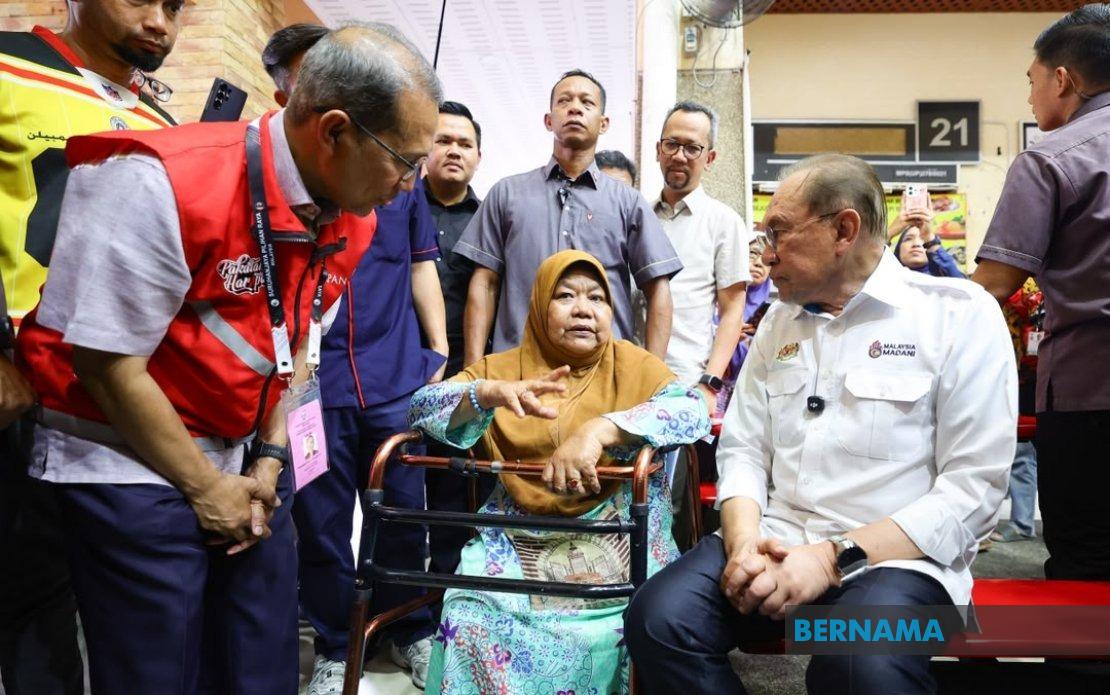
Prime Minister Datuk Seri Anwar Ibrahim has held up the Negeri Sembilan state government as a demonstration of the Pakatan Harapan (PH) coalition's commitment to returning development benefits directly to ordinary citizens. Speaking at a community gathering in Seremban on July 22, Anwar pointed to reciprocal river widening and deepening initiatives across multiple districts as tangible proof that the coalition is managing public resources with integrity and delivering visible improvements to people's lives.
The river management projects, which Anwar highlighted during remarks at an afternoon engagement event in the Ampangan area, serve a dual purpose that reflects the administration's approach to transparent governance. Beyond their primary function of mitigating flood risks that have periodically disrupted residential neighbourhoods, these projects incorporate a circular resource model whereby sand extracted during dredging operations is redirected to finance ongoing maintenance and infrastructure upgrades in the affected river corridors. This method ensures that natural materials harvested from public works benefit the communities most directly impacted by the improvements.
Anwar emphasised that this model of development—where extracted resources finance community infrastructure rather than enriching private contractors or disappearing into opaque channels—distinguishes the PH approach from governance patterns that preceded it. The Prime Minister argued that such projects embody the accountability-centred philosophy that should undergird both state and national development efforts. During his address, he stressed that integrity in public administration must remain the foundation upon which all infrastructure spending and developmental initiatives rest, with the genuine welfare of ordinary citizens as the ultimate measure of success.
The Ampangan river project itself exemplifies the benefits of this philosophy. Residents in that district have experienced repeated flooding, a chronic challenge that compromises property values and disrupts livelihoods. By coupling flood mitigation with transparent resource management and visible infrastructure investment, the state government has addressed immediate community needs whilst demonstrating that public assets are being stewarded responsibly. The willingness to involve residents in understanding how resources extracted from their own neighbourhoods are being reinvested locally signals a departure from top-down development models where communities are excluded from decision-making about projects affecting their surroundings.
Anwar drew broader lessons from his own experience with major development negotiations to reinforce this message of community-centred governance. He recalled his involvement in discussions regarding a hotel development in Port Dickson, noting that such significant projects had been structured to consider not merely commercial returns but the genuine interests of local constituencies, particularly fishing communities whose livelihoods depend on coastal stability. That framework incorporated educational support and housing improvements for affected residents, illustrating how large-scale investments could be calibrated to enhance rather than displace vulnerable populations.
The Prime Minister's visit to Negeri Sembilan forms part of an intensive campaign schedule ahead of the 16th Negeri Sembilan State Election, where PH is fielding candidates across all 36 seats. The coalition's internal composition reflects its multi-ethnic structure, with PKR contesting 16 seats, DAP putting forward 11 candidates, and Amanah fielding nine candidates. This distribution within Negeri Sembilan mirrors the coalition's broader approach to inclusive representation and shared governance responsibility among its component parties.
Anwar used the Ampangan event to appeal directly to voters to sustain PH's mandate in the state. His pitch centred on the argument that demonstrated competence and integrity in managing resources should determine electoral choices rather than ethnicity or religious affiliation. He called on residents to select candidates based on their trustworthiness and dignity, arguing that many capable individuals from all Malaysian communities—Malay, Indian, and Chinese—were available to serve with integrity. This framing positions the election as a choice between governance models rather than a contest defined primarily by identity politics.
The timing of Anwar's campaign activities reflects the compressed timeframe for the election campaign. The Election Commission has set August 1 as polling day, with early voting scheduled for July 28, giving campaigners less than two weeks to reach voters across the state's diverse constituencies. During this window, the PH machinery has emphasised tangible projects and delivery records rather than abstract policy promises, with the river management initiatives serving as visible evidence of governance capability.
Negeri Sembilan's state election carries significance beyond the immediate contest for control of the state assembly. The result will provide an early indicator of voter sentiment regarding the PH coalition's performance since returning to federal power in 2022. Neighbouring Selangor, Malaysia's wealthiest and most populous state, is also governed by PH and has become a showcase for the coalition's development agenda. How voters in Negeri Sembilan evaluate PH's track record—particularly on infrastructure delivery and resource management—may influence broader perceptions of the coalition's effectiveness and influence voting patterns in future contests.
For residents in flood-prone areas like Ampangan, the river projects represent more than symbolic governance reform; they address chronic infrastructure deficits that affect property security, health, and economic opportunity. The integration of resource management into flood mitigation creates a sustainability model that, if successfully replicated across multiple sites, could demonstrate how fiscal discipline and community investment can be aligned rather than treated as competing objectives. This potential resonates particularly for Malaysian urban and peri-urban communities that have experienced inadequate infrastructure maintenance and competing demands on limited budgets.
The emphasis on transparent resource management also responds to public concerns about development spending that have animated Malaysian politics since the 1MDB scandal exposed the vulnerabilities of systems lacking adequate checks on how public funds are deployed. By explicitly tying project implementation to transparent accounting and community benefit, Anwar positioned PH as offering a corrective to that era of governance dysfunction. Whether voters perceive this messaging as credible will likely shape both the Negeri Sembilan outcome and the broader political trajectory ahead of the next general election.

