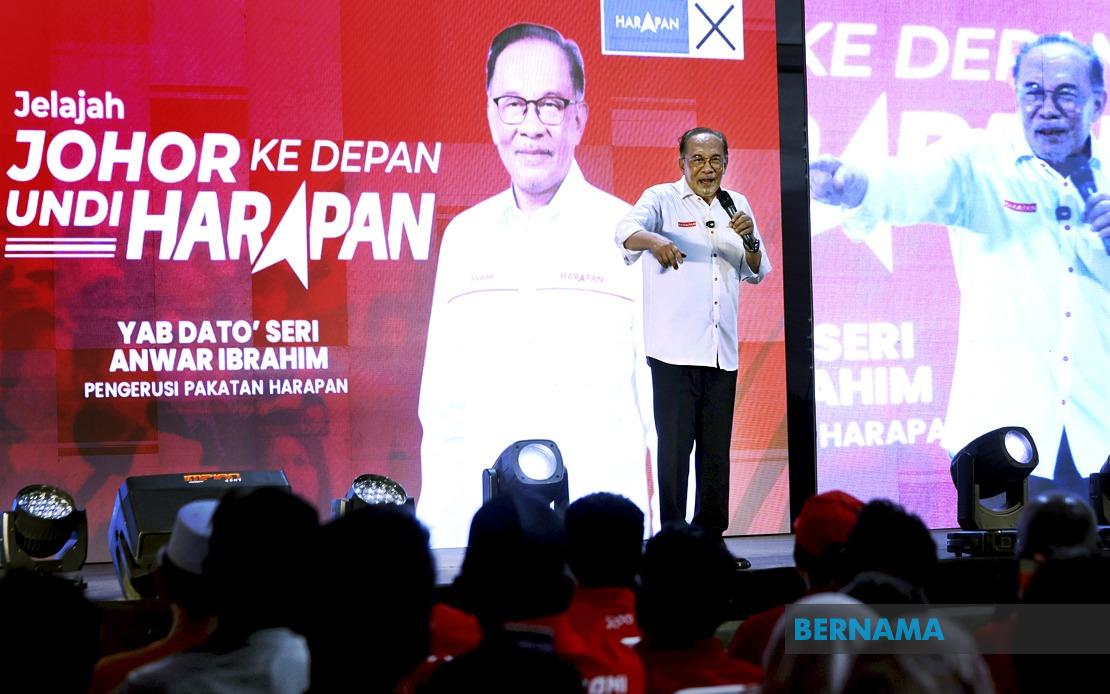
Prime Minister Datuk Seri Anwar Ibrahim has drawn a definitive line under Malaysia's history of systemic corruption and patronage politics, declaring that the era of using state power for personal enrichment has fundamentally ended. Speaking at a campaign rally in Sungai Mati during the run-up to the Johor State Election, Anwar characterised the previous model of governance—where senior officials and their families extracted wealth through government contracts and administrative privilege—as a "culture of plunder" that his MADANI Government is actively dismantling. The remarks signal a strategic pivot in how the federal administration frames its legitimacy: not through ideological purity or communal appeals, but through a performance-based standard of administrative competence and personal integrity.
The Prime Minister's emphasis on meritocratic leadership untethered from racial categorisation represents a notable repositioning of coalition messaging at a sensitive moment in Johor politics. Rather than appealing to voters through traditional communal narratives, Anwar explicitly stated that his preference was for "Malays who are good, honest and not corrupt" alongside "Chinese who are good and not corrupt" to assume leadership positions. This framing attempts to elevate integrity as the primary criterion for political selection, potentially resonating with urban, education-conscious voters while simultaneously preempting opposition accusations that the MADANI Government privileges particular communities. By articulating this position in Johor—a state where communal sensitivities have historically influenced electoral outcomes—Anwar appears intent on testing whether anti-corruption messaging can transcend traditional ethnic voting patterns.
Central to Anwar's narrative is the claim that systematic administrative reform has commenced to prevent public resources from being diverted toward private networks. He outlined the government's ambition to "clean up" Malaysia's institutional machinery by rooting out entrenched corrupt practices that have permitted the misallocation of taxpayer funds. This framing positions anti-corruption work not as retrospective accountability for past regimes, but as prospective institutional engineering designed to protect future public expenditure. The implicit argument is that governance effectiveness—ensuring "every sen of Malaysia's wealth was fully returned for the benefit of the people"—depends on severing the informal networks through which political actors have historically converted state authority into personal advantage. This resonates particularly with middle-income voters whose support for reform often derives from frustration with visible dysfunction rather than abstract principles.
Anwar's pledge that no individual would be "protected by the government" if discovered engaging in corruption during his administration addresses a persistent credibility challenge facing the coalition. Public perception that corruption prosecutions are selectively applied based on political affiliation has eroded trust in institutional impartiality. By staking his personal authority on a commitment to non-discriminatory enforcement, Anwar is essentially offering himself as a guarantor against the replication of previous patterns wherein ruling elites escaped accountability through political connections. Whether such assurances can be sustained across successive administrations remains an open question, particularly given Malaysia's history of selective prosecution and amnesty arrangements that have often reflected shifting political alignments. The effectiveness of this pledge will ultimately depend on whether visible prosecutions of individuals across the political spectrum materialise to validate the claim.
The Prime Minister explicitly attributed opposition criticism to instrumental motives rather than principled governance concerns, framing such attacks as driven by "a personal agenda to regain control of the federal government." This characterisation serves to delegitimise opposition anti-corruption messaging by reducing it to factional struggle rather than engaging with substantive criticisms of MADANI Government performance or implementation. The rhetorical move effectively insulates Anwar from accountability by redefining the terms of debate from questions of whether reform is occurring to questions of which coalition possesses greater legitimacy to govern. However, this strategy carries risks if public perception diverges from government narratives about institutional reform progress, as voters may increasingly interpret such rhetorical dismissals as evasion rather than substantive response.
Anwar's campaign activities in Johor, encompassing fifteen engagements across two days, underscore the electoral stakes in a state that historically provides significant parliamentary representation to the governing coalition. The 172 candidates contesting the 56 state seats in the July 11 polling represent a decisive test of whether the MADANI Government's messaging resonates with regional electorates, particularly given Johor's geographic proximity to Singapore and its comparatively developed economic base. The presence of Penang Chief Minister Chow Kon Yeow alongside Anwar at the Sungai Mati event signals coalition coordination and the symbolic value of aligning multiple state leaders around common messaging themes. Early voting scheduled for July 7 will provide preliminary indicators of voter engagement levels preceding the main polling date.
The framing of clean governance as incompatible with narrow racial politics, while appealing to cosmopolitan voters, simultaneously introduces potential vulnerabilities if the government faces implementation setbacks or if visible prosecutions prove insufficient to satisfy public demand for accountability. The articulation of anti-corruption commitments during campaign periods, while necessary for electoral legitimacy, cannot itself substitute for institutional capacity to deliver on such promises. Previous Malaysian governments have similarly promised administrative reform only to see momentum dissipate once electoral pressure subsided. The real test of Anwar's commitment lies in whether systematic institutional changes—such as autonomous investigative authorities insulated from executive pressure, transparent procurement systems, and professional civil service reforms—actually materialise beyond rhetorical affirmation during campaign seasons.
The emphasis on leaders being judged by "integrity and honesty rather than political rhetoric aimed at concealing past abuses" implicitly critiques Anwar's own political history, which includes previous corruption allegations and imprisonment. His ability to position himself as a credible arbiter of integrity standards, notwithstanding his own contested past, depends on consistent demonstration that reform commitments translate into institutional action rather than selective application based on political convenience. This dynamic introduces complexity into the anti-corruption narrative that campaign messaging cannot fully resolve; only sustained implementation across successive administrations can validate the sincerity of current pledges.
For Southeast Asian observers, the Johor campaign illustrates how anti-corruption messaging has become essential to maintaining electoral legitimacy even among previously dominant parties. The shift from defence of patronage systems toward rhetorical commitment to meritocratic administration reflects broader regional trends wherein voters increasingly demand governance demonstrable by institutional performance rather than communal solidarity. Whether Malaysian political institutions possess the structural capacity to deliver on such commitments remains a defining question for the MADANI Government's sustainability.

