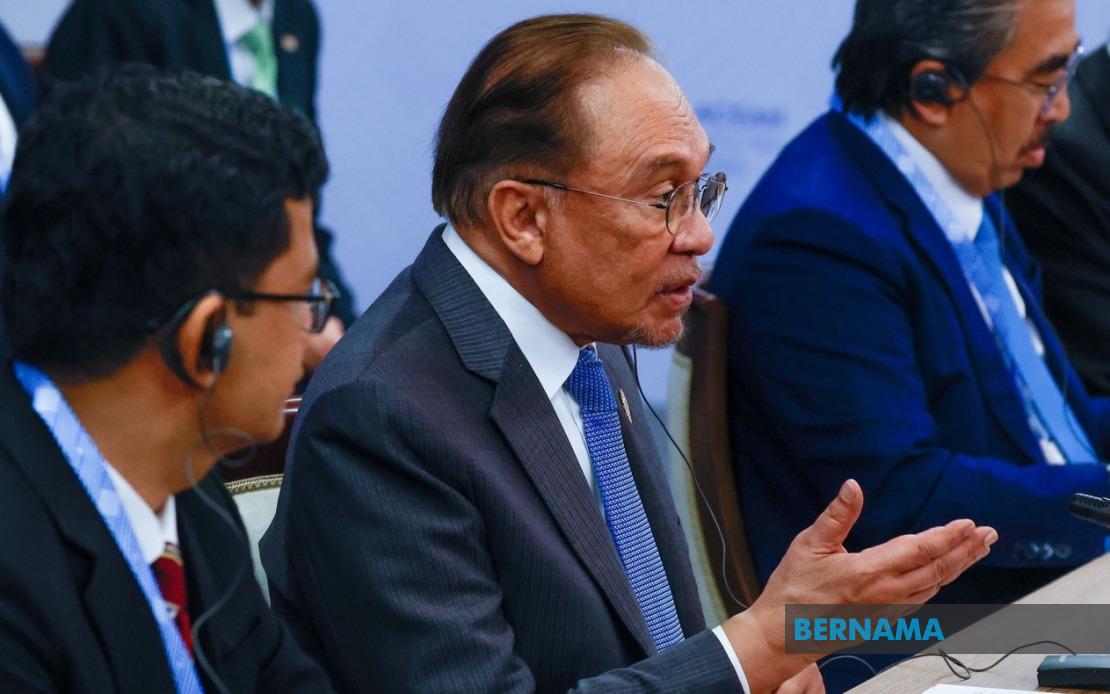
Malaysian Prime Minister Datuk Seri Anwar Ibrahim used a bilateral meeting with Russian President Vladimir Putin in Kazan on Wednesday evening to commend Moscow's approach to two of the Middle East's most pressing geopolitical challenges. Addressing the Russian leader directly, Anwar singled out the Kremlin's handling of both the Gaza conflict and the broader tensions surrounding Iran, framing these positions as principled and unwavering in an increasingly complex international landscape.
The Prime Minister's remarks reflected Malaysia's diplomatic alignment with Russia on several key Middle Eastern issues. In his opening statement at the bilateral engagement, Anwar emphasised that the consistency of Moscow's position on these matters deserved recognition. He stressed that Malaysia and numerous other nations appreciated Putin's tenacity in adhering to these stands, suggesting that such steadfastness was a rare commodity in contemporary international relations where nations often shift positions based on external pressures or strategic recalibrations.
Russia's stance on Gaza has centered on calls for a sustainable ceasefire that would allow humanitarian assistance to reach Palestinian civilians caught in the conflict. The Kremlin has repeatedly advocated for unimpeded access to affected populations and has positioned itself as a voice for diplomatic resolution in a conflict where military interventions have deepened humanitarian suffering. This approach has resonated with nations seeking alternative perspectives to Western-dominated discourse on the Palestinian-Israeli situation, and Malaysia's endorsement of Russia's consistency suggests Kuala Lumpur views Moscow's position as aligned with its own principled stance on the issue.
On Iran specifically, Russia has maintained a carefully calibrated diplomatic posture that balances engagement with Tehran while avoiding direct military confrontation. Moscow's emphasis on dialogue and negotiated settlements contrasts sharply with the confrontational approaches that have characterised some international actors' strategies. The Kremlin's historical ties with Iran, forged through decades of strategic partnership and shared regional interests, provide context for this diplomatic approach. Russia's willingness to engage Iran while advocating for peaceful resolution of disputes distinguishes its approach from more hawkish international positions.
The bilateral meeting in Kazan underscores Malaysia's active engagement in broader geopolitical discussions extending well beyond immediate Southeast Asian concerns. As a major Muslim-majority nation with significant economic and diplomatic interests, Malaysia has positioned itself as a voice for balanced international relations on Middle Eastern matters. Anwar's public acknowledgment of Russia's consistency signals Malaysia's openness to cooperation with Moscow across various international platforms and issues, despite the vast geographical distance separating the two nations.
Gaza and Iran represent complex flashpoints where major powers including the United States, China, and Russia all maintain competing interests and strategic objectives. The Middle East remains central to global security calculations, energy markets, and religious concerns that resonate across Muslim-majority populations worldwide. Malaysia's emphasis on Russia's principled approach suggests Kuala Lumpur views consistency and steadfast commitment to diplomatic solutions as virtues in a region where vacillation can breed further instability and humanitarian crises.
The timing of Anwar's remarks carries significance given the cyclical nature of Middle Eastern tensions and the growing role of regional actors in shaping conflict dynamics. By publicly praising Russia's consistency, Malaysia reinforces its commitment to seeking peaceful resolutions through dialogue rather than military means. This position reflects Malaysia's broader foreign policy orientation and its role within international forums where Middle Eastern matters are regularly debated and discussed among diverse stakeholder nations.
Moscow's consistent advocacy for Palestinian humanitarian access and ceasefire provisions has positioned Russia as a counterweight to Western-dominated security frameworks in the region. The Kremlin's refusal to align with sanctions regimes or isolation strategies targeting Iran has maintained diplomatic channels that other nations have severed, potentially enabling future negotiations should opportunities arise. These positions, though sometimes criticised by Western governments, have gained appreciation from nations seeking alternative power balances in international affairs.
Anwar's bilateral engagement with Putin in Kazan represents a broader trend of Malaysian foreign policy diversification, where Kuala Lumpur maintains substantive relationships with multiple power centres. Rather than aligning exclusively with any single bloc or strategic partner, Malaysia has cultivated a nuanced approach that allows engagement with Russia, China, the United States, and regional actors based on shared interests and mutual benefit. The Prime Minister's public commendation of Russian positions on Gaza and Iran exemplifies this balancing act.
For Southeast Asia, Malaysia's diplomatic engagement with Russia holds implications for regional stability discussions and economic cooperation. The broader Middle Eastern situation influences global energy prices, security frameworks, and the flow of capital and investment across continents. Malaysia's position as a bridge nation between the Islamic world and broader international frameworks positions it well to facilitate dialogue and mutual understanding across different geopolitical perspectives.
The meeting between Anwar and Putin also reflects the practical dimensions of bilateral relations extending beyond symbolic gestures. Both nations have interests in economic cooperation, energy partnerships, and coordinated positions on international governance matters. Russia's consistent approach to Middle Eastern issues, as praised by the Malaysian leader, provides a foundation for enhanced bilateral coordination and potentially broader cooperation within multilateral forums where both countries maintain active participation.
Looking forward, Malaysia's public endorsement of Russia's principled stance may influence how other nations in the region calibrate their own positions on these contentious issues. As a respected voice within the Non-Aligned Movement and the Organisation of Islamic Cooperation, Malaysia's diplomatic weight carries particular significance for nations attempting to maintain independent foreign policies while navigating great power competition and regional complexities.

