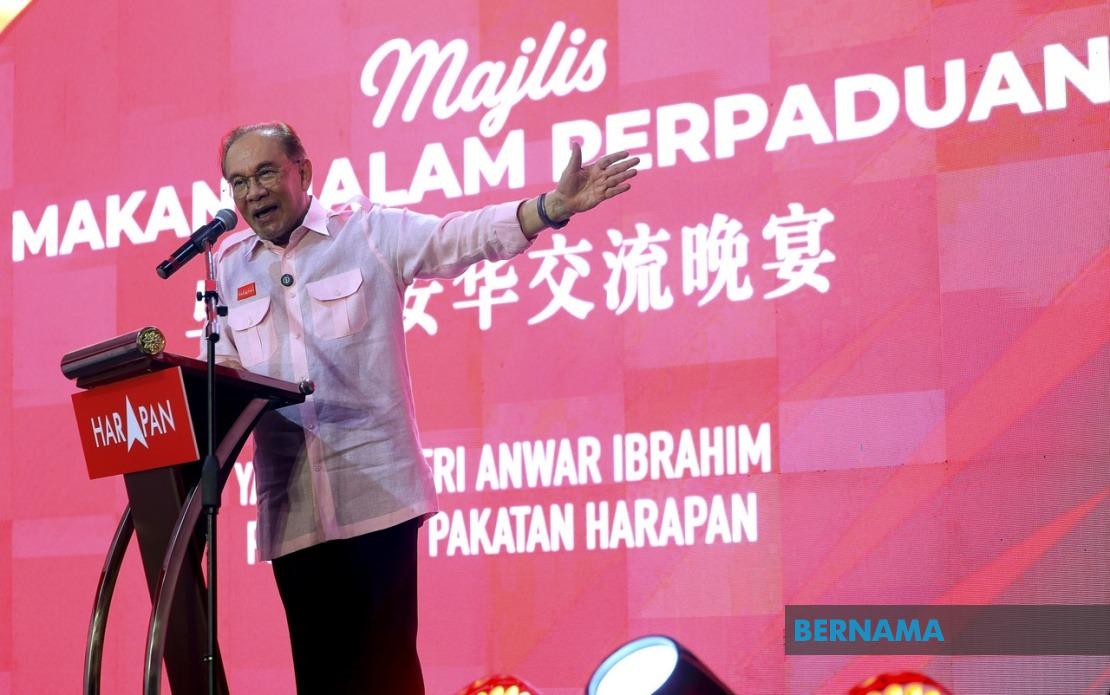
Prime Minister Datuk Seri Anwar Ibrahim has launched a pointed critique of rival parties' apparent fixation on securing the menteri besar's position in Negeri Sembilan, suggesting their preoccupation with internal power struggles reveals a lack of genuine commitment to public service. Speaking at a campaign dinner in Sikamat tonight, the Pakatan Harapan chairman drew a sharp contrast between his coalition's focus on effective governance and what he characterised as the opposition's scramble for leadership roles before voting has even taken place.
Anwar's remarks carry particular weight in a state where political fragmentation has historically complicated administration. His observation that competing factions within the opposition are already manoeuvring for the top job signals that PH intends to position itself as the pragmatic choice for voters concerned about stability. The prime minister framed the election as a straightforward choice: whether to entrust governance to leaders focused on public welfare or to those distracted by internal rivalries that are likely to persist after polling day.
The campaign comments underscore a broader PH strategy emphasising continuity and proven leadership. Anwar specifically praised Negeri Sembilan's incumbent menteri besar, Datuk Seri Aminuddin Harun, who is contesting as the PH candidate for the Linggi constituency. Aminuddin's track record in administering the state, according to the prime minister, demonstrates integrity and a commitment to combating corruption and the misuse of power—implicit contrasts with opposition governance elsewhere in Malaysia.
Beyond internal opposition dynamics, Anwar addressed what he views as divisive electoral tactics being deployed during the campaign. He expressed concern that certain quarters are weaponising racial narratives to secure political backing, a concern that reflects ongoing tensions in Malaysian politics around identity-based mobilisation. This critique is particularly significant given the Unity Government's explicit commitment to inclusive governance that transcends communal lines.
The prime minister doubled down on the coalition's development agenda as evidence of its inclusive approach. He highlighted increased socio-economic allocations, expanded housing initiatives, and salary adjustments for civil servants as concrete manifestations of a government serving all Malaysians regardless of ethnicity. These tangible policy achievements, in Anwar's framing, contrast sharply with what he implies are the opposition's preoccupations with factional positioning rather than substantive governance.
Pakatan Harapan is contesting all 36 state assembly seats in Negeri Sembilan, with the coalition's three component parties dividing responsibilities according to their respective electoral strategies. The PKR is fielding 16 candidates, while the DAP is running 11 and Amanah nine. This distribution reflects a careful calibration of seat allocation among parties, designed to maximise the coalition's overall electoral appeal while respecting each party's influence within the broader alliance.
The election itself will take place on August 1, with early voting scheduled for July 28, giving the coalition roughly a week to consolidate its messaging and mobilise supporters. Anwar's appearance at the campaign dinner, alongside Aminuddin and other PH candidates including Nor Azman Mohamad in Sikamat and Datuk Muhammad Nazri Kassim in Ampangan, underscores the national leadership's direct investment in securing a state-level victory. Such high-profile engagement by the prime minister signals that PH views the Negeri Sembilan contest as strategically important, not merely a routine state election.
For Malaysian voters and political observers, the Negeri Sembilan election serves as a significant barometer of public sentiment toward the Unity Government. The state, often overshadowed by larger neighbours like Selangor and Johor, nonetheless holds importance as a bellwether for coalition performance. A convincing PH victory would reinforce claims that the government enjoys grassroots support beyond its base, whilst conversely, losses would provide ammunition to critics questioning the coalition's legitimacy and durability.
Anwar's implicit warning about opposition disunity resonates against Malaysia's fractured opposition landscape. Multiple camps across the political divide have struggled to present a coherent alternative to the current administration, with leadership disputes and ideological differences frequently undermining collective electoral strategies. By highlighting opposition infighting over the menteri besar post, Anwar attempts to sow doubt about whether rival parties possess the cohesion necessary for stable governance at state level.
The emphasis on racial divisiveness and inclusive governance speaks to deeper anxieties within Malaysian politics about whether identity politics can be transcended in favour of results-oriented, multiethnic administration. The Unity Government's positioning as a force for inclusivity remains contested, with detractors arguing that PH's coalition partners, particularly PKR and DAP, still operate within identity-based constituencies. Nonetheless, Anwar's framing of the election as a choice between governance focused on delivering benefits to all communities and opposition politics rooted in factional competition may resonate with swing voters exhausted by polarisation.
Negeri Sembilan's electorate will ultimately decide whether Anwar's critique of opposition infighting and his coalition's record of inclusive governance outweigh other considerations voters might prioritise. The state's relatively small population and compact electoral geography mean that the result will be determined by fairly tight margins in competitive constituencies, making ground-level campaign execution decisive.

