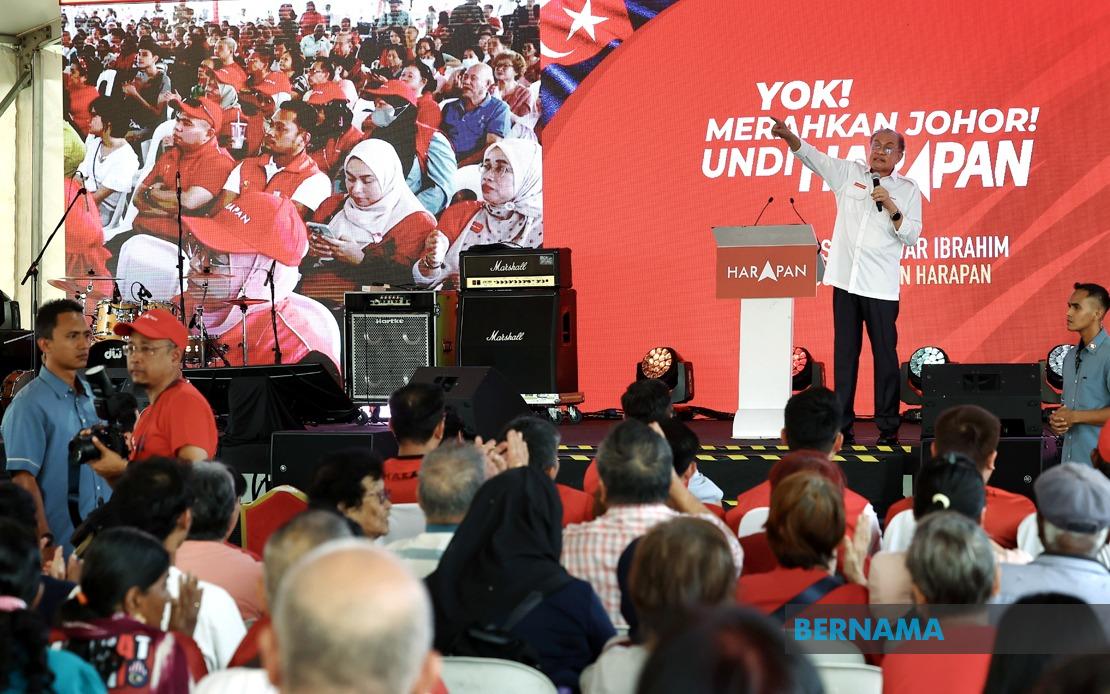
Prime Minister Datuk Seri Anwar Ibrahim has made a direct plea to political parties contesting the forthcoming Johor state election to refrain from leveraging the detention of former premier Datuk Seri Najib Razak as campaign material. Speaking at a Pakatan Harapan rally in Kulai, Anwar emphasised that ongoing attempts to politicise Najib's incarceration detract from substantive governance discussions and distract from addressing the nation's pressing economic challenges and citizen welfare priorities.
Anwar's intervention reflects growing concern within the government coalition about the trajectory of campaign discourse in Johor, where opposition parties have increasingly sought to mobilise supporters by questioning the legitimacy of Najib's conviction and advocating for his release. The Prime Minister's remarks suggest that rather than engaging with these provocative narratives, the electorate should demand candidates focus on tangible policy commitments regarding schools, hospitals, infrastructure and poverty alleviation. His comments underscore the government's preference for shifting electoral debate away from contentious judicial outcomes and towards measurable development outcomes.
Central to Anwar's argument is the substantial financial burden inherited by the current administration from the 1Malaysia Development Berhad (1MDB) scandal. The government continues servicing a debt of RM51 billion stemming from the misappropriation of sovereign wealth fund monies under the previous administration. This enormous liability represents capital that could otherwise be directed toward essential public services. Anwar stressed that the accumulated debt from 1MDB has constrained the government's capacity to fund healthcare infrastructure, educational facilities, transportation networks and social assistance programmes that directly impact ordinary Malaysians' quality of life.
The timing of Anwar's intervention is strategically significant given heightened political tensions in Johor, a state with historical significance to UMNO and where opposition parties have sought to capitalise on public sentiment regarding Najib's legal troubles. By calling for "enough is enough" regarding the matter, Anwar appears to be attempting to depoliticise a sensitive judicial issue while simultaneously reminding voters of the material consequences of the financial mismanagement that necessitated Najib's prosecution. This dual messaging seeks to reframe the conversation around personal grievance toward institutional accountability and forward-looking governance.
The event in Kulai brought together key figures from the ruling coalition, including Youth and Sports Minister Mohammed Taufiq Johari, Deputy Investment, Trade and Industry Minister Sim Tze Tzin, PKR Youth chief Muhammad Kamil Abdul Munim and Pakatan Harapan's Bukit Batu candidate Arthur Chiong Sen Sern. The presence of these officials signalled unified messaging from the coalition regarding campaign conduct and priorities. Their attendance underscored the government's determination to keep electoral competition focused on developmental agendas rather than allow opposition narratives to dominate public discourse.
For Malaysian voters and regional observers, Anwar's position reflects an evolving calculation about how past corruption controversies intersect with contemporary electoral competition. While the 1MDB scandal and Najib's conviction remain emotionally resonant for many Malaysians, the Prime Minister's intervention suggests the government believes continued emphasis on these issues yields diminishing political returns while continuing to consume public resources through debt servicing. By contrast, redirecting campaign energy toward demonstrable improvements in service delivery, economic growth and poverty reduction may prove more persuasive to electorates evaluating governance performance.
The RM51 billion debt figure itself warrants scrutiny regarding Malaysia's fiscal trajectory. This outstanding obligation represents a significant constraint on budget flexibility and restricts the government's capacity to fund expansionary social programmes or infrastructure investment that might stimulate economic growth. For a middle-income nation seeking to transition toward higher-value economic activities, this debt burden diverts resources from productivity-enhancing investments in research, technology and human capital development. The opportunity cost extends beyond immediate public service provision to encompass long-term competitiveness and prosperity.
Anwar's appeal also speaks to international perceptions of Malaysia's political maturity and institutional stability. Foreign investors and development partners increasingly assess governance quality by observing whether political competition centres on policy alternatives and programmatic visions or devolves into personalised attacks and zero-sum struggles over judicial outcomes. A campaign environment dominated by calls for Najib's release and counter-arguments defending his conviction may suggest institutional instability to external actors, potentially affecting investment flows and developmental partnership opportunities. By urging candidates to elevate discourse, Anwar implicitly seeks to project an image of institutional confidence and forward-focused governance.
The opposition's resort to Najib release advocacy represents a calculated political gambit in Johor, where UMNO retains substantial organisational capacity and traditional support bases. By centring campaigns on the former premier's detention, opposition actors effectively remind their core constituencies of grievances while simultaneously attempting to position themselves as defenders of a fallen leader. However, this strategy carries risks, particularly if swing voters prioritise governance competence and economic management over symbolic gestures regarding past administrations. Anwar's public rebuke suggests the government believes this electoral calculation favours ruling coalition candidates.
Looking forward, the balance between substantive policy debate and emotionally-charged personalised politics will likely determine Johor's electoral outcome. Voters must weigh whether past accountability measures adequately address historical wrongdoing, or whether resources should prioritise forward-looking development. Anwar's intervention attempts to frame this choice in terms of competing visions for resource allocation and national priorities. His willingness to directly address campaign tactics also demonstrates the government coalition's confidence in its developmental record and suggests belief that when electoral competition centres on tangible governance outcomes rather than personalised grievances, ruling coalitions benefit from demonstrated competence.
The Johor state election thus becomes a potential referendum on whether Malaysian voters prioritise accountability for past mismanagement or demand immediate improvements to current service delivery and economic opportunity. Anwar's appeal for campaign discipline ultimately reflects a government betting that most voters will choose the latter, valuing schools, hospitals and employment prospects over continued litigation of historical corruption controversies.

