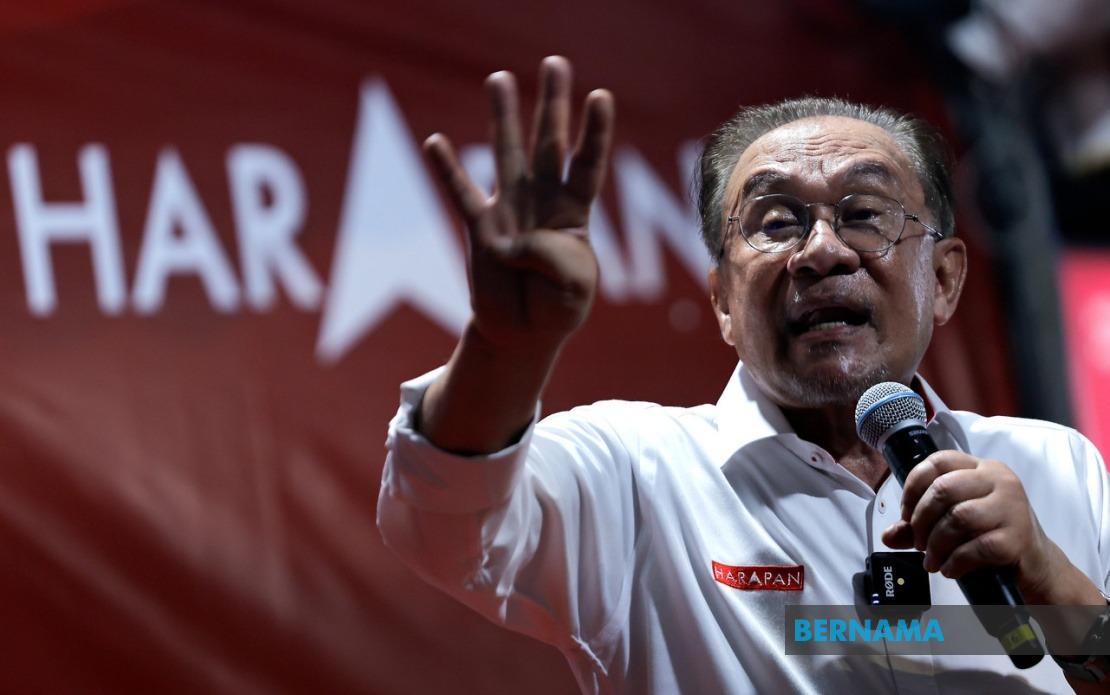
Prime Minister Datuk Seri Anwar Ibrahim has appealed to voters in Johor to prioritize integrity and wisdom when selecting their leaders in the upcoming state election, cautioning against those who wield power with arrogance. Speaking at a Pakatan Harapan grand rally in Muar on June 15, the PH chairman stressed that electoral choices fundamentally shape a state's trajectory, and that voters should remain vigilant against political factions that weaponize communal divisions to secure support only to abandon their obligations once in office.
Anwar's remarks underscored a broader concern about the quality of political leadership in Malaysia's states. He highlighted a pattern whereby certain groups gain electoral traction by inflaming racial and religious sensibilities, only to demonstrate little commitment to addressing citizens' actual needs afterward. This critique reflects ongoing tensions within Malaysia's political landscape, where populist appeals frequently overshadow substantive policy discussions. For Johor, a state traditionally dominated by Umno-led coalitions, such messaging represents a direct challenge to incumbent governance models and serves as an invitation for voters to reassess their political preferences.
The Prime Minister's appeal carried particular weight given his dual role as both national leader and PH chairman. He explicitly linked Johor's electoral outcome to federal-level development priorities, arguing that administrative coherence between state and federal authorities is essential for channeling economic benefits effectively to ordinary citizens. This integration of governance levels has become increasingly significant as Malaysia pursues major infrastructure initiatives, particularly the Johor-Singapore Special Economic Zone (JS-SEZ) and expansion of the Port of Tanjung Pelepas, projects that require coordinated implementation across different administrative tiers.
Anwar emphasized that while state governments may contribute to these ventures, the federal government assumes primary responsibility for their execution and outcomes. He indicated that a PH-led Johor state administration would align more seamlessly with federal development objectives, enabling more efficient resource allocation and ensuring that grassroots communities benefit tangibly from macroeconomic projects. This framing positions the July 11 election not merely as a local contest but as a crucial component of Malaysia's broader economic transformation strategy, particularly relevant given the regional significance of Johor as a gateway to Singapore and a key node in Southeast Asian commerce.
Central to Anwar's argument was the necessity for voters to demonstrate discernment in political selection. He urged citizens to engage critically with political messaging, to resist narratives built on antagonism toward others, and instead to contemplate long-term consequences for institutions like schools and hospitals that directly impact family welfare. This appeal for rational deliberation stands in contrast to emotional or identity-based voting patterns that have traditionally influenced Malaysian electoral behavior. For Southeast Asian democracies navigating similar pressures toward populism and divisive messaging, Anwar's emphasis on thoughtful citizenry offers a counternarrative promoting substantive governance standards.
The Prime Minister specifically cautioned against the arrogance that sometimes accompanies electoral victory. Leaders, he asserted, must remain grounded in humility and focused on resolving public grievances rather than consolidating personal power. This emphasis on post-election accountability reflects lessons from Malaysia's recent political history, where several administrations have faced criticism for neglecting policy implementation in favor of internal party consolidation. By framing leadership as a custodial responsibility toward vulnerable populations, Anwar attempts to elevate voter expectations beyond mere tribal loyalty or personality-driven politics.
Anwar also directly addressed diaspora voters residing outside Johor, urging them to return home to participate in the state election. This mobilization effort acknowledges that electoral margins in Malaysia's state contests frequently depend on voter turnout, particularly among constituencies where opposition support has traditionally concentrated. The call to diaspora voters also implicitly recognizes that Johor's future development depends on inclusive participation from all its citizens, regardless of current residence. For a state with significant out-migration to federal territories and other regions, reconnecting these voters with electoral participation could materially influence the outcome.
The emphasis on economic spillover effects carries particular resonance for Malaysian voters increasingly concerned about cost-of-living pressures and employment opportunities. By highlighting federal commitment to major infrastructure projects and linking their benefits to state-level governance quality, Anwar frames the election as consequential for household prosperity rather than abstract political principle. This messaging attempts to translate national economic strategy into locally comprehensible terms, demonstrating how voting decisions at the state level cascade into tangible improvements in employment, services, and investment within communities.
Anwar's reference to the JS-SEZ and Port of Tanjung Pelepas expansion projects situates Johor within Malaysia's broader positioning as a regional economic hub. These initiatives represent substantial federal investment aimed at enhancing Johor's competitive advantages relative to other Southeast Asian ports and economic zones. A state government synchronized with federal priorities would presumably facilitate smoother regulatory processes, better infrastructure coordination, and faster project advancement—benefits ultimately accruing to Johor residents through expanded economic activity and public revenue generation for enhanced services.
The timing of these remarks, made just weeks before the July 11 election, reflects the intensity of PH's determination to expand its footprint beyond peninsular strongholds. Johor's electoral significance stems partly from its size and partly from its historical role as a Barisan Nasional fortress. A PH victory there would represent a substantial realignment of Malaysia's political geography and vindicate the coalition's claim to represent authentic change distinct from the Umno-dominated models that governed the state for decades. Conversely, a defeat would suggest that despite federal power, PH struggles to persuade voters in certain demographic contexts to abandon established political attachments.
Anwar's call for integrity and wisdom in leadership ultimately reflects a maturing recognition within Malaysian politics that electoral behavior should consider governance quality and administrative competence alongside traditional markers like ethnicity or religion. Whether Johor voters respond to this appeal will provide crucial insights into whether Malaysia's electorate is transitioning toward more issue-oriented decision-making, or whether established patterns of political affiliation continue to dominate despite rhetorical appeals for change. The results on July 11 will offer significant indicators about the broader trajectory of Malaysian democracy and the continuing negotiation between populist impulses and aspirations toward better governance.

