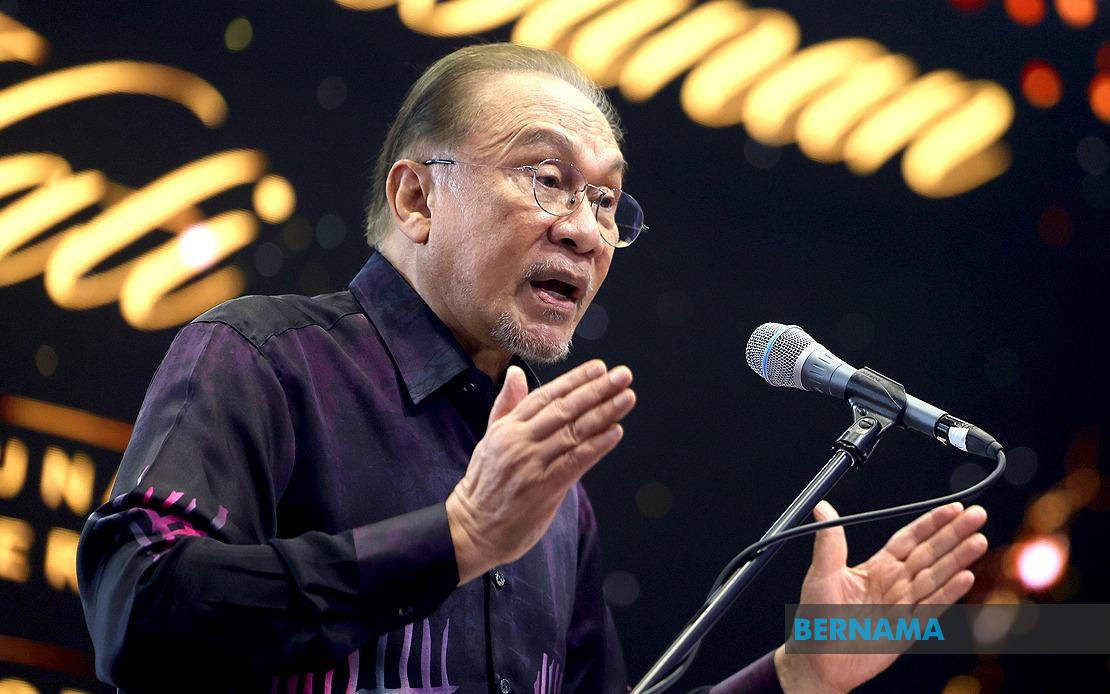
Prime Minister Datuk Seri Anwar Ibrahim has issued a forthright appeal to Malaysians of all backgrounds to defend the nation's multicultural character and reject divisive racial messaging from political figures seeking to exploit ethnic tensions. Speaking at a dinner gathering in Seremban organised by Pertubuhan Lima Generasi Malaysia, Anwar emphasised that Malaysia's strength fundamentally depends on the maintenance of interethnic harmony and cooperation rather than the cultivation of suspicion and animosity between communities.
Anwar's remarks signal growing concern within the government about inflammatory rhetoric that portrays different ethnic groups as adversarial forces. The Prime Minister specifically cautioned against leaders who deliberately attempt to position Malays against Chinese, Chinese against Indians, and Indians against Malays—a pattern of polarising messaging that he characterised as fundamentally contrary to national interests. By naming these specific divisions, Anwar sought to make transparent the mechanisms through which some political actors attempt to instrumentalise ethnicity as a wedge issue for electoral advantage or ideological mobilisation.
The Prime Minister's intervention reflects an understanding that Malaysia's capacity to develop economically and remain stable hinges on ethnic coexistence. Rather than treating diversity as a liability requiring management through hierarchical structures, Anwar framed it as an intrinsic asset that generates competitive advantage when underpinned by genuine mutual respect and collaborative spirit. This framing represents a deliberate counternarrative to zero-sum conceptions of ethnic relations that have periodically surfaced in Malaysian political discourse.
Anwar's emphasis on rising above divisive appeals carries particular resonance in the Malaysian context, where communal tensions have occasionally translated into social discord and where electoral competition sometimes incentivises politicians to mobilise voters along ethnic lines. By positioning unity as an active choice requiring conscious effort and leadership, rather than a default state, the Prime Minister acknowledged that preserving interethnic relations demands sustained commitment from political elites willing to resist short-term temptations to exploit communal grievances.
The event at which these comments were delivered drew more than 1,000 participants from Pertubuhan Lima Generasi Malaysia, suggesting substantial public engagement with questions of social cohesion. The attendance of Negeri Sembilan Menteri Besar Datuk Seri Aminuddin Harun underscored the gathering's significance as a platform for articulating government positions on communal harmony at both federal and state levels. Such forums provide opportunities for political leaders to reinforce messages about shared national identity with activist constituencies and civil society representatives.
For Malaysian policymakers and observers, Anwar's statement represents an acknowledgment that demographic diversity constitutes both opportunity and challenge. The Prime Minister's formulation—that ethnic pluralism strengthens the nation only when paired with institutional commitment to mutual understanding—suggests recognition that diversity itself generates neither automatic harmony nor inevitable conflict. Rather, outcomes depend substantially on leadership choices and the cultural norms that political figures model and reinforce through their public conduct.
The explicit naming of multiple ethnic communities—Malays, Chinese, Indians, Kadazans and others—in Anwar's framing of national unity serves an important symbolic function. By encompassing indigenous and immigrant-origin groups within a single conception of Malaysian identity, the Prime Minister emphasised that the nation comprises diverse elements whose integration represents an achievement rather than a problem to be solved. This inclusive rhetoric contrasts with formulations that privilege particular communities or treat others as incorporated minorities rather than equal stakeholders.
Anwar's appeal also carries implications for Malaysia's regional standing and international reputation. In an era when many Southeast Asian nations contend with ethnic or religious polarisation, Malaysia's maintenance of stable interethnic relations—imperfect though it remains—constitutes a significant achievement. Political leaders who publicly commit to defending multicultural coexistence and resisting sectarian mobilisation thereby contribute to regional stability and demonstrate the viability of alternative models to identity-based conflict.
The timing of these remarks reflects ongoing political contestation within Malaysia regarding the character of national identity and the appropriate relationship between state and ethnic communities. By positioning himself as a defender of pluralism against divisive forces, Anwar attempted to set terms for political competition around shared values of national cohesion rather than allowing debate to be framed exclusively through communal interest representation. Whether this rhetorical positioning translates into substantive policy that adequately addresses grievances within all communities remains a question for evaluation based on subsequent government actions and allocations of resources.

