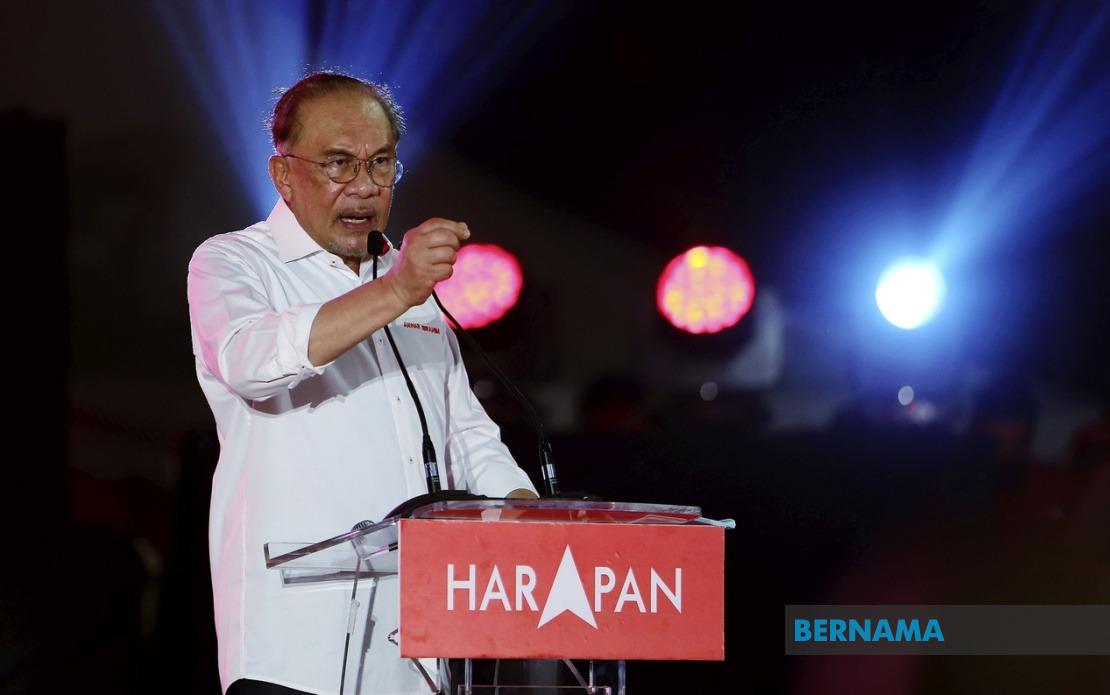
Prime Minister Datuk Seri Anwar Ibrahim has issued a clear directive to all parties contesting the 16th Negeri Sembilan State Election: keep royal institutions and constitutional safeguards away from campaign rhetoric. Speaking at the Pakatan Harapan candidate announcement ceremony in Kuala Pilah on July 14, the coalition chairman stressed that while electoral competition remains integral to democratic governance, such contests must unfold within boundaries of responsibility and decorum.
Anwar's cautionary remarks reflect growing concern that state-level campaigns could escalate into divisive territory by exploiting constitutionally sensitive subjects. The Prime Minister articulated a distinction between legitimate political contestation and irresponsible discourse, arguing that nations thrive when competing parties preserve consensus around foundational institutions. His intervention signals that the federal government considers constitutional and royal matters non-negotiable terrain for partisan advantage, setting a benchmark that extends beyond Negeri Sembilan to the broader health of Malaysian democracy.
The timing of Anwar's intervention carries particular significance. State elections in Malaysia frequently serve as barometers for federal political momentum, with parties testing messaging and mobilising grassroots machinery ahead of potential national contests. By establishing ground rules early, Anwar attempted to shape the campaign atmosphere and prevent rivals from adopting increasingly inflammatory tactics. This approach reflects lessons learned from previous electoral cycles where constitutional and institutional questions became flashpoints for communal tension.
Packaging the appeal within the Pakatan Harapan's own candidate launch underscored the coalition's commitment to conducting its campaign on the basis of governance credentials and development promises rather than institutional challenges. Alongside Anwar at the ceremony were senior PH figures including DAP secretary-general Anthony Loke, Amanah president Datuk Seri Mohamad Sabu, and communications director Datuk Seri Fahmi Fadzil, their collective presence reinforcing that the coalition leadership unified around this messaging framework.
Anwar simultaneously pivoted toward substantive governance themes, emphasizing that Negeri Sembilan voters deserved leadership defined by integrity and capable of propelling the state toward accelerated development. This framing repositioned the election around tangible outcomes—infrastructure, economic opportunity, service delivery—rather than ideological or institutional disputes. The strategy suggests confidence that Pakatan Harapan's track record and vision could prevail on merit without requiring resort to destabilising rhetoric.
The coalition unveiled 36 candidates combining newcomers with seasoned political operators from its three component parties: PKR, DAP, and Amanah. This balanced composition reflected an attempt to marry fresh energy with institutional knowledge, signalling renewal without abandoning experience. The roster included incumbent Menteri Besar Datuk Seri Aminuddin Harun contesting the Linggi seat and Anthony Loke representing the coalition in Chennah, placing senior federal and state figures directly in the contest.
Anwar's public endorsement of Aminuddin's stewardship functioned simultaneously as reassurance to the Negeri Sembilan electorate and reinforcement of PH's internal alignment. By characterising the Menteri Besar as cooperative and effective, Anwar signalled continuity and partnership between the state and federal administrations, suggesting that re-electing the incumbent would ensure seamless coordination for development implementation. This framing matters considerably in Malaysian federalism, where collaborative state-federal relationships often determine whether projects advance efficiently.
The Prime Minister's insistence that Negeri Sembilan must not fall behind carries implicit warnings about opposition victories potentially disrupting the state's development trajectory. In the Malaysian context, where infrastructure spending and economic initiatives frequently flow through federal-state channels, control of state governance directly influences resource allocation and project implementation. Anwar's messaging effectively positioned a PH retention as essential to ensuring the state continued benefiting from federal development initiatives.
For Malaysian and Southeast Asian observers, this election unfolds within broader regional patterns where institutional guardrails face pressure from competitive electoral politics. The Prime Minister's intervention represented an attempt to enforce democratic norms that preserve constitutional structures while permitting vigorous political competition. Whether rivals honour this implicit agreement will significantly shape the campaign's trajectory and the state electorate's exposure to divisive messaging.
The statement also reflected Anwar's broader governance philosophy emphasising institutional stability as prerequisite for economic development and social cohesion. By separating political competition from institutional critique, the Prime Minister advanced an argument that even ideological rivals must converge around constitutional fundamentals. This approach distinguishes between what remains subject to electoral contestation and what transcends party politics, a distinction increasingly vital as Malaysian democracy navigates polarisation.
Pakatan Harapan's campaign strategy in Negeri Sembilan would likely emphasise concrete achievements—job creation, infrastructure investments, educational and healthcare improvements—rather than engaging opposition rhetoric around constitutional questions. This substantive orientation reflected confidence in the coalition's development record and belief that voters ultimately respond to material improvements in living standards. The early demarcation of boundaries around institutional matters allowed the coalition to concentrate firepower on governance performance metrics.

