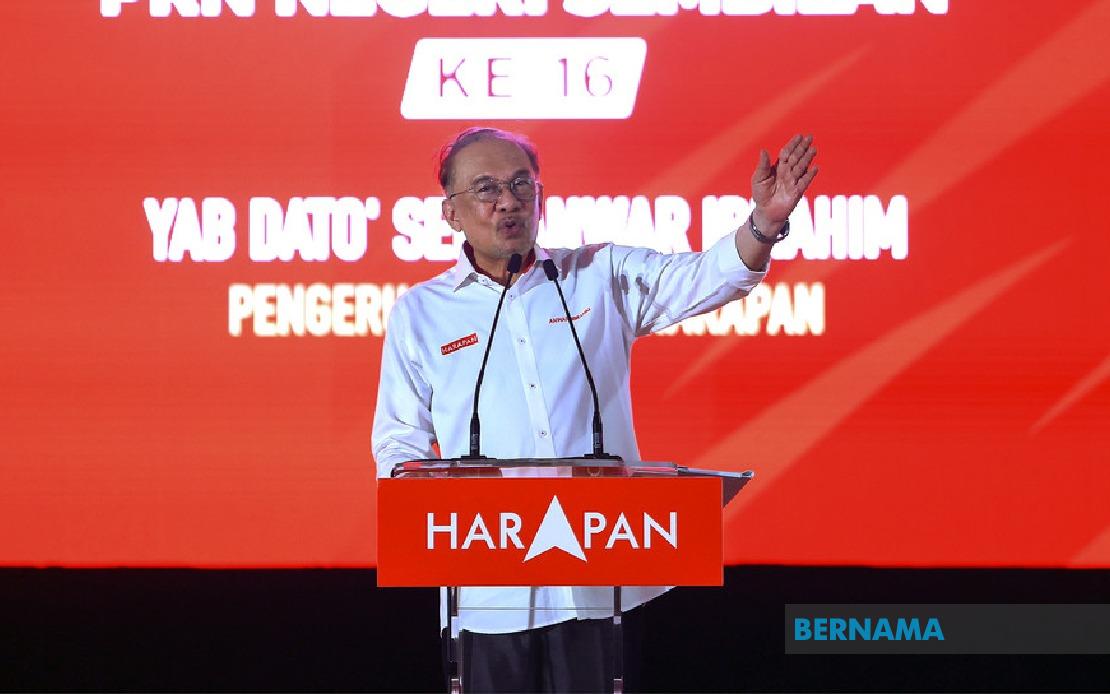
Prime Minister Datuk Seri Anwar Ibrahim has made a direct appeal to Negeri Sembilan voters, urging them to maintain their support for Pakatan Harapan (PH) in the upcoming state election scheduled for August 1. In remarks posted to his Facebook account on July 16, Anwar highlighted what he characterized as the coalition's track record of tangible progress, framing the election as a referendum on continuing the trajectory of improvement that the state has experienced in recent years. The timing of his intervention underscores the significance the federal leadership places on the Negeri Sembilan result, particularly given the state's role as a bellwether in Malaysia's political landscape.
Anwar, who serves simultaneously as Prime Minister and chairman of Pakatan Harapan, emphasized the symbiotic relationship between the state administration and federal government in delivering public projects. His framing suggests that state-level governance cannot be viewed in isolation from the broader coalition agenda. This message carries particular weight in Malaysian politics, where voters often assess state governments partly on their ability to secure federal funding and support. By publicly tying the federal coalition's credibility to state performance, Anwar is essentially asserting that a PH defeat in Negeri Sembilan would be interpreted as diminished confidence in his leadership at the national level.
Central to Anwar's pitch is his endorsement of Menteri Besar Datuk Seri Aminuddin Harun, whom he addresses affectionately as Tok Min. The Prime Minister credited the state leader with five years of stewardship marked by what he characterized as integrity and humility, accompanied by a demonstrated commitment to public service. Since assuming office in 2018, Aminuddin has navigated a complex political environment in Negeri Sembilan, where the state has traditionally been competitive between major political blocs. Anwar's public validation of the Menteri Besar functions both as a personal endorsement and as a signal to fence-sitting voters that the coalition has confidence in its state leadership.
The appeal to continuity represents a deliberate rhetorical strategy designed to resonate with voters who have grown accustomed to PH governance. Anwar's specific warning against allowing "progress we have built together come to a halt halfway" acknowledges that development projects often have multi-year timelines. In Malaysia's political context, state governments operate within constraints imposed by federal allocation mechanisms, meaning that a change of administration could potentially disrupt ongoing infrastructure and development initiatives. This concern carries real weight for voters whose communities depend on announced projects.
For Malaysian readers and particularly those in Negeri Sembilan, the election represents more than a routine state-level contest. The state has strategic economic significance, lying between Kuala Lumpur and the southern corridor, with important manufacturing and agricultural sectors. Development quality in the state therefore has broader implications for regional competitiveness. Anwar's appeal essentially connects local voter concerns about roads, schools, and infrastructure to the larger narrative of national governance and direction.
The electoral calendar outlined in Anwar's statement provides the operational framework for the campaign period. Nominations occur on Saturday, July 16, with early voting scheduled for July 28 and the main polling day set for August 1. This compressed timeline—less than three weeks from nomination to voting—concentrates campaign activity and limits candidates' ability to build awareness. For a coalition seeking to preserve control, such compressed periods can work either for or against the incumbent, depending on voter engagement levels and the clarity of their message.
Anwar's invocation of Islamic values with the phrase "Alhamdulillah" and "Insya-Allah" reflects the religious orientation of Malaysian political discourse, particularly in a state like Negeri Sembilan where Malay-Muslim voters form a significant portion of the electorate. This rhetorical choice positions PH's development agenda within a framework of spiritual responsibility and divine blessing, potentially strengthening the appeal to culturally conservative voters who might otherwise entertain opposition arguments.
The emphasis on a "clean, stable administration" addresses an implicit vulnerability that Pakatan Harapan has sought to rehabilitate since its earlier national government period ended in 2020. Anwar is essentially asserting that the state administration represents the coalition's capacity for accountable governance. This positioning becomes especially important if opposition parties attempt to revive broader narratives about political instability or administrative irregularities. By consistently highlighting administrative virtue, the Prime Minister is preemptively countering such arguments.
For observers across Southeast Asia, the Negeri Sembilan election offers a indicator of Anwar's political standing domestically. A coalition victory would suggest that the Prime Minister's efforts to consolidate support since assuming office in late 2022 are bearing fruit. Conversely, electoral setbacks would invite questions about his capacity to mobilize party machinery and translate national leadership into state-level gains. The result carries implications for regional perceptions of Malaysia's political stability and Anwar's durability in office.
The cooperation framework Anwar describes between state and federal administrations reflects how Malaysian federalism functions in practice, with development capacity heavily dependent on federal-state alignment. This reality creates incentives for state-level leaders to maintain positive relationships with federal colleagues, even when political competition exists. Negeri Sembilan's experience under PH thus serves as a model for how coalition governance might function if maintained across more states.
Looking forward, the campaign will likely center on whether voters perceive the development narrative as compelling and whether opposition parties can articulate an alternative vision for the state. Anwar's early intervention suggests that the coalition recognizes the stakes as significant. His personal investment in the campaign underscores that Negeri Sembilan is not being treated as a routine state election, but rather as an important validation of his leadership and the coalition's capacity to govern.

