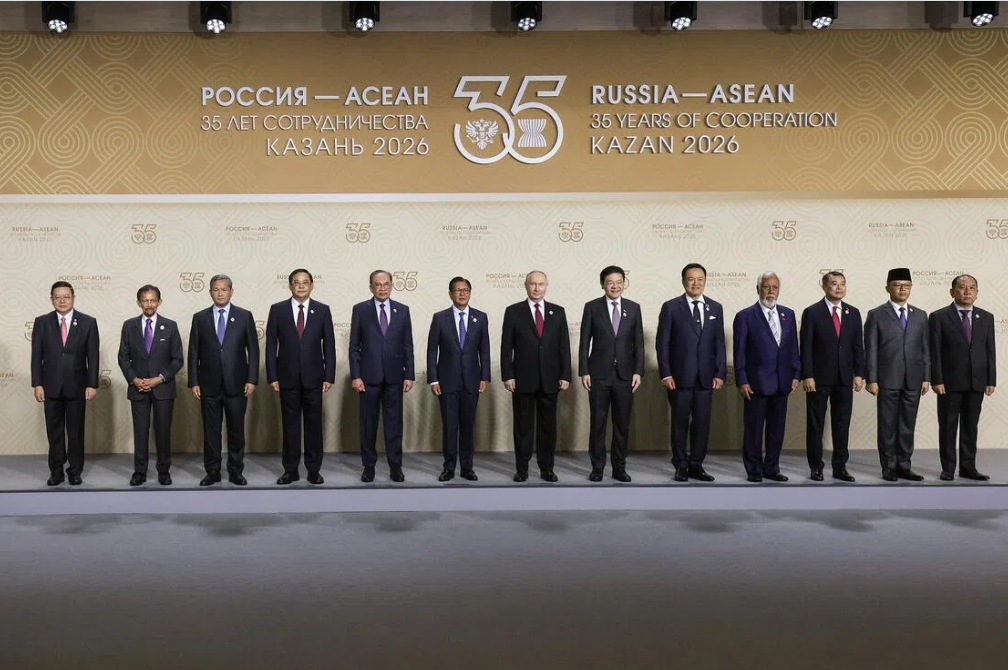
Asean and Russia have reaffirmed their commitment to expanding cooperation across multiple strategic domains at the Asean-Russia Commemorative Summit held in Kazan on June 17 and 18. The gathering, hosted by Russian President Vladimir Putin, served as a milestone moment in bilateral relations, marking three and a half decades of diplomatic engagement and three decades of formal dialogue partnership between the ten-member Southeast Asian organisation and Moscow. The summit produced several binding documents designed to chart the course of future collaboration and address areas where mutual interests align, even as broader geopolitical tensions continue to reshape the regional landscape.
The centrepiece of the summit was the Kazan Declaration, which comprehensively reviews the trajectory of Asean-Russia relations since their establishment and identifies priority areas for intensified cooperation going forward. The declaration specifically emphasises maritime affairs, trade and investment flows, energy sector development, infrastructure connectivity, security matters, educational exchanges and cultural promotion as key pillars for the next phase of engagement. Alongside this overarching framework, both sides adopted a Joint Statement on Cultural Cooperation that explicitly targets deeper people-to-people connections and expanded cultural activities. Most significantly, the Asean-Russia Comprehensive Plan of Action for 2026-2030 was endorsed, providing a detailed roadmap for practical cooperation initiatives across all agreed domains over the five-year period.
The timing of this summit underscores Asean's strategic balancing act in an increasingly unpredictable geopolitical environment. Singapore's Prime Minister Lawrence Wong, speaking at the summit, articulated a vision of partnership grounded in convergent interests while maintaining unwavering commitment to principles of international law and the rules-based global order. He emphasised that Asean's dual priorities of deepening regional integration while simultaneously expanding external partnerships have become more critical as the international landscape grows more volatile and fractious. This framing reflects Southeast Asia's careful navigation between competing powers, seeking to benefit from relationships with multiple actors without allowing itself to become a theatre for great power competition.
Wong highlighted several concrete areas where Asean and Russia can productively collaborate. Disaster management and counter-narcotics cooperation emerged as priority fields where the bloc and Moscow share common challenges and can mobilise complementary resources. Educational and people-to-people exchanges represent another avenue, with Wong noting that Russian officials regularly participate in civil service training programmes across Asean member states, including Singapore. These institutional connections provide the foundation for building mutual understanding and trust, particularly important given the historical wariness and occasional friction that have characterised Asean-Russia relations.
The summit also reflected Russia's ongoing efforts to position itself as a stakeholder in Southeast Asian affairs despite its preoccupation with Ukraine and Middle East tensions. Wong welcomed Russia's support for the concept of Asean Centrality, referring to the bloc's role as a central organising principle in regional diplomacy and security architecture. He specifically noted Russia's participation in Asean-led mechanisms such as the Asean Regional Forum and the East Asia Summit, expressing hope for continued engagement as the Philippines hosts these forums later in 2024 and Singapore assumes the rotational Asean chair in 2027. This prospective involvement signals that despite differences on global issues, Russia remains integrated into Southeast Asia's multilateral structures.
However, the summit highlighted the underlying tensions between pragmatic cooperation and principled positions on contentious international issues. Singapore has been consistent in condemning Russia's invasion of Ukraine as a violation of international law and maintains sanctions and restrictions imposed in 2022. Wong reiterated that Singapore's stance on Ukraine derives not from alignment with any particular side but from steadfast adherence to principles of national sovereignty and territorial integrity—standards applicable to all nations. This careful articulation allows Asean members to maintain dialogue channels with Russia while signalling their commitment to universal norms, a delicate balance that has defined the bloc's approach throughout the Ukraine conflict.
Wong also used the summit as an opportunity to welcome the recently concluded peace agreement between the United States and Iran, expressing optimism that this development could lead to a durable resolution of Middle Eastern tensions and restoration of unimpeded transit through the Strait of Hormuz. For Southeast Asia, freedom of navigation through critical international waterways remains a vital economic interest, directly affecting regional trade flows and energy security. Wong explicitly affirmed that Asean continues championing unrestricted right of transit passage through key maritime routes in accordance with the United Nations Convention on the Law of the Sea, a position that reflects regional dependence on stable global commerce and worry about potential disruptions.
On the bilateral front, Wong held substantive discussions with President Putin at the Russian leader's request, with the two leaders exchanging perspectives on bilateral relations and broader regional and international developments. In subsequent remarks shared on social media, Wong emphasised that these interactions underscored the value of sustained dialogue and engagement even when countries hold divergent views on major issues. He indicated that Singapore values its long-standing relationship with Russia and its people, signalling a determination to identify practical areas for cooperation despite fundamental disagreements on certain matters. This approach reflects Singapore's consistent diplomatic philosophy of maintaining relationships across the geopolitical spectrum.
Wong also met Rustam Minnikhanov, the Rais of the Republic of Tatarstan, on the summit's sidelines. Singapore's ties with Tatarstan possess considerable historical depth, having been nurtured since 2007 when Singapore's then-Minister Mentor Lee Kuan Yew visited the region. The bilateral engagement covered cultural, educational and people-to-people dimensions, reflecting Singapore's strategy of cultivating connections at multiple administrative and societal levels across Russia. These sub-national level engagements often prove more stable and less subject to geopolitical fluctuations than central government relations.
The Kazan summit ultimately exemplifies how Southeast Asian nations, particularly those like Singapore with significant diplomatic profiles, navigate the challenge of maintaining constructive relationships with major powers while adhering to principles of international law and rules-based order. The adoption of binding cooperation documents provides concrete frameworks for collaboration while the continued emphasis on dialogue and engagement signals that bilateral relationships need not be sacrificed on the altar of ideological or geopolitical divides. For Malaysia and other regional states watching from the sidelines, the summit demonstrates how Asean as a bloc can engage Russia through institutional mechanisms that preserve both practical cooperation and principled consistency.
Looking ahead, the 2026-2030 action plan will serve as the operational blueprint for Asean-Russia ties, with specific attention to implementation challenges and the evolution of geopolitical circumstances that may require adjustment of priorities. The bloc's assumption of various diplomatic chairs in coming years, particularly Singapore's 2027 leadership, will provide opportunities to deepen Russia's participation in regional forums and strengthen institutional connections. Whether these mechanisms can successfully bridge the gap between shared interests and fundamental disagreements on issues like Ukraine remains to be seen, but the commitment to continued engagement suggests that both Asean and Russia view the relationship as sufficiently valuable to invest in despite persistent tensions elsewhere.

%22%2F%3E%3C%2Fpattern%3E%3C%2Fdefs%3E%3Crect%20width%3D%22100%25%22%20height%3D%22100%25%22%20fill%3D%22url(%23ph3xuh4g)%22%2F%3E%3Crect%20width%3D%22100%25%22%20height%3D%22100%25%22%20fill%3D%22url(%23ph3xuh4p)%22%2F%3E%3Ctext%20x%3D%2250%25%22%20y%3D%2250%25%22%20text-anchor%3D%22middle%22%20dominant-baseline%3D%22central%22%20fill%3D%22rgba(255%2C255%2C255%2C0.95)%22%20font-family%3D%22Georgia%2C%20'Times%20New%20Roman'%2C%20serif%22%20font-weight%3D%22700%22%20font-size%3D%22272%22%20letter-spacing%3D%22-0.02em%22%3EAnwar%3C%2Ftext%3E%3C%2Fsvg%3E)