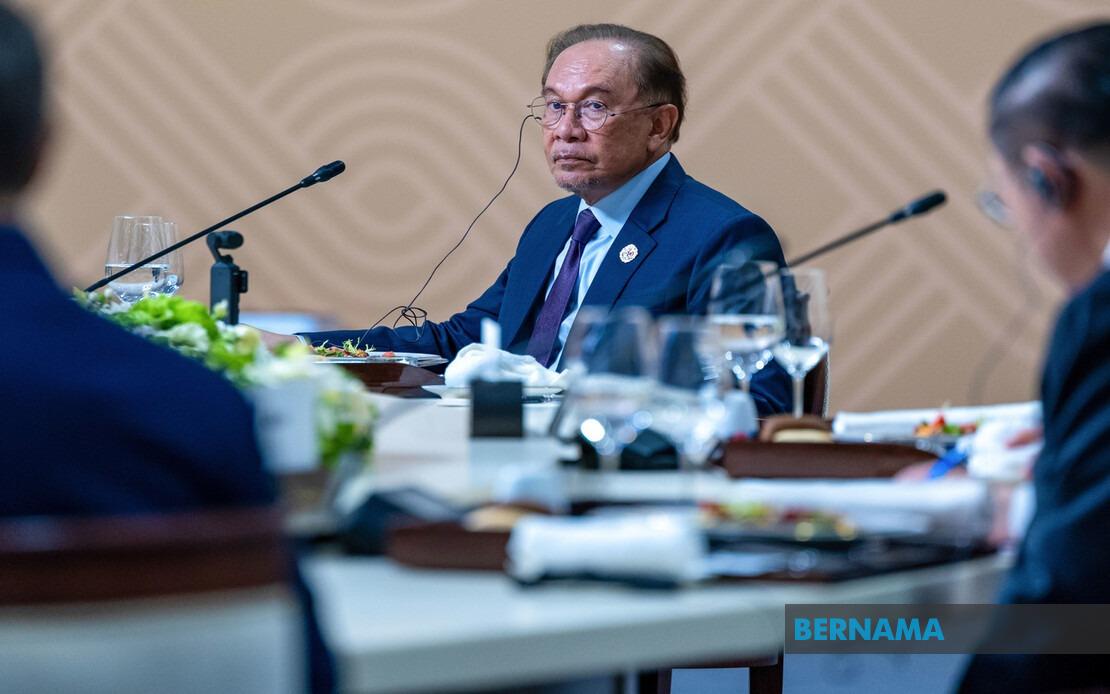
Prime Minister Datuk Seri Anwar Ibrahim has called for ASEAN and the Shanghai Cooperation Organisation to marshal combined resources in the fight against transnational crime and enhance energy collaboration, emphasising that both challenges demand coordinated multilateral responses. Speaking during an ASEAN-Russia working lunch in Kazan on June 18, the Premier underscored that these emerging threats transcend national borders and require more than individual country action to address effectively.
The foundation for such cooperation already exists in the 2005 memorandum of understanding established between the two regional bodies, which covers counter-terrorism initiatives, drug and narcotic enforcement, money laundering prevention, and economic and financial frameworks. Energy cooperation provisions within the agreement specifically address hydroelectric generation and biofuel development, sectors where member states possess complementary capabilities and resources. Rather than creating entirely new mechanisms, Anwar stressed the need to activate and build upon these dormant or underutilised agreements through focused, time-bound initiatives that can demonstrate concrete results.
The security dimension of this partnership has become increasingly urgent as criminal networks exploit technological advances to operate across jurisdictions with growing sophistication. Online fraud schemes, clandestine financial transfers, and human trafficking networks now move faster than governmental responses can contain, creating enforcement vacuums that threaten regional stability. Anwar identified intelligence sharing and mutual capacity development as critical tools for closing these gaps. By establishing regular information channels between ASEAN's ten member states and SCO's expanding membership, authorities could develop shared databases, harmonise investigative techniques, and build forensic capabilities that current isolated efforts cannot achieve.
The Shanghai Cooperation Organisation, which was formally established in 2001 as a political, economic, and security alliance, currently encompasses ten full members including China, India, Iran, Kazakhstan, Kyrgyzstan, Pakistan, Russia, Tajikistan, Uzbekistan, and Belarus, alongside observer states Afghanistan and Mongolia. This composition positions the SCO as a bridge between Asia's major economies and energy producers, a strategic advantage for addressing supply chain vulnerabilities and pricing volatility. Anwar, who simultaneously holds the Finance Ministry portfolio, recognised that the SCO's collective expertise in energy technology and resource extraction provides Malaysia and other ASEAN nations with opportunities to transition toward cleaner energy sources while maintaining supply reliability.
Beyond security cooperation, the Prime Minister outlined a comprehensive energy partnership agenda encompassing efficiency improvements, grid modernisation, liquefied natural gas and conventional gas trading, renewable energy integration, and technical knowledge exchange regarding operational safety. For Malaysia specifically, access to SCO member expertise in these domains could accelerate the country's renewable energy targets and strengthen LNG supply relationships critical to long-term economic planning. The energy dimension reflects recognition that regional prosperity depends on stable, affordable, and increasingly sustainable power supplies, making cooperation on this front an economic necessity rather than merely an environmental preference.
Anwar extended his collaborative vision to the Eurasian Economic Union, a Russia-led trading bloc with which ASEAN has established formal relationship frameworks. He advocated that existing agreements between ASEAN and the EAEU should transition from institutional formality to operational reality, with emphasis on strengthening commercial confidence and expanding trade volumes. The proposal rests on three interconnected pillars designed to deepen economic integration and benefit multiple stakeholder levels across both regions.
First among these priorities is the institutionalisation of private sector engagement through regular forums and trade show participation. Major ASEAN and EAEU companies should integrate their networking activities into established events including the Eastern Economic Forum and the St Petersburg International Economic Forum, creating recurring touchpoints that foster deal-making and partnership formation. This regularisation of business interaction reduces transaction costs and builds the relational capital necessary for cross-border investment and joint ventures.
Second, Anwar highlighted that smaller and medium enterprises from both blocs require targeted support to compete effectively across either region's markets. Such assistance encompasses preferential market access arrangements, technology transfer mechanisms, and skills development programs that enable smaller firms to participate in value chains previously accessible only to large corporations. This democratisation of trade opportunities distributes economic benefits more widely across both regions and creates constituencies within business communities with direct stakes in sustained cooperation.
Third, the Prime Minister identified emerging areas of convergent interest between ASEAN and the EAEU that merit joint exploration. The digital economy, artificial intelligence applications, cybersecurity frameworks, and food security resilience represent frontier domains where technological capabilities and resource endowments of both blocs can be combined for mutual benefit. Food security assumes particular salience for ASEAN nations, many of which depend on imports, and EAEU members including Kazakhstan and Russia hold significant agricultural output capacity. Coordinated approaches to supply chain fortification and price stabilisation in these sectors could generate immediate practical returns on cooperative investment.
Anwar's visit to Kazan, the capital and largest city of Russia's Tatarstan region, formed part of a two-day working engagement centred on the ASEAN-Russia Commemorative Summit, which concluded on June 18. This diplomatic platform provided the appropriate venue for articulating a forward-looking agenda that positions ASEAN not as a passive regional grouping but as an active participant in shaping broader Asian security and economic architecture. By emphasising existing institutional frameworks and practical outcomes over rhetoric, the Prime Minister's remarks signal Malaysia's pragmatic approach to regional diplomacy, where partnership deepening occurs through methodical implementation rather than ceremonial announcements.

