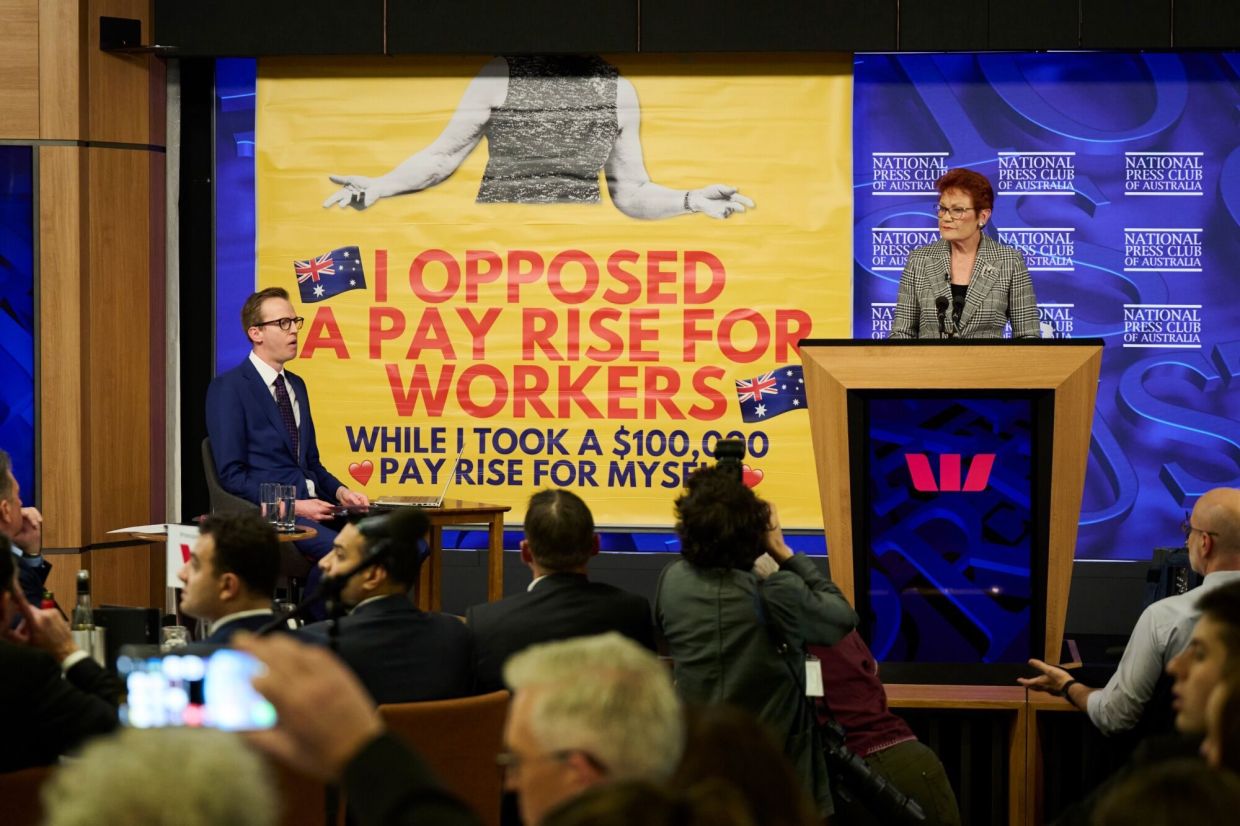
Pauline Hanson, leader of Australia's One Nation party, has launched a frontal assault on multiculturalism, declaring that her country must abandon decades of policy promoting cultural diversity and instead operate under a single cultural framework. Speaking at the National Press Club in Canberra on Wednesday, the hard-right politician argued that while Australia can remain a multiracial society, it must be monocultural—effectively rejecting the philosophical underpinning of how modern Australia has been constructed since the 1970s.
Hanson's intervention marks a significant moment in Australian political discourse, as her address to the National Press Club represented her first appearance at the prestigious venue in a 30-year political career. Her willingness to articulate such uncompromising rhetoric suggests confidence that the political environment has shifted sufficiently to accommodate positions once considered beyond the pale in mainstream Australian politics. The timing reflects real movement in public sentiment, with One Nation experiencing a measurable surge in opinion polling throughout the past year, particularly accelerating after the coalition government's electoral collapse in May of the preceding year.
At the heart of Hanson's argument lies a diagnosis of Australia's housing affordability crisis. She contends that the nation's inability to provide adequate housing at reasonable cost stems fundamentally from immigration policy set at excessively high levels. This framing transforms an economic problem into a question of national identity and cultural cohesion, a rhetorical move that resonates with voters experiencing genuine financial stress. By tying immigration directly to housing unaffordability, Hanson provides voters with a straightforward explanation for their economic anxieties—one that focuses blame outward rather than examining structural economic factors.
Hanson's call to "slash" migration encompasses not only numerical reductions but also qualitative restrictions on who may enter Australia. She specifically proposed limiting entry for people from regions she characterised as "immersed in extremism like radical Islam," language that conflates geographic origin and religious identity with security risk. This articulation of restrictionist immigration policy appeals to voters concerned about social cohesion and security, even as it mobilises religious and cultural stereotypes that many observers find troubling.
The One Nation leader's assault on multiculturalism represents a deliberate rejection of what has been official Australian policy for half a century. Since the early 1970s, successive governments—both Labor and Liberal-National—embraced multiculturalism as a foundational principle, arguing that Australia's strength derived from its ability to welcome migrants from diverse backgrounds while respecting their cultural identities. Hanson's intervention suggests this consensus has fractured significantly, and that substantial portions of the electorate are receptive to messages rejecting the multiculturalist framework entirely.
For Malaysia and Southeast Asia, Hanson's rising influence carries particular significance. Australia maintains extensive business, educational, and diplomatic ties throughout the region, and signals from Australian political leadership shape perceptions of Australia's openness to regional engagement and its stance toward Asian migration and investment. A pivot toward more restrictive immigration and cultural nationalism could have reverberations across the region, potentially affecting student exchanges, skilled migration programmes, and the tenor of bilateral relationships.
Australia's contemporary economic challenges provide fertile ground for Hanson's messaging. The nation has grappled with resurgent inflation, elevated interest rates that burden mortgage holders, and surging fuel costs exacerbated by geopolitical tensions in the Middle East. These pressures create genuine hardship for ordinary Australians and generate demand for political figures offering simple explanations and straightforward solutions. Hanson has positioned immigration and green energy costs as culprits in these struggles, narratives that direct voter frustration toward identifiable targets rather than abstract economic forces.
Prime Minister Anthony Albanese's Labor government has pursued more orthodox economic responses to these challenges. The administration implemented a temporary reduction in fuel excise taxes to provide relief at the pump and initiated tax reform proposals designed to address housing affordability constraints. However, these targeted interventions appear insufficient to counter the political momentum Hanson's One Nation party has generated. Albanese himself has acknowledged the rise of what he terms "simplistic grievance-based politics," recognising that voters increasingly gravitate toward politicians offering uncomplicated narratives that assign blame to identifiable groups.
Albanese's diagnosis—that populism flourishes when economic systems fail ordinary people—contains considerable truth. When housing becomes unaffordable, wages stagnate relative to living costs, and basic services seem stretched, voters naturally seek explanations and alternatives. Hard-right populists like Hanson excel at channelling this discontent, offering explanations that locate blame externally and promise restoration of a mythologised past. The appeal transcends Australia; similar movements have reshaped politics across Europe, North America, and increasingly throughout Asia-Pacific.
The sustainability of Hanson's political momentum remains uncertain. One Nation's support in polling often proves volatile, and the party's history includes periods of sharp decline following disciplinary scandals or policy failures. Nevertheless, the current trajectory suggests that anti-immigration, nationalist politics has established durable roots in Australian electoral preferences. The question facing the Albanese government and other mainstream parties is whether traditional economic management can address the grievances fuelling populist appeals, or whether deeper political realignment is underway.
The implications extend beyond Australian domestic politics. Regional governments increasingly monitor how developed democracies approach immigration and integration, using these examples either as positive models or cautionary tales in their own policy deliberations. An Australia retreating from multiculturalism and restricting immigration could influence regional discussions about managing diversity and cultural change, potentially validating more exclusionary approaches to immigration across Southeast Asia and the broader Indo-Pacific region.

