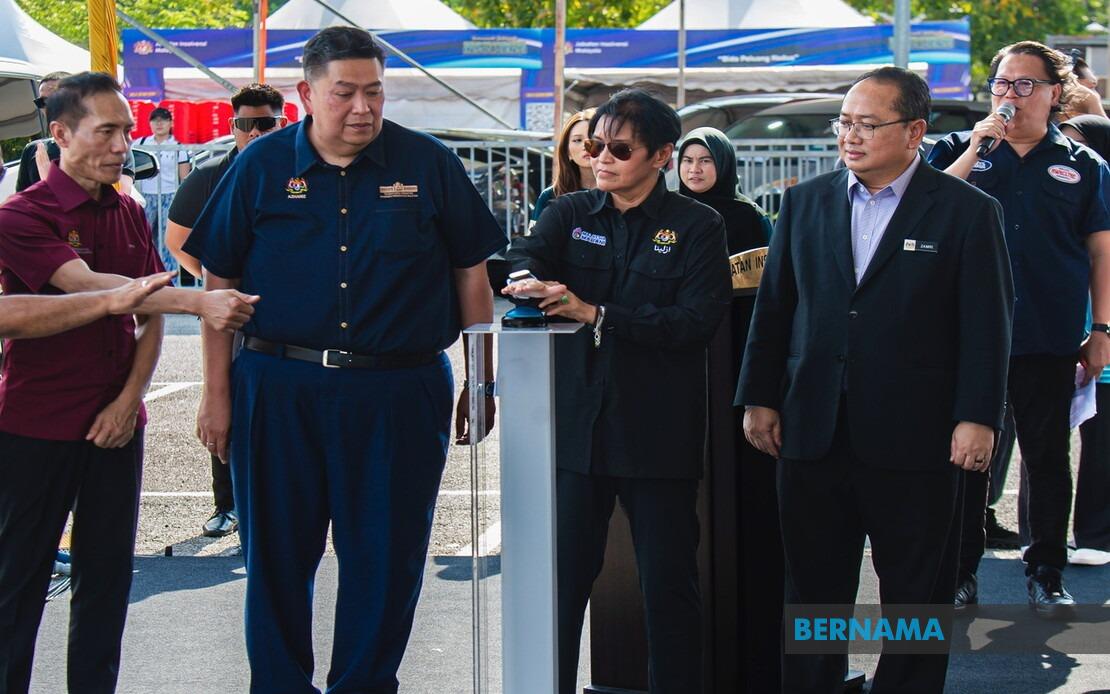
Voters heading to the polls in the Johor state election have been encouraged to prioritise political continuity, with senior UMNO figure Datuk Seri Azalina Othman Said making the pitch that supporting the incumbent Barisan Nasional administration will ensure smooth and uninterrupted public service delivery across the state. Her remarks, made here on June 26, come as the state prepares for what promises to be a significant electoral contest that will reshape the composition of the state legislature.
Azalina, serving as both UMNO's information chief and Minister in the Prime Minister's Department (Law and Institutional Reform), framed the election as fundamentally different from federal contests. She stressed that local governance structures—including village headmen, village development committees, and district-level bodies—function most effectively when there is alignment between local representatives and the state government. This structural argument underpins the BN's campaign positioning, suggesting that divided governance creates friction and delays in implementing development programmes that directly affect ordinary Johoreans.
While acknowledging that all registered political parties possess the constitutional prerogative to contest and field candidates, Azalina appealed to voters to exercise their electoral choice with administrative efficiency as a guiding principle. Her framing represents a deliberate strategy to recast the election debate away from ideological or performance-based critiques and toward the pragmatic theme of governance continuity. This approach suggests BN strategists believe they are vulnerable on other fronts and hope to emphasise stability rather than specific policy achievements or future promises.
The BN's continuity argument carries particular weight in a state where the party has held governmental control, enabling it to highlight infrastructure projects, development initiatives, and service delivery mechanisms that voters have experienced under its administration. However, this logic also implicitly concedes that opposition parties might offer competitive alternatives, necessitating an argument that institutional inertia and administrative paralysis would result from political change.
The electoral timeline has now been firmly established following the dissolution of the Johor State Legislative Assembly on June 1. The Election Commission has set June 27 as nomination day, with early voting scheduled for July 7 and general polling day fixed for July 11. This compressed schedule gives candidates and parties limited time to campaign and persuade voters, potentially advantaging the incumbent administration with its established machinery and resources.
For Malaysian political observers, particularly those tracking Johor's trajectory as a bellwether for broader national trends, this election carries significance beyond state boundaries. Johor has historically been a BN stronghold, yet opposition sentiment has grown in recent years, reflecting broader shifts in peninsular Malaysian politics. A strong BN performance could signal resilience and renewed voter confidence, while setbacks would suggest continued erosion of traditional support bases even in historically reliable territories.
The administrative continuity argument, while pragmatic, reflects a fundamental assumption about voter priorities that may not align with emerging political consciousness. Younger voters and urban constituencies increasingly prioritise accountability, transparency, and performance metrics over institutional stability. Opposition parties are likely to counter that fresh leadership and new perspectives are precisely what ensure responsive governance, framing BN's continuity appeal as conservative and status-quo oriented.
For residents of Johor, the substantive question beneath this rhetorical framing concerns which administration can better address state-specific challenges: infrastructure congestion in urban areas, rural service gaps, economic diversification beyond petrochemicals and agriculture, and environmental concerns including air quality and water management. Neither BN nor opposition parties have yet presented comprehensive policy platforms addressing these issues with sufficient detail to guide voter decision-making beyond partisan loyalty.
Azalina's intervention reflects broader UMNO strategy to reclaim narrative control in a political environment where the party faces generational change and ideological challenges. By emphasising administrative pragmatism rather than party performance, UMNO implicitly acknowledges that voters may harbour reservations about current governance but hopes to convince them that the risks of political change outweigh potential benefits. Whether this argument resonates with Johor's electorate will become apparent on July 11, with implications extending well beyond the state's borders.

