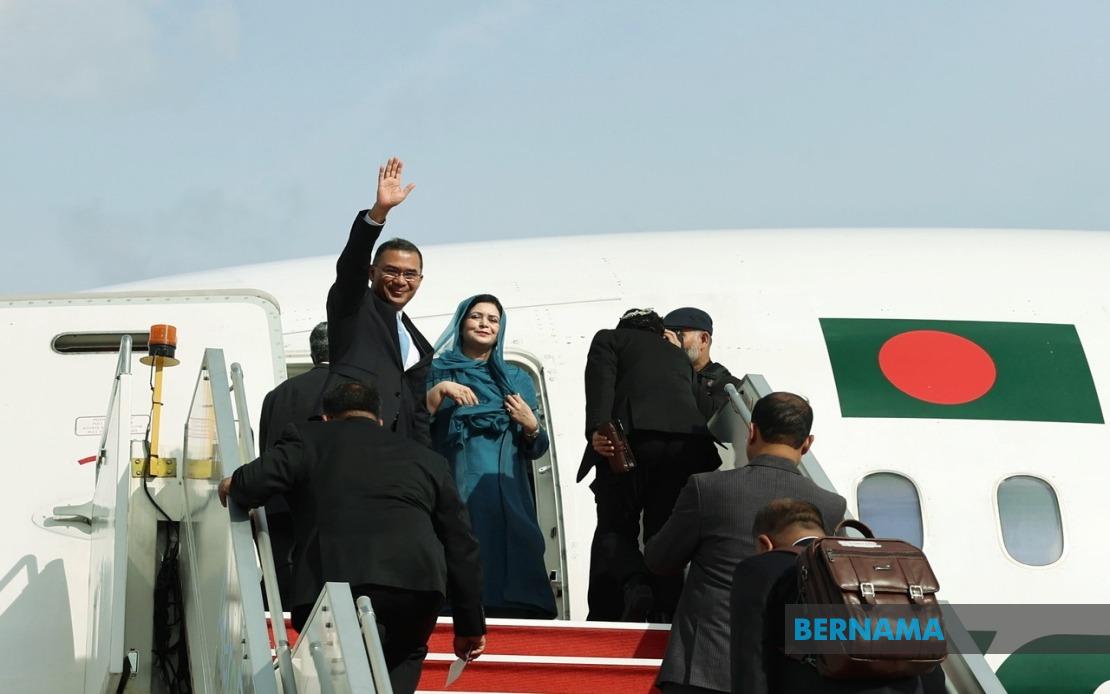
Bangladesh Prime Minister Tarique Rahman departed Malaysia on June 22 from Kuala Lumpur International Airport after completing a two-day official visit, continuing onward to China. The departure was marked by a formal ceremonial send-off that included a guard of honour comprising 28 officers and personnel from the First Battalion of the Royal Ranger Regiment. Minister in the Prime Minister's Department (Religious Affairs) Dr Zulkifli Hasan attended the farewell, bidding goodbye to Tarique, his spouse Dr Zubaida Rahman, and members of the Bangladeshi delegation as their aircraft lifted off from the Bunga Raya Complex at 5 pm.
The visit represents Tarique's maiden bilateral journey since assuming office in February 2026, underscoring Bangladesh's strategic focus on deepening ties with Malaysia as a key Southeast Asian partner. His selection of Malaysia as his first official destination abroad signals the importance both nations place on their growing relationship and positions the visit as particularly significant for regional diplomatic circles.
During the visit, Tarique and Prime Minister Datuk Seri Anwar Ibrahim held substantive bilateral discussions at Perdana Putra Complex, where they examined pressing regional and international matters requiring coordinated responses. The two leaders specifically targeted opportunities to expand cooperation across multiple economic and developmental sectors. Their agenda encompassed trade expansion and foreign direct investment channels, workforce development initiatives, semiconductor manufacturing capabilities, energy security arrangements, agricultural collaboration, and educational exchanges. This broad sectoral approach reflects both nations' understanding that contemporary partnership transcends traditional bilateral trade alone.
The visit yielded tangible institutional outcomes that will guide future cooperation. Tarique and Anwar jointly witnessed the exchange of a Memorandum of Understanding covering Cultural Cooperation, establishing frameworks for artistic, educational, and people-to-people exchanges. Additionally, two Exchanges of Notes were signed addressing Counter-Terrorism Research and Investment Promotion and Facilitation, areas of critical importance to both nations navigating contemporary security challenges and seeking to attract sustainable capital flows.
Economic integration emerged as a cornerstone of bilateral discussions, with both leaders committing to accelerate negotiations toward a comprehensive free trade agreement on an expedited timeline. This commitment demonstrates recognition that traditional tariff-based arrangements require modernisation to unlock fuller trading potential. Beyond conventional goods trade, the leaders highlighted priority growth sectors including energy infrastructure, where Bangladesh seeks technological partnerships and capital investment, and the rapidly expanding halal industry, where Malaysia's established expertise and certification systems offer valuable collaboration opportunities.
Bangladesh's stated ambition to achieve ASEAN Sectoral Dialogue Partner status received explicit support during the visit, with Malaysia affirming its backing for this objective. This endorsement carries weight given Malaysia's standing within the regional bloc. Tarique also expressed Bangladesh's interest in joining the Regional Comprehensive Economic Partnership (RCEP), Asia-Pacific's largest trading mechanism encompassing China, Japan, South Korea, and the 10 ASEAN members. Malaysian support for RCEP membership would facilitate Bangladesh's deeper integration into Asian economic structures and provides tangible pathways for incremental trade liberalisation.
The bilateral dialogue extended beyond commerce into complex geopolitical terrain where both nations discovered substantial alignment. On Palestinian matters, both leaders expressed unified commitment to the cause, reflecting shared values and domestic constituencies concerned with Middle Eastern affairs. They jointly articulated concern regarding humanitarian conditions in Gaza and advocated for diplomatic pathways toward sustainable peace frameworks addressing Gulf region tensions and Iranian regional positioning. These positions indicate coordinated approaches within broader Organisation of Islamic Cooperation frameworks and demonstrate how bilateral relationships increasingly encompass global issue-positioning.
The Rohingya refugee crisis, a particularly acute challenge for both nations, featured prominently in discussions. Malaysia currently hosts over 180,000 registered Rohingya refugees, straining services and social cohesion, while Bangladesh accommodates approximately 900,000 in sprawling camps. The leaders agreed to strengthen collaborative efforts leveraging ASEAN institutional mechanisms to develop lasting solutions, explicitly including engagement with Myanmar authorities. This approach acknowledges that Myanmar's role remains central to any credible resolution and signals willingness to utilise ASEAN's diplomatic channels despite Myanmar's complicated standing within the bloc.
Bilateral trade statistics underscore the relationship's economic significance and growth potential. During 2025, Malaysia and Bangladesh exchanged RM12.18 billion (US$2.84 billion) in total trade value, positioning Bangladesh as Malaysia's 28th-largest trading partner globally and second-largest partner within South Asia after India. Malaysian exports to Bangladesh reached RM10.08 billion (US$2.35 billion), dominated by petroleum products reflecting Bangladesh's energy import requirements for industrial expansion and power generation. Conversely, imports from Bangladesh totalled RM2.10 billion (US$500 million), primarily comprising textiles, apparel, and footwear, sectors where Bangladesh maintains competitive manufacturing advantages.
This trade composition reflects complementary economic structures where Malaysia supplies energy and technology-intensive products while Bangladesh provides labour-intensive manufactured goods, suggesting natural expansion opportunities. As Bangladesh's middle class expands and per capita incomes rise, demand for Malaysian petrochemicals, machinery, and value-added services should increase proportionally. Similarly, Malaysia's investment in Bangladesh's textile and light manufacturing sectors could deepen value-chain integration while supporting employment in both economies.
Tarique's brief Malaysian sojourn preceding his China visit reflects strategic sequencing in Bangladesh's regional diplomacy. Visiting Malaysia first establishes Southeast Asian engagement before proceeding to China, emphasizing that Bangladesh views both as essential partners requiring differentiated but comprehensive relationship management. For Malaysia, hosting the Bangladesh PM's inaugural bilateral visit abroad signals regional influence and underscores the country's importance within South Asian diplomatic calculations.
The visit occurs within context of broader Bangladesh political transitions and Malaysia's evolving regional positioning following its economic and political adjustments. Both nations face overlapping challenges including managing labour migration flows, competing for semiconductor and renewable energy investments, and navigating geopolitical tensions between major powers. The substantive nature of agreements reached suggests both governments view partnership as offering practical benefits rather than symbolic gestures, with potential to expand across multiple dimensions as relationship maturity deepens and institutional mechanisms strengthen.

