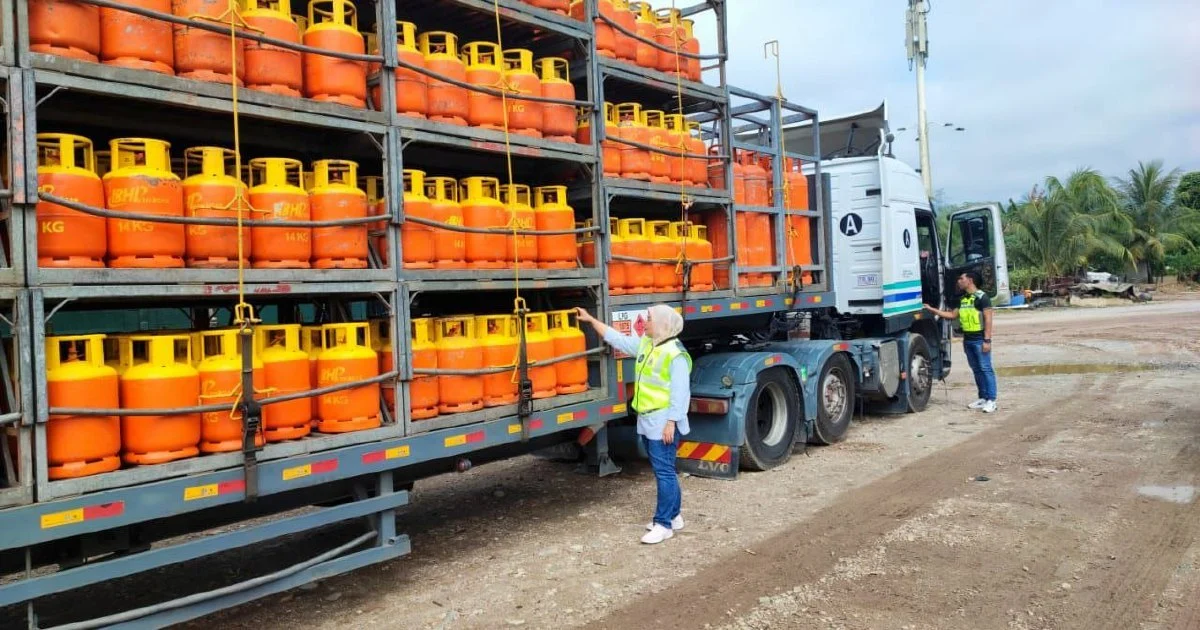
Enforcement authorities in Bentong conducted a raid on a fenced storage facility that culminated in the seizure of liquefied petroleum gas cylinders with an estimated market value of RM405,000. The cylinders were discovered housed on a trailer within the secured compound, suggesting an operation involving systematic accumulation and likely distribution of the fuel supplies. The discovery has raised significant questions about the regulatory oversight of gas storage facilities in the state and the mechanisms through which such substantial quantities can be accumulated without triggering alarms.
The operation represents a substantial haul by enforcement standards, pointing to what investigators believe may be part of a larger network involved in the unregulated trade of LPG products. The deliberate choice to store the cylinders within a fenced perimeter suggests an attempt to obscure the operation from casual observation, though the measure ultimately proved insufficient to evade regulatory scrutiny. For Malaysian consumers reliant on LPG for domestic and commercial purposes, such discoveries underscore the risks associated with informal supply chains that circumvent official distribution networks and safety protocols.
Liquefied petroleum gas remains a critical commodity across Malaysia, serving millions of households and businesses for cooking, heating, and various industrial applications. The legitimate market operates under strict regulatory frameworks administered by government agencies responsible for ensuring product quality, safe storage standards, and equitable pricing. When significant quantities bypass these channels, they not only represent potential revenue losses to the formal sector but also pose genuine safety hazards, as unregulated cylinders may lack proper maintenance, inspection, and certification procedures essential for accident prevention.
The Bentong facility's fenced design indicates deliberate precautions against discovery, yet the storage method on a trailer suggests mobility and potential distribution plans. Such arrangements typically function within shadow economies where suppliers avoid taxation, regulatory compliance costs, and official licensing requirements, allowing them to undercut authorized dealers. For consumers, however, the appeal of cheaper supplies masks serious risks including the possibility of substandard materials, improper cylinder certification, and inadequate safety protocols that could lead to leaks, explosions, or other hazardous incidents.
Enforcement agencies across Malaysia have intensified operations targeting illegal LPG operations in recent years, recognizing both the public safety implications and the revenue losses sustained through unregulated markets. Bentong's geographic position in Pahang places it within a region traversed by supply routes connecting major population centres, making it a logical location for intermediary storage facilities. The discovery in this particular municipality reflects broader patterns of enforcement attention throughout Peninsular Malaysia, where such operations have become increasingly sophisticated in their attempts to evade detection.
The investigation surrounding this seizure likely extends beyond the immediate facility to identify upstream suppliers, downstream distributors, and the customer networks serviced by this operation. Authorities typically pursue such inquiries to dismantle entire chains rather than simply removing inventory from circulation. The scale of the seizure suggests this was no minor illicit operation but rather an established concern with meaningful distribution reach, raising questions about how long the facility remained undetected and how many similar operations may continue elsewhere.
For Malaysian policymakers and regulatory bodies, incidents of this magnitude illuminate persistent challenges in controlling unregulated fuel distribution. The LPG market's structure—involving numerous retail points, diverse customer types, and relatively accessible product—creates enforcement difficulties that dedicated resources and intelligence alone cannot fully resolve. Addressing the root causes requires examining pricing policies, licensing barriers, and supply chain efficiencies that might reduce the economic incentive for informal operations while maintaining fair competition among authorized dealers.
The case demonstrates that enforcement tools, while necessary, function most effectively as components of comprehensive regulatory strategies rather than standalone solutions. When combined with enhanced monitoring systems, stricter cylinder registration protocols, and consumer education initiatives promoting awareness of safety risks, enforcement operations create meaningful pressure on illegal operators. The Bentong discovery thus serves not merely as a snapshot of regulatory action but as evidence of ongoing tension between formal and informal market structures in Malaysia's essential fuel sectors.
Regional implications extend to neighbouring Selangor, Terengganu, and other states where similar networks may operate with varying degrees of detection. The discovery prompts reflection on the adequacy of inter-agency coordination in identifying and pursuing cases spanning multiple jurisdictions, as illegal supply chains frequently operate across administrative boundaries to complicate investigation efforts. For Southeast Asian energy security more broadly, unauthorized distribution channels in any major economy create vulnerabilities that potentially ripple through regional supply stability concerns.
The RM405,000 seizure underscores that illegal LPG trading remains financially attractive enough to sustain organized operations despite regulatory risks. As Malaysia continues developing its energy security frameworks and pursuing cleaner fuel transitions, tightening control over existing commodity chains—including LPG—remains strategically important. The incident invites deeper scrutiny into why formal distribution channels may be losing market share to informal alternatives, whether through pricing pressures, access limitations, or other systemic factors that policymakers might address through structural reforms rather than enforcement alone.