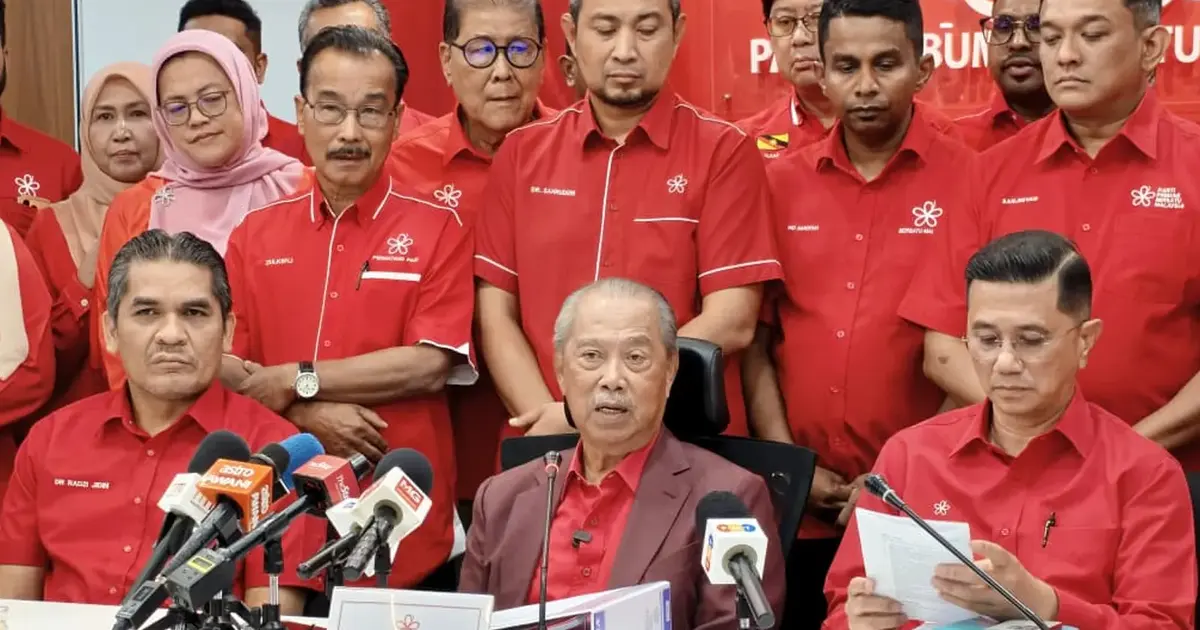
Bersatu will maintain its membership in the Perikatan Nasional coalition, according to party president Muhyiddin Yassin, who has anchored this strategic choice in the receptiveness of ordinary Malaysians to the broader alliance. The declaration underscores the continuing importance of Perikatan Nasional as a counterweight to the federal government, even as various Malaysian political formations navigate shifting parliamentary dynamics and electoral prospects.
Muhyiddin's statement carries particular significance given Malaysia's fluid political landscape in recent years, where coalition alignments have proven volatile and party movements have frequently reshuffled parliamentary arithmetic. Bersatu itself has been central to several of these pivots, having emerged from within UMNO before transitioning through various partnerships. The party's reaffirmation of commitment to Perikatan Nasional therefore signals an intention to establish firmer footing within a defined opposition bloc, rather than maintaining the ambiguous positioning that characterized earlier phases of its political trajectory.
The Perikatan Nasional alliance currently encompasses several component parties beyond Bersatu, including PAS, which collectively command substantial parliamentary representation. This coalition has positioned itself as an alternative government-in-waiting, articulating distinct policy positions on economic management, religious affairs, and constitutional matters. Bersatu's continuation within this framework means the party remains aligned with PAS's approach on critical national questions, potentially constraining but also defining its future negotiating leverage.
Muhyiddin's assertion that public acceptance anchors this decision reflects a broader political calculation about electoral viability. Coalition stability matters significantly in Malaysian politics, where no single party has commanded an outright parliamentary majority in over a decade. Voters, particularly those dissatisfied with the ruling administration, are said to respond more positively to coherent, unified opposition platforms than to fractious, perpetually-realigning alternatives. By framing Bersatu's choice as rooted in popular sentiment, Muhyiddin is attempting to position the party as responsive to grassroots preferences rather than driven by factional leadership rivalries.
For the regional perspective, Bersatu's positioning holds implications beyond Malaysia's immediate political theater. The party's trajectory has long interested observers across Southeast Asia because it represents one model of intra-elite competition within a mature democratic system. How Bersatu navigates coalition politics—whether through principled alignment or opportunistic maneuver—influences perceptions of Malaysian institutional stability among neighboring governments and international observers assessing democratic health in the region.
The public acceptance that Muhyiddin references has concrete manifestations in survey data, grassroots engagement metrics, and electoral performance in local contests. Whether this acceptance reflects genuine ideological alignment with Perikatan Nasional's policy prescriptions or primarily represents rejection of the incumbent government remains analytically important. Malaysian voters have demonstrated willingness to shift coalitional preferences when circumstances warrant, as demonstrated by previous electoral cycles. Bersatu's reading of current public sentiment therefore operates against a backdrop of demonstrated volatility.
Within Perikatan Nasional itself, Bersatu occupies a particular position relative to PAS, the coalition's largest component. The two parties have collaborated extensively at state level, jointly administering several northern and southern states where they command majorities. These working relationships, forged through practical governance challenges, have created institutional dependencies that extend beyond simple electoral convenience. Bersatu's decision to remain in Perikatan Nasional therefore reflects not merely national-level strategic calculation but accumulated commitments at subnational tiers.
The timing of Muhyiddin's reaffirmation may respond to various speculative reports about potential Bersatu repositioning or negotiations with other political formations. Malaysian political commentary frequently entertains scenarios involving party realignment, particularly as parliamentary terms progress and electoral horizons approach. By explicitly restating commitment to Perikatan Nasional, Muhyiddin foreclosed certain interpretive possibilities and signaled to coalition partners, particularly PAS, that Bersatu leadership regards the alliance as durable.
From a Malaysian political economy perspective, Bersatu's coalition choice influences government formation scenarios and thus shapes business community expectations about policy continuity. Investors and corporate interests monitor coalition stability carefully, recognizing that different governmental combinations bring distinct regulatory and economic philosophies. Bersatu's remaining in Perikatan Nasional therefore carries implications for how various economic constituencies calculate their engagement strategies across political actors.
The opposition coalition's coherence remains tested by various pressures. Federal resources flow to the ruling government, allowing it to implement popular programs that can shift electoral momentum. Regional differentiation means that winning peninsular urban areas differs strategically from securing rural support or leveraging advantages in particular states. Bersatu's membership in Perikatan Nasional provides a framework for negotiating these variations, though tensions occasionally surface over seat allocations and policy priorities in different contexts.
Muhyiddin's invocation of public acceptance as legitimating Bersatu's coalition choice reflects broader Malaysian political discourse emphasizing responsiveness to rakyat preferences. This framing matters because it positions party leadership as implementing popular mandates rather than merely pursuing factional advantage. Whether voters genuinely perceive the party as responsive depends partly on how effectively Bersatu translates Perikatan Nasional's coalition position into tangible benefits or policy achievements that resonate with constituents.
Looking forward, Bersatu's commitment likely persists through the next electoral cycle, barring dramatic political ruptures. However, Malaysian political history suggests that coalition durability proves contingent on continuous demonstration of electoral viability and policy coherence. Bersatu's position within Perikatan Nasional will continue requiring active management, coalition maintenance work, and periodic reaffirmation of shared purpose among constituent parties navigating competitive pressure from the ruling government and potential recruitment overtures from various political entrepreneurs.

