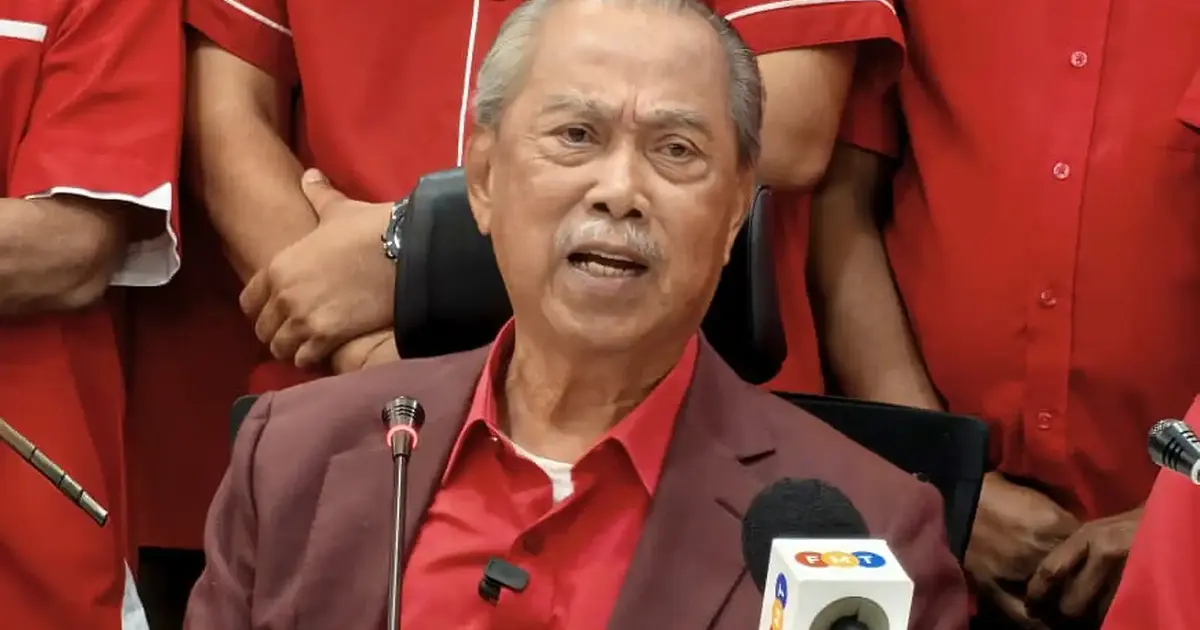
Muhyiddin Yassin has made clear that Bersatu will not shy away from direct confrontation with PAS as the two major Islamic-leaning parties navigate an increasingly fractious political landscape. Speaking to his party faithful, the former prime minister articulated a combative stance, indicating readiness to engage his rival across multiple dimensions rather than adopt a posture of coexistence or power-sharing compromise.
The declaration reflects deepening tensions within what was once envisioned as a unified Islamist political force. Bersatu and PAS have diverged significantly since their collaboration in the 2018 general election, when they jointly mobilized anti-establishment sentiment. Today, the two parties represent competing visions of Islamic governance, organisational strength, and political ambition. Muhyiddin's combative language signals that Bersatu leadership views PAS not merely as an ideological rival but as a direct threat to its electoral viability and political relevance in Malaysia's increasingly segmented political marketplace.
The timing of Muhyiddin's remarks carries particular weight given the scheduled state elections. Johor and Negeri Sembilan represent strategic battlegrounds where both parties have demonstrated electoral influence. In these contests, Bersatu's decision to field candidates under the Perikatan Nasional banner rather than as independents or within a broader coalition framework represents a calculated assertion of organisational independence. This approach allows the party to maintain distinct branding and control over candidate selection while benefiting from Perikatan Nasional's coalition infrastructure.
Perikatan Nasional itself has evolved considerably since its formation. Originally anchored by Bersatu, UMNO, and PAS, the coalition fractures when individual components prioritize factional interests over collective goals. Muhyiddin's commitment to contest under the PN banner suggests a desire to preserve the coalition's nominal unity while simultaneously preparing for internal competition. This apparent contradiction reflects the complex calculus facing Malaysian political coalitions, where maintaining a united front for general elections can coexist with regional campaigns where individual partners compete vigorously.
The prospect of Bersatu-PAS conflict in Johor carries particular historical significance. Johor remains economically vital and demographically significant, commanding substantial parliamentary representation. PAS has made considerable inroads in rural constituencies throughout the state, while Bersatu retains support among certain demographics and localized power bases. A two-front competition between these parties could reshape the state's political dynamics, potentially fragmenting the anti-DAP vote that has historically benefited Islamic-oriented parties collectively.
Negeri Sembilan presents a different competitive environment. The state has traditionally leaned towards UMNO and BN, though recent years have witnessed PAS gaining ground in specific constituencies. Bersatu's intervention here, particularly through Perikatan Nasional, introduces additional complexity to state-level power calculations. The state government's composition and the distribution of ministerial positions between competing parties will likely emerge as contentious issues, especially if electoral results produce fragmented support across multiple Islamic-leaning formations.
Muhyiddin's pugilistic posture suggests Bersatu leadership believes competitive confrontation serves the party's long-term interests better than accommodation strategies. This calculation rests on several assumptions: that Bersatu possesses sufficient organizational capacity and popular appeal to gain ground against PAS; that regional electoral success will enhance the party's standing for future national contests; and that demonstrating independence and combative spirit will appeal to party members and supporters who might otherwise drift toward larger, more established organizations.
However, sustained inter-coalition warfare carries risks for both parties and for Perikatan Nasional's broader political viability. Excessive internecine conflict could fragment the anti-DAP vote in crucial constituencies, inadvertently benefiting opposition parties that neither Bersatu nor PAS considers aligned with their ideological orientation. The Malaysian electoral system, with its winner-take-all approach to parliamentary seats, punishes vote-splitting particularly severely. In tight three-way or four-way contests typical of contemporary Malaysian politics, aggressive Bersatu-PAS competition could produce outcomes neither party anticipates or desires.
The declaration also reflects broader patterns within Islamic-leaning Malaysian politics, where organisational jealousy and leadership rivalries frequently override programmatic coherence. Muhyiddin and PAS leadership represent distinct political generations and organizational traditions. Where older UMNO-aligned Islamic politics emphasized patronage networks and corporatist arrangements, both Bersatu and PAS aspire toward grassroots mobilization and ideological differentiation. Yet these parties compete for substantially overlapping constituencies, creating inevitable friction regarding representation, symbolic authority, and control over Islamic political discourse.
For Malaysian voters, Muhyiddin's confrontational positioning carries practical implications. The coming Johor and Negeri Sembilan elections will effectively function as trial contests for national political repositioning. Bersatu's performance will substantially influence calculations regarding Perikatan Nasional's national electoral viability. Poor results could accelerate internal party discussions regarding coalition arrangements or even party mergers; strong results would validate Muhyiddin's combative strategy and potentially embolden more aggressive Bersatu positioning in future contests.
The broader political context matters considerably. With Malaysia's next general election not constitutionally required until 2027, state-level contests provide valuable data regarding shifting voter preferences and evolving coalition dynamics. Bersatu's willingness to confront PAS directly signals that the party leadership remains committed to establishing Bersatu as a distinct political force rather than accepting subordinate status within larger coalitions. Whether this strategy generates electoral success or merely fragments the Islamic-leaning vote remains an open question that the coming state polls will partially illuminate.

