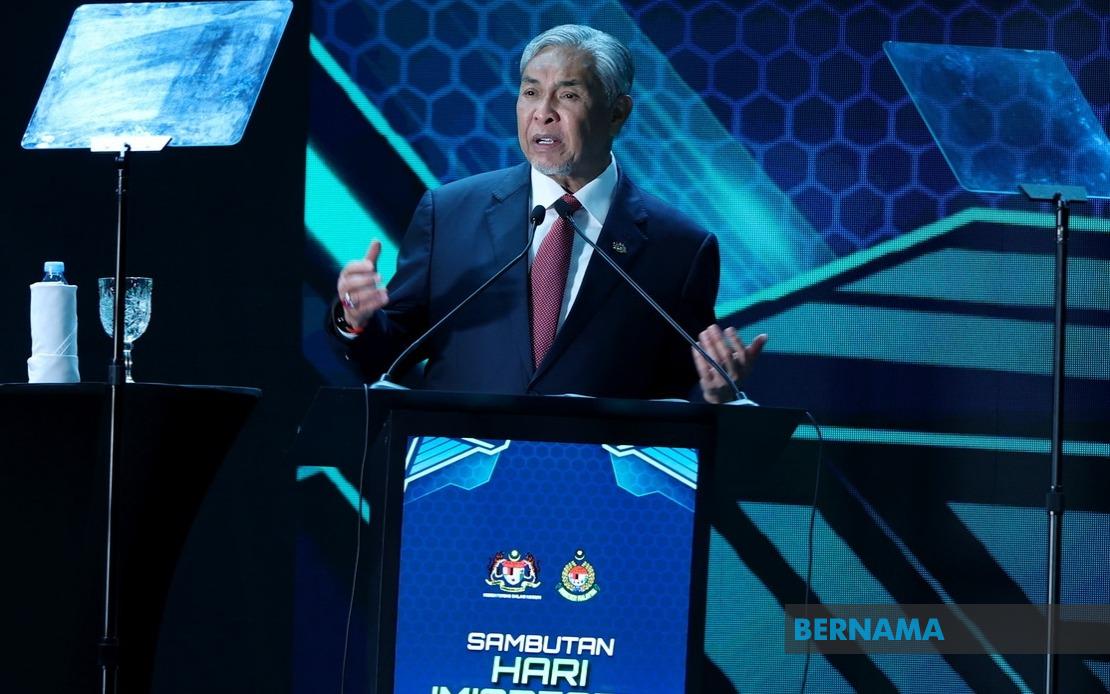
Barisan Nasional has reaffirmed its commitment to remaining within the Unity Government framework, with party chairman Datuk Seri Dr Ahmad Zahid Hamidi emphasising that the coalition's stance reflects resolutions adopted at UMNO's most recent General Assembly. Speaking in Cyberjaya on July 21, the UMNO president and Deputy Prime Minister stressed the binding nature of decisions taken at the party's highest deliberative body, signalling that the BN's participation in the multiparty government is not subject to ongoing negotiation or reversal.
Ahmad Zahid's remarks come at a time when coalition dynamics remain under scrutiny, particularly as state-level electoral activity intensifies across the country. By anchoring the BN's commitment to a formal party resolution rather than ad hoc political positioning, the leadership is attempting to project stability within an alliance that has historically been prone to internal friction and shifting alliances. The invocation of the General Assembly's authority serves to elevate the decision beyond mere ministerial preference, presenting it as the considered judgment of UMNO's broader membership.
The timing of these remarks reflects wider tensions within Malaysia's political landscape. The Prime Minister, Datuk Seri Anwar Ibrahim, has recently issued warnings to government office-holders against using their official positions to attack or undermine other coalition partners during state election campaigns. This directive addresses a persistent problem in Malaysia's multiparty governments: the tendency for coalition members to compete fiercely at the state level while ostensibly maintaining unity at the federal level. Such contradictions have repeatedly strained previous governing coalitions and threaten the credibility of joint policy initiatives.
Ahmad Zahid's acknowledgement of the Prime Minister's prerogative over cabinet appointments and removals represents an important clarification of power distribution within the current government structure. By explicitly stating that Anwar Ibrahim retains absolute authority over ministerial composition, the Deputy Prime Minister has attempted to pre-empt speculation about potential conflicts between UMNO and the Prime Minister's office. This deference also implicitly accepts that any minister found to have breached the Prime Minister's directive on campaign conduct would face consequences determined unilaterally by Anwar, without requiring UMNO's consent.
For Malaysian political observers, this exchange reveals the delicate balancing act that coalition governance demands. The BN remains the largest bloc within the Unity Government, and its cooperation is essential for maintaining the government's parliamentary majority. However, Ahmad Zahid's careful language suggests underlying awareness that the coalition's partnership is contingent rather than organic. By repeatedly framing BN's participation as a principled decision rooted in party assembly deliberations, rather than as a pragmatic arrangement, the leadership seeks to reinforce the legitimacy of continued alignment with Anwar's administration.
The focus on cabinet disciplinary powers carries particular significance for Southeast Asia's largest Muslim-majority democracy. Previous Malaysian governments have frequently experienced ministerial defections or public disagreements between coalition partners over policy matters. By establishing and reinforcing clear consequences for breaching coalition discipline, the current administration is attempting to construct stronger institutional guardrails against the fragmentation that has plagued earlier multiparty arrangements. This approach reflects lessons learned from the 2018-2020 Pakatan Harapan government, which collapsed partly due to insufficient coordination mechanisms among its diverse constituent parties.
Regional implications merit consideration as well. Malaysia's political stability directly affects investor confidence, economic performance, and the country's standing in Southeast Asian affairs. Coalition governments that appear fragile or prone to internal conflict can impede policy implementation and create uncertainty around long-term commitments. By presenting the Unity Government as a stable arrangement anchored in formal party resolutions and clear lines of authority, Ahmad Zahid and Anwar Ibrahim are collectively attempting to project an image of competent, coordinated governance to both domestic and international audiences.
The statement also reflects changing dynamics within UMNO itself. The party has undergone significant internal restructuring and leadership renewal in recent years, and Ahmad Zahid's tenure as president has involved efforts to consolidate control and align the party's direction with national coalition objectives. By frequently referencing the General Assembly's collective wisdom, he strengthens his own leadership position by presenting decisions as party-wide consensus rather than top-down directives.
Looking ahead, the sustainability of this arrangement will depend on whether state-level electoral competition can be adequately managed without spilling over into federal government dysfunction. Both the BN and other coalition partners face incentives to mobilise their supporters aggressively during state campaigns, yet such mobilisation often requires contrasting themselves against rival coalitions—including other federal government members. Ahmad Zahid's emphasis on General Assembly backing suggests UMNO hopes to manage this tension through top-level coordination and ministerial discipline, though the historical record suggests such arrangements require constant reinforcement and remain vulnerable to emerging pressures.

