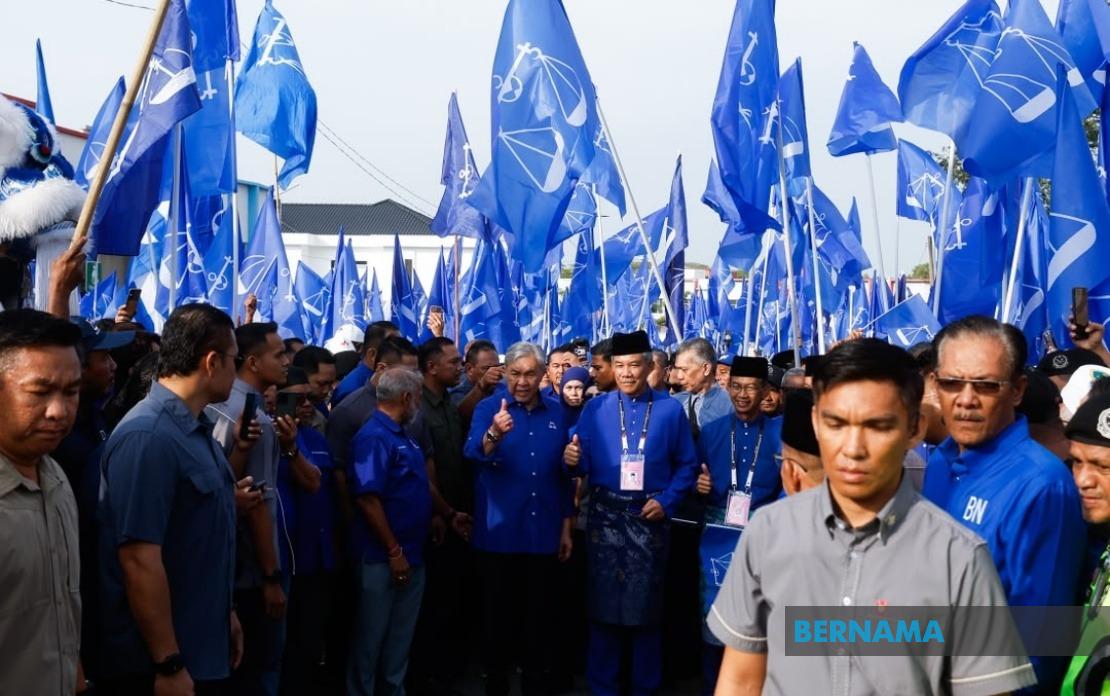
The Negeri Sembilan state election campaign shifted into formal mode on July 18 as Barisan Nasional's most senior figures fanned out across the state to accompany candidates through nomination centres, a symbolic show of party cohesion and electoral confidence. Datuk Seri Dr Ahmad Zahid Hamidi, BN chairman and UMNO president, arrived at the Dewan Seri Rembau nomination centre at 8.40 am alongside his deputy Datuk Seri Mohamad Hasan, who submitted papers to defend the Rantau state seat he has represented since 2004. The calculated visibility of top-tier leadership throughout the day underscored BN's determination to maintain dominance in a state where it has governed continuously for decades, though recent electoral patterns across Malaysia have demonstrated that incumbency alone provides no guarantee of victory.
The nomination process unfolded simultaneously across all eight designated centres throughout Negeri Sembilan, with the windows opening at 9 am and closing precisely at 10 am—a compressed timeframe that condensed weeks of formal campaigning into a single concentrated morning. This efficiency reflected the Election Commission's streamlined procedures for state contests, though the brevity also meant that candidates and parties had to ensure all documentation and preparations were flawless before the appointed hour. The presence of senior BN figures at multiple locations demonstrated the coalition's organisational reach, yet it also hinted at the competitive pressure the party faces in retaining its traditional base amid shifting political dynamics across the nation.
Beyond Ahmad Zahid's high-profile appearance in Rembau, BN's machinery operated at full capacity across the state. In Port Dickson, party secretary-general Datuk Seri Dr Zambry Abd Kadir shepherded Datuk Mohd Faizal Ramli through the nomination process for the Linggi seat, while UMNO vice-president Datuk Seri Johari Ghani accompanied Suhaimizan Bizar in Gemencheh, located within the Tampin parliamentary constituency. Simultaneously, UMNO secretary-general Datuk Dr Asyraf Wajdi Dusuki oversaw the nominations of three candidates—Datuk Mustapha Nagoor, Datuk Mohd Zaidy Abdul Kadir, and Chong Fui Ming—contesting Palong, Jeram Padang, and Bahau seats respectively within Jempol parliamentary constituency. This orchestrated deployment of ministerial and party apparatus reflected BN's well-honed campaign machinery, though observers noted that such prominence of national figures can occasionally overshadow local candidates and their community connections.
The coalition's partners in the BN framework also activated their support structures during the nomination day. PAS president Tan Sri Abdul Hadi Awang accompanied Mohd Fairuz Mohd Isa, the party's nominee for the Serting state seat, demonstrating the ongoing alignment between the Islamist party and UMNO-led BN in Negeri Sembilan despite tensions elsewhere in the country. Parti Orang Asli Malaysia (ASLI), a smaller coalition component representing indigenous community interests, fielded Dayana Dal as its candidate in Jeram Padang within Jempol. The participation of PAS and ASLI alongside BN's dominant contingent illustrated how the coalition has traditionally maintained a broader electoral footprint by incorporating diverse party brands, though questions persist about whether this multi-party framework dilutes messaging or strengthens the coalition's appeal across different demographic segments.
The Electoral Commission's meticulously planned timeline emphasised the compressed nature of this state contest. Polling day was set for August 1, providing the electorate with roughly two weeks between nomination closure and casting ballots—a notably condensed campaign period by Malaysian standards. Early voting had been scheduled for July 28, accommodating voters unable to cast ballots on the main election day, though participation in early voting tends to skew toward security personnel and civil servants. The Negeri Sembilan State Legislative Assembly itself had been formally dissolved on June 5 following the Yang Dipertuan Besar's consent, formally triggering the electoral process months earlier. This succession of dates meant that candidates had limited time to build momentum through traditional campaigning methods, forcing a reliance on pre-existing party structures and voter familiarity with incumbent representatives.
The 16th Negeri Sembilan state election carried implications extending well beyond the state itself. As Malaysia's political landscape continued to fragment following the 2022 general election, state contests provided crucial testing grounds for shifting coalition dynamics and voter sentiment. BN's decision to project unified leadership during the nomination process reflected party strategists' assessment that strength and organisation remained powerful electoral assets in Negeri Sembilan, where the coalition had traditionally performed strongly in rural and semi-rural constituencies. Conversely, the relatively modest public profile of opposition coalition candidates during the same period suggested that Pakatan Harapan and other opposition blocs faced organisational challenges in Negeri Sembilan, though this did not necessarily translate into voter apathy.
For Malaysian political observers, the nomination day demonstrated how state elections continue to function as meaningful contests rather than mere procedural formalities. The presence of the BN chairman, multiple vice-presidents, and various secretary-generals at nomination centres nationwide signalled that party leadership viewed the Negeri Sembilan outcome as symbolically important for maintaining morale within UMNO and broader coalition partners. A loss in Negeri Sembilan would have reverberated through the coalition, potentially emboldening opposition parties and demoralising BN grassroots activists ahead of anticipated federal-level contests. Conversely, a decisive victory would have provided the coalition with renewed momentum and evidence that traditional BN strongholds remained secure despite broader erosion of UMNO's support in urban and younger demographic segments.
The ceremonial aspects of nomination day—the motorcades, the accompanying officials, the photographs of candidates with senior leaders—served purposes beyond electoral theatre. These rituals reinforced hierarchical relationships within the BN coalition, signalling to party members which candidates enjoyed backing from national leadership and which represented continuity of established political networks. For Mohamad Hasan's successful nomination defence in Rantau after two decades of representation, Ahmad Zahid's personal accompaniment underscored the state assembly member's continued importance to UMNO's power structure. Similarly, the presence of multiple national figures at different nomination centres reflected the coalition's effort to energise its base across diverse constituencies and ethnic communities throughout Negeri Sembilan.
The nomination process also illuminated the composition of BN's candidate slate and the coalition's strategic positioning across different state seats. Candidates representing Malay-majority constituencies like Rantau and Serting received backing from UMNO and PAS respectively, consistent with the parties' traditional electoral bases. However, the presence of candidates with surnames suggesting Chinese Malaysian heritage in seats like Jeram Padang and Bahau indicated BN's continued efforts to maintain multiethnic representation and appeal to non-Malay voters, a particularly significant strategy given the community's demonstrated willingness to shift voting patterns in recent electoral cycles. The inclusion of ASLI's Dayana Dal in Jeram Padang further reinforced BN's emphasis on representing the state's diverse population, though electoral success would ultimately depend on whether such formal representation translated into actual policy responsiveness and community trust.
Looking forward, the abbreviated campaign period before August 1 polling meant that voters would make decisions largely based on pre-existing impressions of candidates and parties rather than ground-level persuasion campaigns. BN's leadership activation during nomination day provided important optics for party faithful and sympathetic media outlets, establishing the narrative of a united, confident coalition. Opposition parties would need to utilise the compressed timeline efficiently to challenge incumbent narratives and offer compelling alternatives to established power structures. For Malaysian political analysts, the Negeri Sembilan election would provide valuable data points about voter behaviour in an era of coalition fragmentation and shifting demographic dynamics—insights that would inevitably inform calculations ahead of the next general election.

