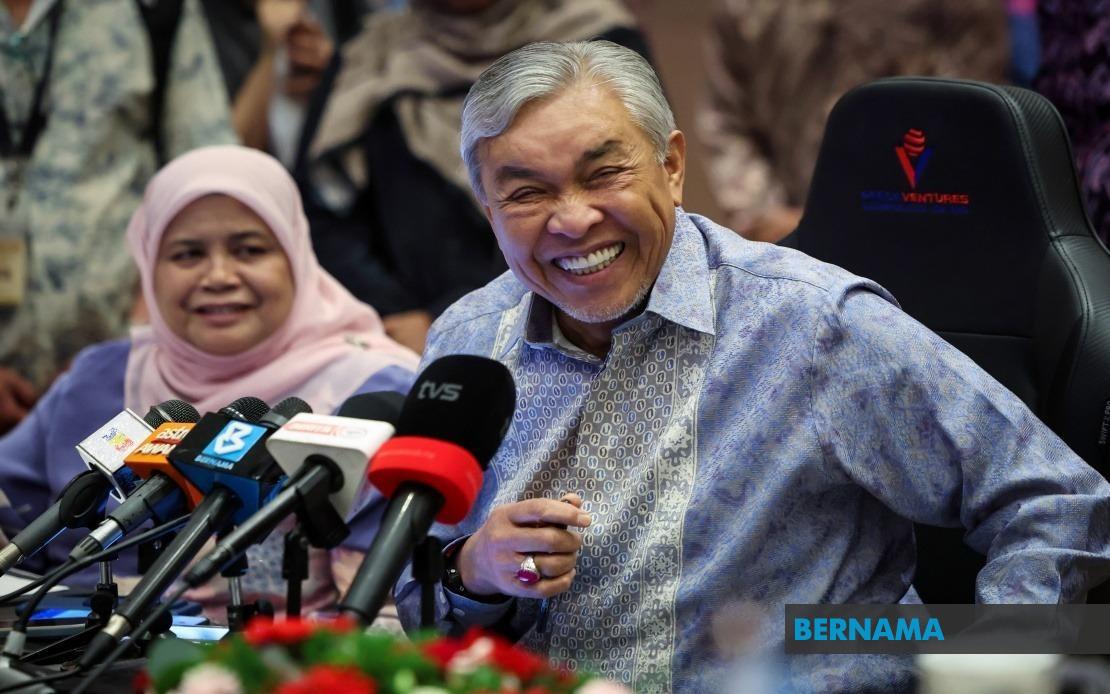
Barisan Nasional has firmly rejected claims that it harbors intentions to undermine the Unity Government led by Prime Minister Datuk Seri Anwar Ibrahim, with Deputy Prime Minister Datuk Seri Dr Ahmad Zahid Hamidi delivering an unequivocal statement of the coalition's political staying power during remarks made in George Town. The assurance comes amid persistent speculation about the stability of Malaysia's governing coalition, which has navigated considerable internal pressures since its formation following the 2022 General Election under royal decree.
Ahmad Zahid, who chairs the Barisan Nasional coalition and leads UMNO as its president, emphasized that the partnership entered into at the Yang di-Pertuan Agong's instruction represents a binding commitment extending until the conclusion of the 15th Parliament's term. This explicit reassurance addresses recurring rumors about potential political realignments, including references to past destabilization attempts such as the "Bangkok Move" of 2020 and the "Dubai Move" of 2015, both of which Ahmad Zahid categorically denied any involvement in. The deputy premier's language was deliberately unambiguous, stating his position as absolute and final, suggesting a desire to eliminate any lingering doubts among party members, coalition partners, or the broader political establishment.
The context for these assurances extends beyond mere political theater. Malaysia's governing coalition operates as a fragile equilibrium between traditionally competing blocs—Barisan Nasional, Pakatan Harapan, and related parties—that historically viewed themselves as adversaries. This unity construct emerged from electoral outcomes that denied any single coalition a commanding parliamentary majority, forcing an unprecedented power-sharing arrangement. For Barisan Nasional, a coalition that governed Malaysia almost uninterrupted for seven decades before its 2018 defeat, participation in a subordinate role within this arrangement represents a strategic recalibration rather than a permanent realignment of Malaysian politics.
Ahmad Zahid's invocation of "political stability" as justification for BN's continued participation deserves examination in the Malaysian context. The country experienced significant economic and social turbulence during the brief tenures of previous prime ministers from 2018 onwards, marked by policy inconsistency, investor uncertainty, and polarized public discourse. The Unity Government, despite its internal contradictions, has provided relative institutional steadiness and allowed the current administration to pursue a coherent economic agenda. For Barisan Nasional, maintaining this arrangement preserves its access to federal resources, state governments, and political influence while allowing it to position itself as the guarantor of stability—a branding exercise with electoral implications for future contests.
However, the deputy premier's remarks also inadvertently illuminate the tensions simmering within this coalition structure. His specific mention of the Klawang constituency dispute during the Negeri Sembilan state election illustrates how the Unity Government framework creates friction at state and local levels, where coalition partners compete directly. The Klawang polling district center suspension in protest against Barisan Nasional's decision not to field a candidate there demonstrates that ground-level party operatives struggle with the contradictions of supporting a national unity arrangement while engaging in conventional electoral competition. Ahmad Zahid's acknowledgment that "the matter is being resolved" suggests active management of such flashpoints, indicating that maintaining coalition unity requires constant negotiation and pressure from the national leadership.
The emergence of discussions around a proposed "Perikatan Barisan Nasional" alliance with Perikatan Nasional introduces another dimension to this political landscape. Ahmad Zahid's characterization of such proposals as merely mentioned in campaign rhetoric rather than formally deliberated suggests either that such conversations genuinely remain preliminary or that public denial serves tactical purposes. From a Malaysian perspective, any formal alignment between these two major blocs would fundamentally reshape the country's political architecture, potentially marginalizing Pakatan Harapan and creating a new governing duopoly. The deputy premier's emphasis on the need for "careful consideration" appears designed to keep this door open while maintaining public commitment to the current arrangement—a balancing act common in Malaysian coalition politics.
The cordial relationship Ahmad Zahid maintains with Prime Minister Anwar Ibrahim despite campaigning on opposite sides in the Negeri Sembilan election exemplifies how Malaysian political culture has evolved to accommodate simultaneous cooperation and competition. The exchange of pantun verses between the two leaders, carrying messages about unity and discipline, represents a sophisticated political communication reflecting Malay cultural traditions while managing substantive policy differences. This capacity to maintain personal warmth while pursuing electoral advantage distinguishes Malaysian politics from more adversarial democratic systems and partially explains how the Unity Government has survived its first phase without collapsing.
For Malaysian business and investor communities, Ahmad Zahid's reaffirmation of coalition stability carries significant implications. Political uncertainty historically correlates with capital flight, delayed investment decisions, and slower economic growth in Malaysia. The deputy premier's definitive statement, whether it fully reflects party sentiment or represents aspirational positioning, contributes to an environment where businesses can plan medium-term strategies without anticipating imminent governmental disruption. This consideration extends to Malaysia's relationships with major trading partners and multilateral institutions, which benefit from predictable governance structures.
The broader regional context also matters for interpreting these statements. Southeast Asia has experienced considerable political volatility in recent years, including military interventions, contested elections, and governmental collapses in several countries. By Malaysian standards, the current administration maintains legitimacy through parliamentary majority and constitutional processes, even if that majority depends on coalition management. Ahmad Zahid's emphasis on adherence to the Yang di-Pertuan Agong's decree appeals to Malaysia's unique constitutional monarchy framework, positioning the coalition's unity as a matter of respect for royal authority rather than mere partisan convenience.
Yet questions remain about the depth and durability of Barisan Nasional's commitment to this arrangement. Historical patterns suggest that Malaysian coalitions under stress tend to experience fragmentation when electoral incentives shift or when significant numbers of party members perceive disadvantage in the partnership. The Negeri Sembilan state election campaign itself provides a test case, with Barisan Nasional competing against both Pakatan Harapan and Perikatan Nasional while nominally allied with the former at the federal level. How ground-level party members and supporters navigate these contradictions will influence whether Ahmad Zahid's assurances reflect actual institutional commitment or merely current tactical positioning.
The deputy premier's assertion that "people can say what they want" but that Barisan Nasional will remain united acknowledges the reality of constant speculation, rumor-mongering, and genuine uncertainty that characterizes Malaysian political discourse. Such speculation itself becomes politically consequential, as it shapes investor confidence, party morale, and parliamentary behavior. Ahmad Zahid's attempt to create rhetorical closure around the question of coalition stability serves important functions in managing these perceptions, even if the fundamental vulnerabilities he addresses remain present beneath the surface of official statements and public posturing.

