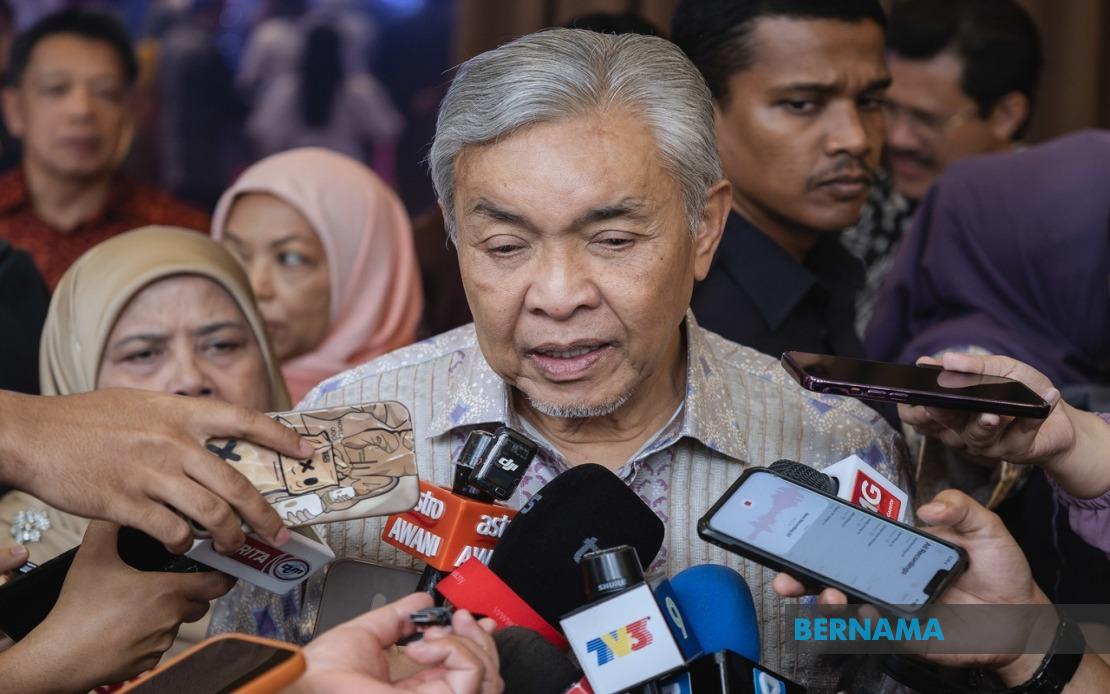
Barisan Nasional will maintain a strict hands-off approach regarding the Negeri Sembilan royal institution and its Council of Justice and Laws during the countdown to the state election, Deputy Prime Minister Datuk Seri Dr Ahmad Zahid Hamidi announced on Friday. The UMNO president's assurance came after a strategic meeting with party officials in the state, signalling the coalition's intention to keep constitutional and legal processes insulated from electoral politics as the August 1 polling date draws closer.
Ahmad Zahid's declaration reflects a carefully calibrated positioning by BN as it prepares for what officials acknowledge will be a markedly different electoral contest compared to 2018. The coalition's willingness to explicitly disavow involvement in palace and legal council matters suggests an awareness of the sensitivities surrounding royal prerogatives and judicial independence in Malaysian federalism. By drawing this clear boundary, BN appears to be attempting to project responsibility and institutional respect, particularly given recent political turbulence that has sometimes entangled constitutional bodies in partisan debates.
The distinction Ahmad Zahid drew between legitimate political campaigning and interference in constitutional affairs carries particular weight in Negeri Sembilan, a state where the Duli Yang Maha Mulia Yang di-Pertuan Besar holds ceremonial significance and where the Council of Justice and Laws advises on matters of legal interpretation and constitutional propriety. The DKU's role in state governance means its autonomy and perceived impartiality are essential to public confidence in institutional integrity. BN's pledge to remain outside this sphere may be intended to insulate both the coalition and the state institutions from perceptions of partisan manipulation.
Central to BN's strategic messaging is an emphasis on internal party cohesion as the election approaches. Ahmad Zahid stressed that unifying leaders and members across all organizational tiers represents the coalition's primary focus. This messaging underscores recognition that electoral success depends less on external machinations and more on organizational effectiveness, volunteer mobilization, and candidate quality. For a coalition that has faced internal fissures and defections in recent years, particularly in state-level contests, the insistence on party unity may signal a return to traditional ground-game strategies rather than reliance on institutional leverage.
The political landscape BN faces in Negeri Sembilan this year differs substantially from the 15th state election in 2018, when the coalition partnered with components of Pakatan Harapan in a cooperative arrangement. That cross-coalition approach reflected the fluidity and realignments characteristic of post-2018 Malaysian politics. The decision to contest this election without such formal alliances suggests a consolidation within BN's own ranks and a strategic calculation that the coalition is better positioned to compete independently. This shift implies confidence in the coalition's grassroots machinery while acknowledging that the political center of gravity has stabilized compared to five years ago.
With 36 state seats at stake in the August 1 election, Negeri Sembilan represents a significant but not dominant portion of the national legislative landscape. However, state-level electoral performances carry symbolic weight for BN's national standing and provide insight into voter sentiment regarding specific parties and leadership. The coalition's performance here will be closely watched by analysts assessing whether BN is consolidating recovered ground after difficult years, or whether opposition parties retain momentum in constituencies beyond the urban centers where they have traditionally performed strongly.
Ahmad Zahid's insistence that BN will not transgress into matters affecting the palace and DKU must be understood within the context of Malaysia's constitutional monarchy and the careful conventions that govern interactions between political parties and royal institutions. Although the role of the Negeri Sembilan ruler's office in state affairs differs somewhat from the constitutional position of Yang di-Pertuan Agong at the federal level, the principle of preserving institutional independence remains fundamental. In a federation where constitutional law and parliamentary procedure are increasingly contested along partisan lines, explicit commitments to institutional neutrality carry strategic value in signalling maturity and constitutional propriety.
The timing of Ahmad Zahid's statement, delivered during his visit to a rural development ceremony, reflects how contemporary political messaging integrates campaign preparation with routine government activities. Such platforms allow senior politicians to address organizational matters while maintaining the appearance of regular governance work. The presence of Deputy Minister Rubiah Wang at the event underscored BN's emphasis on presenting a united front across multiple government tiers and party structures.
BN's approach in Negeri Sembilan may offer lessons for how Malaysia's dominant coalition adapts to an environment where electoral dominance cannot be taken for granted and where public expectations regarding institutional independence have demonstrably risen. By voluntarily constraining its engagement in palace and legal council affairs, BN positions itself as the coalition willing to prioritize constitutional convention over short-term electoral advantage. Whether this messaging translates into voter confidence and electoral gains will become apparent on August 1, but the explicit articulation of such boundaries suggests a coalition conscious of the reputational costs of institutional entanglement in competitive politics.

