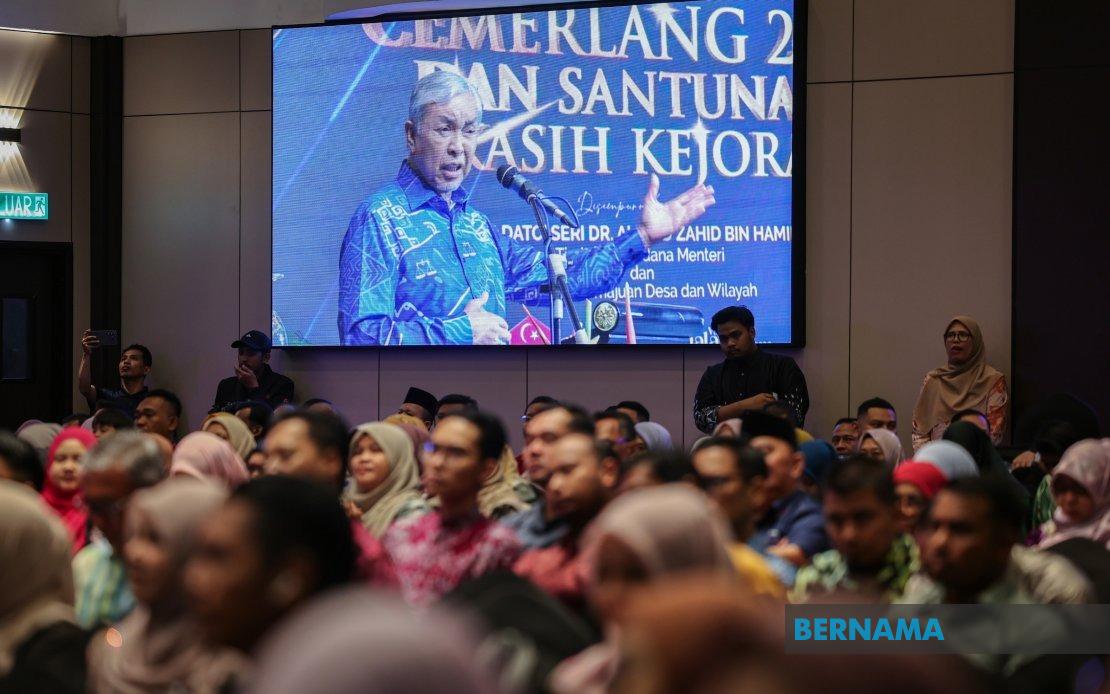
Barisan Nasional's campaign machinery for the Johor state election is operating at full capacity despite external criticism to the contrary, according to coalition chairman Datuk Seri Dr Ahmad Zahid Hamidi. Speaking at a press conference in Kota Tinggi on July 2 following his official launch of the Southeast Johor Development Authority's (KEJORA) Excellent Service Awards 2025, Zahid characterized assessments describing the BN effort as 'lacklustre' as fundamentally misguided perceptions rather than reflections of conditions in the field.
Zahid emphasized that BN welcomes alternative viewpoints from competing coalitions but maintains confidence in its grassroots organization and candidate positioning. The party leader framed opposing commentary as a legitimate expression of political preference while reaffirming the coalition's commitment to energetic campaigning. His measured response suggests BN is conscious of momentum narratives in electoral contests, particularly given that perceptions of campaign vigour can influence voter turnout and enthusiasm.
The BN chairman sought to address one of the more substantive concerns raised by observers: whether federal-level cooperation between BN and Pakatan Harapan under the Unity Government might disorient Johor voters accustomed to opposing these coalitions. Zahid's response highlighted Johor's distinctive constitutional arrangement, whereby the state administration predates the formation of the Unity Government at federal level. This temporal distinction provides some political insulation, allowing BN to maintain its separate state-level identity while participating in federal governance structures.
Zahid stressed that cooperation between state and federal authorities within the Unity framework operates smoothly and professionally, suggesting that institutional collaboration need not create voter confusion. The argument implies that Malaysian voters are sufficiently sophisticated to distinguish between coalition arrangements at different levels of government, and that programmatic delivery matters more than coalition labelling. This positioning may prove crucial for BN in retaining traditional support bases that have never favoured PH governance.
The Deputy Prime Minister pointed to the Johor government's recent financial performance as concrete evidence justifying BN's re-election. Under Menteri Besar Datuk Onn Hafiz Ghazi's administration, the state recorded revenue of RM2.26 billion in the previous year, figures Zahid characterized as the highest among peninsular states. Such metrics serve to ground BN's campaign narrative in quantifiable outcomes rather than rhetorical promises, a particularly effective approach in state elections where voters can assess incumbent performance across multiple years.
BN is contesting all 56 state seats in this election, signalling confidence that the party configuration and candidate selection will appeal across Johor's diverse constituencies. The coalition's stated aim of securing a resounding mandate extends beyond simple victory to establishing a platform for executing its five-year development agenda without internal constraints. This approach acknowledges that while BN holds the state government, stronger numerical representation would provide greater policy flexibility and resource allocation authority.
Zahid's comments regarding Perikatan Nasional president Tan Sri Abdul Hadi Awang's recent calls for voters to reject Pakatan Harapan entirely, even in contests where BN opposes PH, reveal subtle friction within Malaysia's opposition landscape. Rather than embracing PAS's zero-sum framing, Zahid adopted a posture of professional restraint, indicating that BN prefers emphasizing its own candidates' merits rather than enlisting third-party opposition mobilization. This distinction matters because it potentially positions BN as the more stable, institutionally-focused political force compared to more ideologically-driven competitors.
The electoral landscape for Johor comprises eight competing entities contesting the 56 seats. Pakatan Harapan fields 56 candidates matching BN's full complement, indicating the race's essentially bipolar nature at the top level. Perikatan Nasional's 33 candidates represent the third significant force, while Bersama, MUDA, Asli, PSM, and independent candidates collectively offer approximately 27 additional nomination options. This fragmentation benefits BN if it successfully consolidates traditional support while limiting PH's ability to build unified opposition momentum.
The polling date of July 11 with early voting on July 7 provides a relatively compressed campaign period of roughly two weeks from Zahid's statement. Within this timeframe, election machinery effectiveness becomes particularly consequential, making Zahid's emphasis on ground-level activity strategically important. The coalition's capacity to mobilize voters during a compressed period will substantially determine whether its claimed campaign vigour translates into electoral returns.
For Malaysian observers, the Johor election holds broader significance beyond state-level governance. The contest effectively tests whether the federal Unity Government structure can coexist with robust state-level coalition competition, or whether federal cooperation mechanisms inevitably reshape political competition at subnational levels. Zahid's arguments suggest BN believes these dynamics can be managed separately, though voter behaviour on July 11 will ultimately determine whether theoretical distinctions between federal and state politics retain practical validity.
The election also provides an early indicator of whether structural challenges within Malaysian politics—the relationship between institutional cooperation and partisan competition, the durability of traditional coalition identities, and the sustainability of federal power-sharing arrangements—can be reconciled successfully. For investors, political analysts, and regional observers monitoring Malaysian stability, Johor's election results will offer important signals regarding the viability of consensus-based governance structures in a context of genuine electoral competition.

