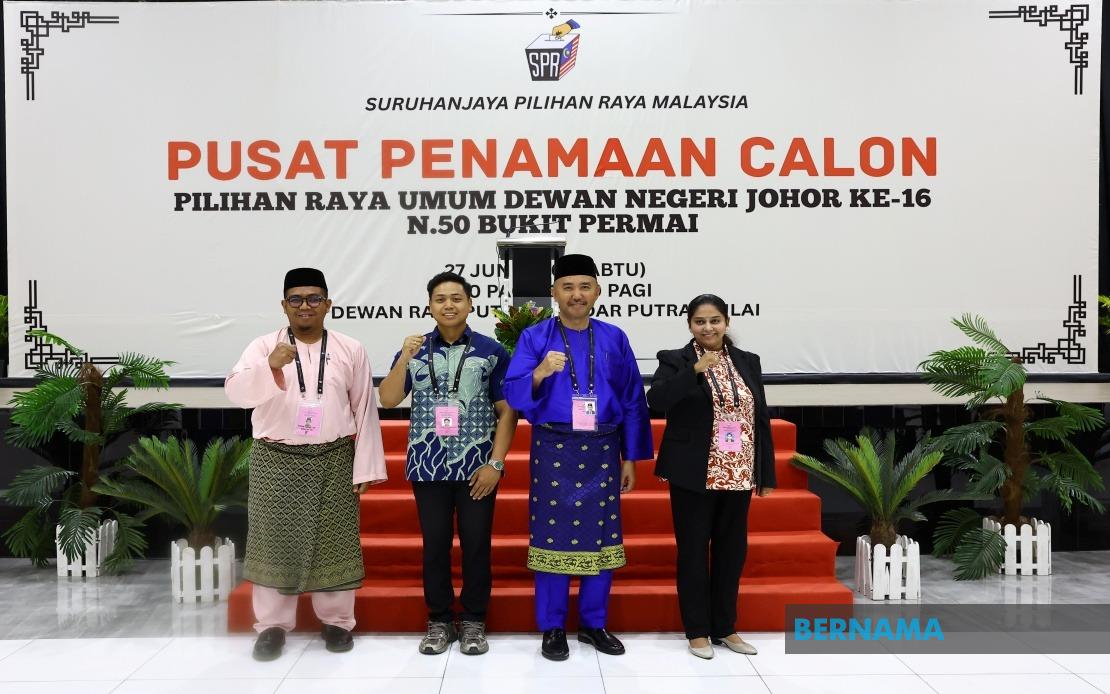
Datuk Mohd Jafni Md Shukor, the incumbent Bukit Permai state assemblyman representing Barisan Nasional, faces a tightly contested battle to retain his seat in the 16th Johor state election, with three challengers lined up to contest from rival coalitions and a newer political party. The nomination process concluded at the Dewan Raya Putra in Bandar Putra on Thursday morning, with the returning officer Afzan Azhari officially announcing the four candidates who will stand in what promises to be an engaging multi-cornered contest in the southern state.
Jafni's challengers bring diverse political allegiances to the race. Mohamad Shafwan Ani carries the colours of Pakatan Harapan, the opposition coalition that has gained substantial traction across various state elections in recent years. M. Lina Manoh represents Perikatan Nasional, the Islamist-leaning coalition that has established itself as a significant force in Malaysian politics particularly in certain state constituencies. Meanwhile, Muhammad Aidil Riduan Mohd Yusof flies the flag for Parti Bersama Malaysia, a newer entrant to the electoral landscape that has been gradually building its presence across different constituencies.
Jafni's track record in the constituency suggests he maintains considerable voter support. In the 2022 Johor state election, contested under similar four-cornered circumstances, he secured victory with a comfortable majority of 4,755 votes. That result demonstrated his ability to consolidate support among Bukit Permai voters and fend off challenges from multiple opposition forces. However, the changing political landscape since that election and the introduction of fresh candidates may reshape voter dynamics this time around.
The presence of Johor DAP chairman Teo Nie Ching accompanying Mohamad Shafwan to the nomination centre signals the importance Pakatan Harapan attaches to this particular contest. Such high-level party representation at nominations often indicates strategic constituencies where coalitions believe they can make significant inroads. The DAP's involvement underscores the broader contest within Bukit Permai between established political forces competing for influence in Johor's parliament.
The Bukit Permai contest reflects broader trends evident across Malaysian electoral politics. Four-cornered contests have become increasingly common as voters fragment across multiple political offerings. The traditional two-party system has given way to a more complicated landscape where regional coalitions, state-specific movements, and newer parties carve out electoral space. Bukit Permai's composition as a mixed urban-rural constituency makes it sensitive to different political currents affecting both city and countryside voters.
BN's prospects across Johor remain significant given the coalition's historical dominance in the state, though recent elections have demonstrated its vulnerability to coordinated opposition challenges. The party machine and incumbency advantage that Jafni enjoys provide tangible assets, yet the fragmentation of opposition votes across three separate candidates could theoretically work in his favour by preventing any single challenger from consolidating anti-BN sentiment.
The electoral commission has established clear timelines for the 16th Johor state election process. Early voting will take place on July 7, accommodating voters unable to cast ballots on the main election day. The general election itself will occur on July 11, giving candidates and parties less than three weeks from nomination closure to campaign intensively across their respective constituencies. This compressed timeframe means campaigns must move quickly to establish messaging and mobilise voter bases.
Bukit Permai's electoral dynamics deserve attention within the broader context of Johor politics. The southern state remains politically consequential given its size, population and economic importance to Malaysia's overall development. Results here will contribute to the overall composition of the state assembly and potentially influence how future governments approach policies affecting Johor's communities. The constituency therefore represents a microcosm of broader voter preferences and political alignments.
For Malaysian and Southeast Asian political observers, the Bukit Permai contest exemplifies contemporary challenges facing established parties across the region. Coalition politics remains fluid, with new groupings emerging and traditional alliances occasionally fracturing. The ability of established parties to retain voter loyalty while adapting to changing political preferences becomes increasingly critical. Jafni's defence of his seat will test whether BN's organisational strength and incumbency advantages remain sufficiently potent to overcome fragmented opposition challenges.
The participation of Parti Bersama Malaysia alongside the two major opposition coalitions adds another dimension. As a relatively newer political force, Bersama's presence signals how Malaysian electoral politics continues to evolve beyond established two-coalition frameworks. Whether such newer parties ultimately consolidate into broader coalitions or remain distinctive forces shaping Malaysian political competition remains to be determined through results such as those expected in Bukit Permai and across Johor next month.

