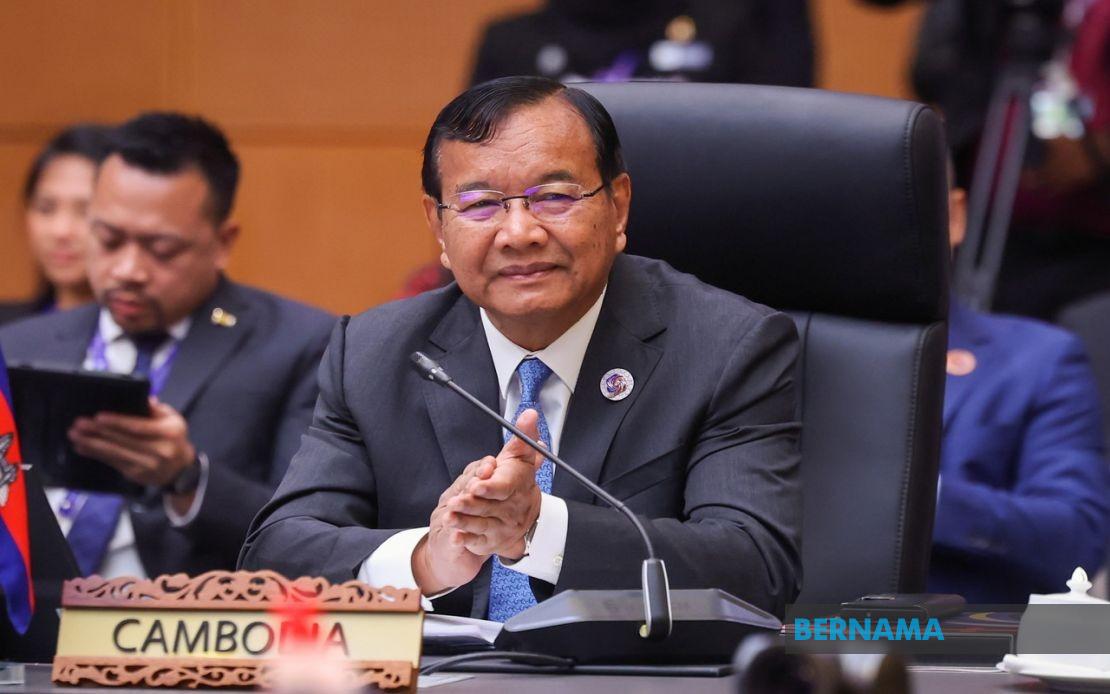
Cambodian Deputy Prime Minister and Foreign Minister Prak Sokhonn touched down in Malaysia on August 3rd for a carefully orchestrated two-day diplomatic mission designed to reinvigorate the multifaceted partnership between Phnom Penh and Kuala Lumpur. His arrival at Kuala Lumpur International Airport Terminal 1 at 1.48 pm marked the beginning of an engagement centred on advancing shared regional interests and consolidating economic ties that have grown substantially in recent years.
The timing of Sokhonn's visit underscores the renewed momentum both governments are seeking to inject into their relationship. Malaysia and Cambodia share not only geographical proximity within Southeast Asia but also overlapping interests in regional security, trade expansion, and multilateral cooperation frameworks. By hosting a senior-level delegation at this particular juncture, Malaysia signals its commitment to deepening engagement with a neighbour whose strategic importance has grown within ASEAN's broader architecture.
Sokhonn's itinerary reflects the structured nature of contemporary bilateral diplomacy. Upon arrival, he was greeted by Cambodian Ambassador to Malaysia Ouk Chandara and Datuk Rozainor Ramli, Malaysia's government chief ceremony officer—a detail that illustrates the formal protocols surrounding such high-level visits. The delegation's first substantive engagement will involve a courtesy call on Prime Minister Datuk Seri Anwar Ibrahim, a ceremonial but politically significant moment that allows both leaders to set the tone for deeper discussions and demonstrate the personal commitment their governments maintain toward the relationship.
The centrepiece of Sokhonn's visit is his participation in the 3rd Meeting of the Cambodia-Malaysia Joint Commission for Bilateral Cooperation (JCBC), scheduled for the following day in Kuala Lumpur. This trilateral mechanism serves as the primary institutional framework through which both nations assess progress on previously negotiated agreements and chart new collaborative pathways. The commission's agenda will comprehensively examine implementation of minutes agreed during the second JCBC session, providing both delegations an opportunity to identify bottlenecks, celebrate achievements, and recommit to shared objectives.
Sokhonn is also slated to conduct bilateral discussions with Malaysian Foreign Minister Datuk Seri Mohamad Hasan. These talks will likely extend beyond the JCBC's formal scope, allowing the two ministers to address bilateral issues with greater flexibility and explore potential new areas of cooperation. Such engagements between foreign ministers are particularly valuable in Southeast Asian diplomacy, where personal relationships and frank exchanges often determine the trajectory of broader state-to-state ties.
The economic dimension of this visit cannot be understated. Malaysia and Cambodia's bilateral trade relationship has experienced remarkable growth, with 2025 figures showing a 27.4 per cent year-on-year increase to RM5 billion (USD1.17 billion). This expansion reflects deeper integration across multiple sectors and demonstrates that both economies have found mutually beneficial opportunities despite differing development levels and industrial structures. For Malaysia, Cambodia represents not merely a trading partner but an increasingly important market for goods, services, and capital investment.
Malaysia's investment footprint in Cambodia further illustrates the depth of economic linkage between the two nations. As of 2024, Malaysian cumulative investments in Cambodia reached USD3.20 billion (RM13.07 billion) across 162 registered projects, positioning Malaysia as Cambodia's third-largest foreign investor. This standing reflects years of patient relationship-building and demonstrates that Malaysian businesses view Cambodia as a stable, rewarding investment destination. The breadth of projects—spanning 162 separate ventures—indicates diversification across multiple sectors rather than concentration in a single industry, reducing volatility and building resilience into the economic relationship.
These investment and trade figures carry implications extending beyond bilateral commerce. They signal to other ASEAN members and major trading partners that Malaysia has successfully leveraged geographical proximity and established institutional frameworks to capture significant economic opportunities in Cambodia's growth trajectory. In an era of heightened great-power competition and economic fragmentation, such demonstrated capacity to build substantive economic relationships with neighbours strengthens Malaysia's position within the region and its claim to leadership on ASEAN economic integration.
Sokhonn's visit also reflects broader currents within Southeast Asian diplomacy. Both Cambodia and Malaysia have navigated complex relationships with major powers while maintaining ASEAN centrality in regional affairs. By reinforcing bilateral mechanisms and deepening economic ties, Sokhonn and the Malaysian leadership reaffirm a commitment to an ASEAN-led regional order in which smaller nations can prosper through institutional frameworks and multilateral engagement rather than alignment with external powers.
The visit's success will likely be measured not in immediate announcements but in whether both sides emerge with renewed clarity on medium-term cooperation priorities and concrete mechanisms for addressing implementation challenges. The JCBC process, repeated at three-year intervals or similar schedules, provides reliable institutionalisation that can withstand political fluctuations in either capital and maintain continuity in bilateral relations through changing circumstances.
For Malaysian policymakers, Sokhonn's presence offers an opportunity to strengthen ties with a strategically located neighbour whose stability and prosperity contribute to broader regional equilibrium. For Cambodian leadership, deepening cooperation with Malaysia—particularly on trade and investment facilitation—offers pathways to accelerate development and diversify external partnerships. Both governments, through this carefully choreographed visit, demonstrate their commitment to building an increasingly integrated and prosperous Southeast Asia.

