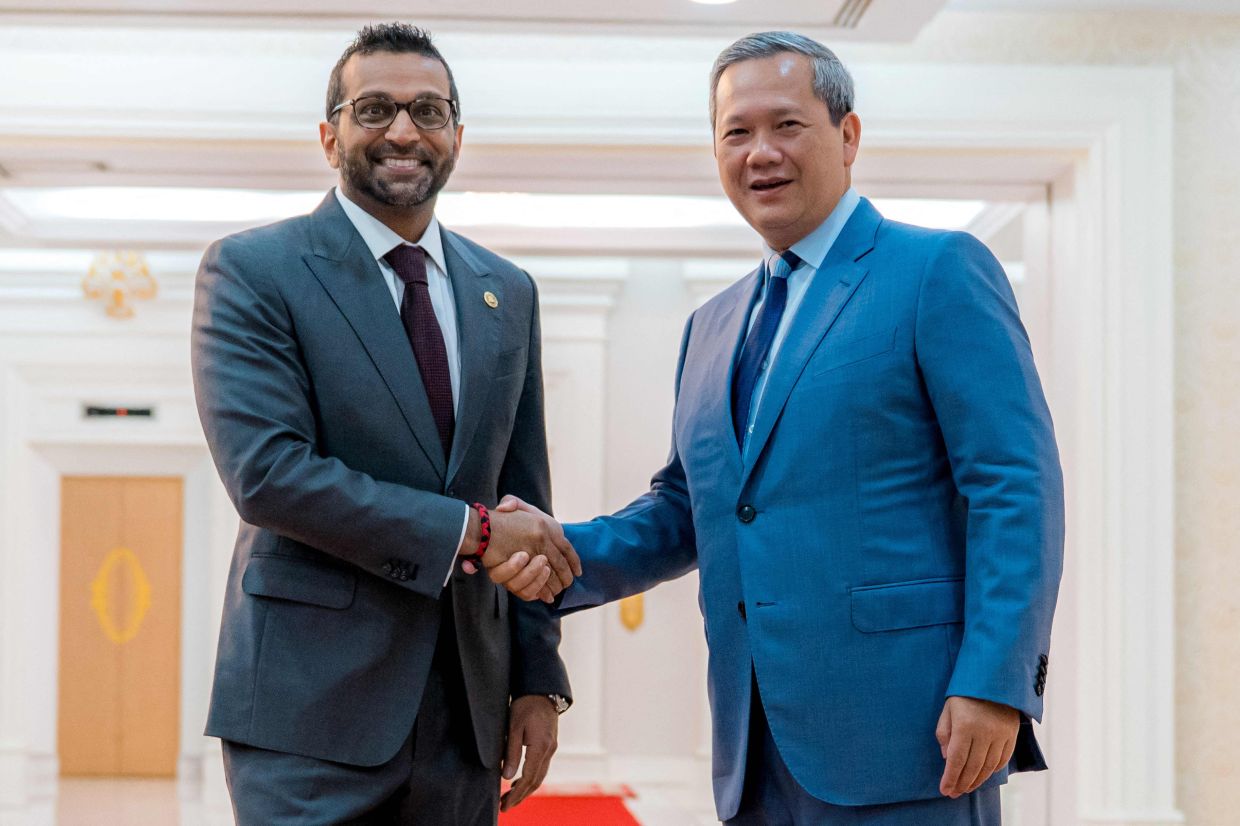
Cambodia's leadership has signalled a renewed determination to combat the proliferation of transnational online scam operations that have become entrenched across Southeast Asia since the pandemic. Prime Minister Hun Manet outlined an increasingly ambitious enforcement strategy during recent remarks to media, while simultaneously acknowledging a sobering reality: the criminal enterprises orchestrating these fraud networks are evolving faster than authorities can contain them. The challenge facing Cambodia and its regional neighbours has become more intricate as scam syndicates deliberately decentralise their operations, fragmenting into smaller, harder-to-detect cells distributed across multiple jurisdictions.
The scale of Cambodia's enforcement response so far reveals the magnitude of the problem authorities are confronting. Over 670 illegal scam operations have been dismantled through coordinated action by Cambodian agencies, Hun Manet disclosed during an interview aired this week. Yet these impressive headline figures mask a more troubling trend: as soon as one major compound is shut down, criminal networks rapidly reconstitute themselves elsewhere in the region, often relocating to less scrutinised locations or operating across borders with increasing sophistication. The international dimension of this challenge has prompted Cambodia to expand intelligence-sharing arrangements with key foreign law enforcement partners, most notably reflected in high-level engagement with US Federal Bureau of Investigation Director Kash Patel during his recent visit to the country.
The prime minister's characterisation of the evolving threat—that criminals are leveraging technology to operate in a decentralised fashion—speaks to the fundamental difficulty facing regional governments. Traditional enforcement strategies designed to target physical compounds and centralised command structures have become less effective when criminal networks can coordinate fraud campaigns through encrypted communications, use cryptocurrency for money laundering, and employ multiple dispersed nodes that lack obvious hierarchical connections. This technological sophistication, combined with the significant profit margins available in online fraud targeting international victims, creates powerful incentives for criminal organisations to constantly innovate their operational methods and evade detection.
Hun Manet's assumption of the premiership in August 2023 represented a generational transition in Cambodian politics, as his father Hun Sen relinquished the position after leading the country for nearly four decades. The younger leader, a West Point graduate who has cultivated an image as a more technocratic administrator, has attempted to project a modernising agenda while preserving the authoritarian structures that have maintained the Cambodian People's Party's grip on power since the Khmer Rouge's overthrow in 1979. Notably, Hun Sen retains substantial political influence through his roles as President of the Senate and head of the ruling party, suggesting continuity alongside the generational change in the premiership.
The scam compounds that have flourished in Cambodia, Myanmar, and Laos represent far more than merely fraudulent enterprises targeting unsuspecting victims globally. Multiple credible international sources, including human rights organisations and United Nations bodies, have documented systematic links between these operations and human trafficking networks that exploit vulnerable workers. More significantly, investigations and journalistic reporting have repeatedly indicated that these criminal enterprises could not function at their current scale without tacit protection from elements within Cambodia's political and business establishment. This symbiotic relationship between organised crime and state actors represents a profound governance challenge that law enforcement actions alone cannot resolve.
International pressure on Cambodia regarding scam compounds has intensified from both Western and Chinese sources, reflecting the truly transnational nature of the problem. The United States has imposed sanctions against prominent Cambodian political figures, specifically senators Ly Yong Phat and Kok An, citing their alleged involvement in human trafficking, forced labour, and the cyber scam networks that have defrauded American citizens of substantial sums. Hun Manet characterised these sanctions as legal matters being contested through court proceedings, while asserting that state agencies actively investigate cases involving both government officials and private sector executives. He pointed to instances where military generals and provincial governors have been dismissed and prosecuted as evidence of the government's commitment to accountability.
The economic dimensions of the scam problem across the broader Asia-Pacific region are staggering. According to a recent report from the UN Office on Drugs and Crime, combined losses from scams across East Asia, Southeast Asia, Australia and New Zealand reached an estimated US$114 billion in the previous year. This figure underscores the tremendous wealth being extracted from victims across multiple countries and transferred through complex money-laundering networks, much of which eventually benefits corrupt officials and criminal syndicates. For Malaysia and other regional economies, the scale of these criminal flows represents both a direct threat—as Malaysian citizens and businesses are targeted—and an indirect concern regarding regional financial stability and the enabling role played by compromised governance structures.
Beyond the immediate scam crisis, Hun Manet used the platform to address Cambodia's fraught relations with Thailand over unresolved border disputes. The prime minister urged Bangkok to immediately resume joint boundary demarcation negotiations, emphasising that more than 20,000 displaced citizens remain unable to return to their homes in border provinces. While a ceasefire has held since conflict erupted a year ago, Hun Manet stressed that the situation remains inherently unstable, with thousands of troops stationed in a tense face-to-face configuration along the frontier. The resumption of demarcation talks represents, in his view, a necessary step toward normalisation and the restoration of civilian life in affected areas.
Thailand's position linking maritime conciliation discussions with Cambodia's pursuit of UN involvement to its decision to pause land-border negotiations drew sharp criticism from the Cambodian leader. Hun Manet characterised this linkage as both inaccurate and inequitable, noting that land demarcation and maritime disputes operate under separate legal frameworks established through bilateral agreements. His assertion that these matters should be treated independently reflects a fundamental disagreement over how the two nations should sequence their dispute-resolution efforts. For Myanmar, Thailand, and other Southeast Asian nations grappling with their own territorial tensions and transnational security challenges, Cambodia's experience illustrates the difficulty of compartmentalising different categories of interstate disputes when political relationships are fundamentally strained.
The convergence of Cambodia's internal governance challenges—reflected in the scam networks' deep penetration of state structures—with its external security vulnerabilities demonstrates the interconnected nature of Southeast Asia's contemporary security landscape. The region's governance deficits create environments where transnational criminal networks flourish, while the same weak institutional capacity hampers effective regional cooperation on border security and dispute resolution. Hun Manet's public commitments to intensified enforcement and expanded international partnerships suggest official recognition of these problems, yet the structural challenges underlying Cambodia's predicament—including entrenched corruption and authoritarian governance—will require far more fundamental reforms to address definitively. For Malaysia and other neighbouring states, Cambodia's struggles serve as a cautionary reminder of how criminal enterprises and governance failures can undermine regional stability if left unaddressed.

