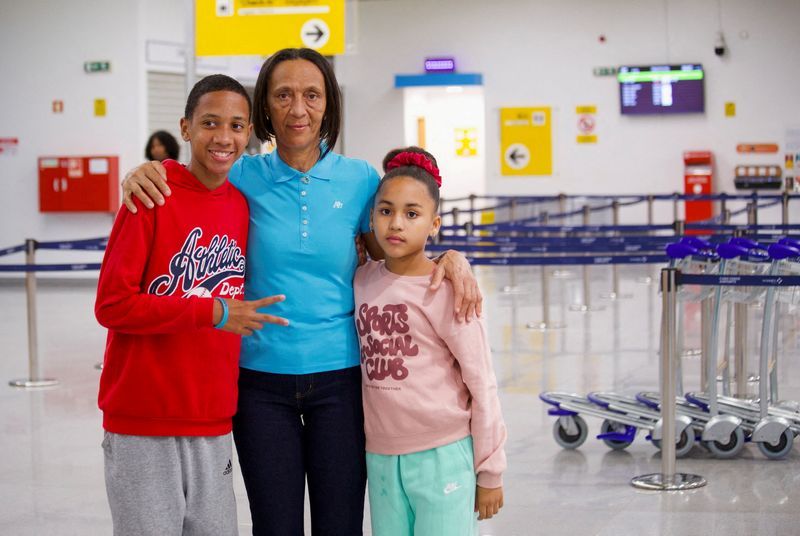
Cape Verde's goalkeeper Vozinha will finally see his mother in the stands after the United States granted Ana Candida Evora a visa to travel to the country and watch her son compete at the World Cup. The emotional turnaround comes weeks after the 40-year-old goalkeeper publicly disclosed that his mother was unable to attend his team's opening match against Spain due to visa complications, drawing international attention to what had become a personal and symbolic story of exclusion during the tournament.
Vozinha's performance in that opening fixture had been extraordinary by any measure. Playing against the reigning European champions in Atlanta, the goalkeeper produced a masterclass in shot-stopping, making seven crucial saves to help Cape Verde achieve a remarkable 0-0 draw. His contribution was so decisive that he was named his team's player of the match, a recognition that highlighted his individual brilliance on football's biggest stage. For a player competing with one of the tournament's smaller footballing nations, such a performance represented validation on the world stage and a moment of immense professional pride.
The contrast between his on-field triumph and personal disappointment became the story's emotional core. Despite achieving what many considered a career-defining performance, Vozinha found himself unable to fully celebrate because his mother had been unable to secure the necessary travel documentation. The goalkeeper's candid revelation about missing his mother's presence at such a pivotal moment resonated across global media, transforming a technical visa issue into a deeply human narrative about family and sport.
The immediate catalyst for change was the viral spread of Vozinha's emotional disclosure. His vulnerability in publicly discussing his mother's absence struck a chord that transcended typical sports coverage, reaching audiences who might otherwise have little interest in World Cup developments. The narrative became impossible for official channels to ignore, as it encapsulated broader frustrations about immigration protocols intersecting with international sporting competition.
The United States State Department responded to the public pressure with demonstrable action. Officials acknowledged that their visa processing team in Praia, Cape Verde's capital, had been in direct contact with Evora to facilitate her application. The department emphasised that while all standard procedures and policies would be maintained, the approval process would proceed with full momentum to enable her attendance at upcoming Cape Verde matches. This diplomatic language masked what was clearly a prioritisation driven by the high-profile nature of the case and its symbolic importance during an international tournament.
Vozinha will now have the opportunity to see his mother in attendance at Cape Verde's second group-stage fixture against Uruguay scheduled for Sunday in Miami. This match represents a crucial juncture in Cape Verde's World Cup campaign, as the team seeks to build on the momentum generated by their draw against Spain. The presence of his mother in the stadium will add another dimension to what is already shaping up to be an emotionally charged encounter.
The broader context of Evora's visa struggles reveals complications within America's immigration framework during this particular moment. The Trump administration had implemented sweeping immigration measures that required citizens from numerous nations, including Cape Verde, to post bonds reaching as high as $15,000 simply to enter the United States. Such financial requirements placed impossible barriers in front of ordinary families seeking to travel legally and temporarily for specific purposes like attending a World Cup.
These bond requirements were later rescinded specifically for individuals holding World Cup tickets, suggesting that even policymakers recognised the incongruity of preventing legitimate tourists from attending an international sporting event. However, by the time this exception was established, the financial obstacle had already prevented many families from even attempting the visa application process. Evora had calculated that the potential costs of bond payments, combined with the uncertainty of approval, rendered a trip to Atlanta economically unfeasible for her circumstances.
The resolution of Evora's case illuminates the arbitrary nature by which immigration barriers can be erected or removed depending on public attention and pressure. Her eventual approval was not based on any change to her circumstances or qualifications, but rather on external pressure and diplomatic convenience. This raises questions about how many other World Cup attendees from developing nations might have faced similar obstacles that lacked the platform or emotional narrative to capture official attention.
For Malaysian and Southeast Asian observers, Evora's journey carries particular resonance. Citizens of countries in this region frequently navigate complex visa regimes when travelling to distant nations, and the intersection of immigration policy with cultural and sporting aspirations remains a perennial tension. The story underscores how international sporting events can expose the human costs of restrictive immigration frameworks, even among nations with developed diplomatic relations.
Vozinha's situation also reflects the broader pattern of how football provides a platform for marginalized voices and stories. Cape Verde's unexpected resilience at the World Cup, embodied in performances like Vozinha's against Spain, demonstrates that smaller footballing nations can compete with honour and distinction. His mother's journey from exclusion to inclusion mirrors the team's own narrative of persistence against systemic disadvantages.
Looking ahead, Evora's approval represents a small but meaningful victory for a family that had initially resigned itself to separation during a momentous occasion. For Vozinha, knowing that his mother will be present for at least one more match during the tournament provides emotional reinforcement as Cape Verde navigates the challenges of group-stage competition. The goalkeeper's focus can now shift entirely to the pitch, unburdened by the weight of family absence that had shadowed his triumph against Spain.

