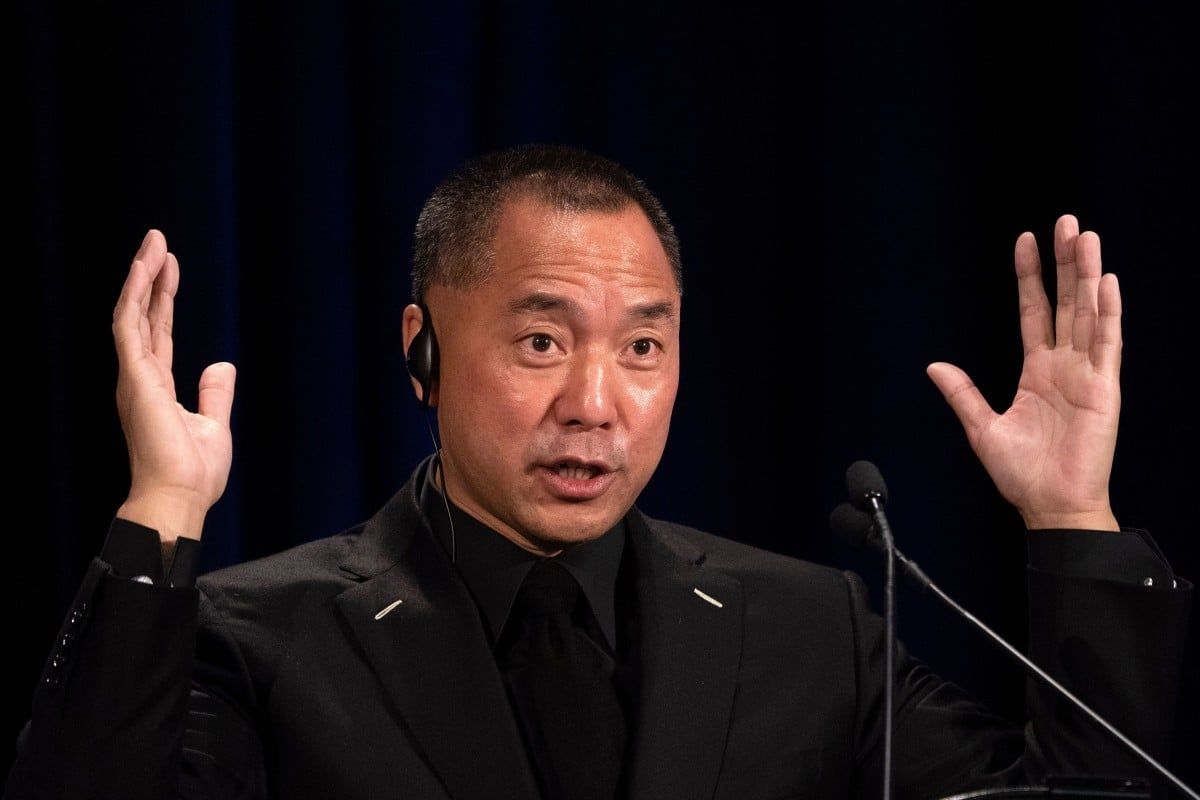
A prominent Chinese billionaire who fled his homeland over a decade ago and reinvented himself as a vocal opponent of Beijing's ruling Communist Party has received a 30-year prison sentence in Manhattan for perpetrating one of the largest financial frauds targeting diaspora communities and political activists. Guo Wengui, also known as Miles Guo and Ho Wan Kwok, was convicted of nine criminal charges after a seven-week trial that revealed an elaborate scheme to defraud hundreds of thousands of investors through multiple entities, extracting over US$1 billion from victims who believed they were supporting both investment opportunities and efforts to challenge the Chinese government's authority.
Judge Analisa Torres issued the sentence in a packed courtroom, characterizing Guo's conduct as particularly predatory because it specifically targeted individuals motivated by democratic ideals and opposition to Communist Party rule. The judge noted that Guo deliberately exploited the hopes and financial resources of those seeking to advance political change in China, using their trust to accumulate wealth that financed an ostentatious lifestyle featuring luxury residences, yacht ownership, exotic automobiles, and haute couture acquisitions. Court documents revealed that over 1,000 identifiable victims lost their life savings in the scheme, with many experiencing severe psychological distress, family discord, and acute anxiety following their financial devastation.
The fraud operated primarily through several interconnected entities under Guo's control, including GTV Media Group Inc., the Himalaya Farm Alliance, and the Himalaya Exchange, each presenting itself as a legitimate business opportunity worthy of investor capital. Prosecutors demonstrated during trial that Guo systematically misrepresented the financial viability and operational status of these ventures, consistently redirecting investor funds toward personal expenditures rather than the stated business purposes. The sophisticated nature of the deception involved sophisticated marketing campaigns that leveraged Guo's growing prominence within conservative political circles and his cultivated image as a courageous dissident challenging Beijing's authority.
Prior to his arrest and pretrial detention without bail three years ago, Guo had cultivated extraordinarily high-profile political associations in the United States, most notably with Steve Bannon, a conservative political strategist with whom he jointly announced initiatives purporting to overthrow the Chinese government in 2020. These connections afforded Guo considerable credibility and access to influential American political networks, helping him establish residence in a luxury Manhattan apartment with Central Park views and membership in Mar-a-Lago, the exclusive Florida golf club associated with former President Donald Trump. The positioning strategically enhanced Guo's public profile as a serious political actor rather than a financial operator, elements his legal team would later emphasize during sentencing proceedings.
During the sentencing phase, multiple victims submitted written statements describing the profound emotional and financial devastation wrought by Guo's fraud. One victim, Wei Chen, testified that the scheme had fundamentally destroyed her life and that of her family members. The judge emphasized that Guo demonstrated complete absence of remorse, instead insisting that his actions caused no losses and harmed nobody, while simultaneously encouraging his supporters to harass and intimidate victims and witnesses willing to testify against him. This pattern of witness intimidation and victim harassment added a particularly troubling dimension to the case, suggesting an organized effort to suppress accountability beyond the initial fraud itself.
The court ordered Guo to forfeit US$889 million in restitution to defrauded victims, though the practicality of collecting such amounts from a now-imprisoned defendant remains uncertain. Prosecutors had specifically requested the 30-year sentence, arguing that Guo's scheme between 2018 and 2023 represented an "astonishing" fraud that destroyed hundreds of lives and left families devastated not merely financially but emotionally and psychologically. The government characterized Guo's conduct as deliberately leveraging lax American asylum and business regulations to flourish financially while perpetuating fraud against an exceptionally vulnerable population.
Guo's defense team mounted an alternative narrative during sentencing proceedings, portraying their client as ultimately a victim of the Chinese Communist Party's relentless persecution. They submitted evidence suggesting that Guo bore physical scars from torture endured in China between 1993 and 2022, with subsequent surgical interventions required to address resulting injuries. The defense argued that a lengthy sentence would validate Beijing's alleged smear campaign against Guo and potentially embolden further efforts to suppress Chinese dissidents active in the United States, suggesting that comparable defendants in similar fraud cases typically received sentences ranging from two to four years.
According to defense filings, Guo's initial wealth accumulation occurred through his family's substantial shareholdings in what they characterized as China's largest publicly traded securities company, before government officials targeted him after he allegedly exposed their corruption. The narrative traced Guo's subsequent relocation through Hong Kong and London before his 2017 arrival in New York. Chinese authorities have consistently accused Guo of rape, kidnapping, bribery, and additional crimes, allegations he has categorically denied as fabricated elements of a broader persecution campaign orchestrated by Beijing officials.
The Chinese Ministry of Foreign Affairs responded to the sentencing by noting that Guo remains wanted by the Chinese government and currently carries an Interpol Red Notice, a formal request to global law enforcement authorities to arrest and detain individuals pending extradition proceedings. This international component adds geopolitical complexity to the case, as it reflects longstanding tensions between Beijing and Washington regarding asylum policies and the protection of Chinese dissidents operating within American territory. For Southeast Asian observers, the case illustrates vulnerabilities within diaspora communities, particularly among Chinese business professionals and activists who may lack sophisticated financial literacy regarding investment opportunities.
The sentencing carries important implications for Malaysian and broader Southeast Asian Chinese communities, as many investors in similar schemes originate from wealthy diaspora networks throughout the region who maintain emotional and political investment in developments affecting China. The case demonstrates how sophisticated fraudsters leverage legitimate political narratives and genuine dissident credentials to access capital from ideologically motivated investors who may be less analytically rigorous regarding financial fundamentals. Financial regulators and law enforcement agencies throughout Southeast Asia increasingly recognize that transnational fraud schemes targeting diaspora populations require coordinated international responses combining investor education, regulatory oversight, and financial institution scrutiny.
The conclusion of Guo's criminal proceedings does not necessarily resolve broader questions regarding his alleged connections to international business and political networks, nor does it definitively settle disputes regarding the legitimacy of Chinese government allegations against him. However, the conviction and substantial sentence represent significant vindication of American prosecutorial efforts to hold wealthy defendants accountable despite their prominence and access to sophisticated legal resources. The case underscores enduring regulatory challenges in monitoring capital flows among diaspora populations and the vulnerabilities inherent when political narratives become entangled with financial transactions, a pattern particularly relevant to Southeast Asian contexts where capital mobility and political engagement remain persistently intertwined.

