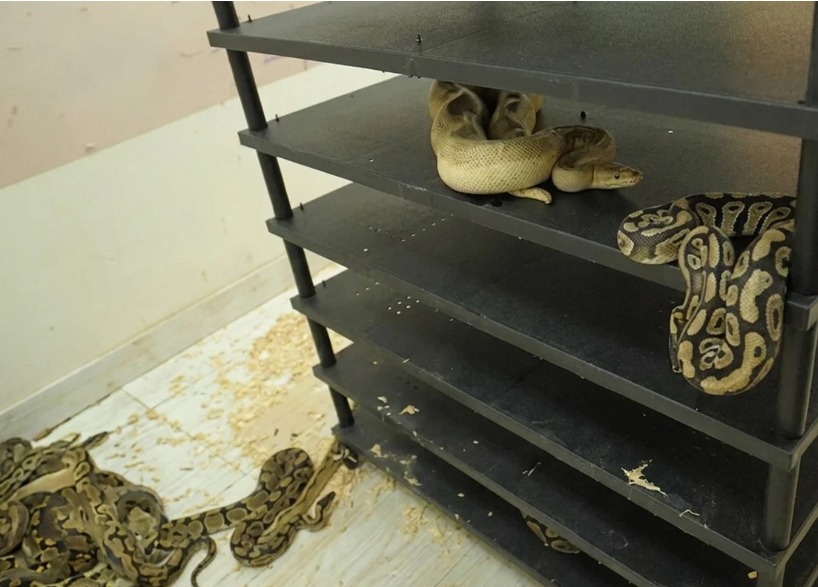
A resident of Zhejiang province in eastern China has been sentenced to imprisonment for operating an illegal breeding operation involving over 300 pythons, creatures protected under Chinese law. The discovery of the sprawling contraband operation came to light through state media coverage in late June and reveals how wildlife enforcement authorities used utility consumption patterns to identify environmental crime.
The investigation began innocuously in March 2024 when a senior citizen in Taizhou stumbled upon a large snake at the base of a local mountain. The elderly resident, struck by the unusual appearance of the thick, tawny reptile, reported the finding to police. What made this encounter remarkable was the python's presence in a region where such species do not naturally occur, prompting officers to theorize that the animal had escaped from a breeder's facility rather than wandered from the wild. The seasonal timing also suggested an escape; pythons typically remain dormant during March in outdoor environments, making a sighting of an active specimen highly irregular.
The breakthrough in the investigation came through specialized expertise. When police consulted a professional snake specialist, the expert explained that pythons demand strictly controlled thermal conditions to survive in captivity. Maintaining temperatures between 20 and 30 degrees Celsius year-round requires consistent heating infrastructure that would generate distinctive electricity consumption patterns. This insight transformed the investigation from a simple animal report into a targeted search based on utility usage data. Officers began analyzing electricity bills from residences in the vicinity, looking for households displaying abnormally high power consumption that could not be easily explained by conventional domestic use.
This analytical approach led authorities to a man surnamed Guo who lived alone, was unemployed, and maintained no obvious legitimate reason for elevated electricity usage. Further surveillance revealed a suspicious pattern: a man named Di made regular visits to Guo's apartment, often collecting courier packages from nearby delivery stations. Investigation of these parcels showed they contained live white mice purchased online. Police traced the suppliers of these mice and confirmed they typically sold such animals to customers breeding reptiles as food sources. The connection between the escaped python, the suspected breeder, and the food supply chain was forming.
Digital evidence strengthened the case considerably. Guo had posted photographs of snakes on social media and made veiled references to selling pythons to other enthusiasts. Transaction records indicated that Di had facilitated the sale of at least two pythons to another buyer for 1,000 yuan. When officers obtained a warrant and entered Guo's flat, they encountered a scene that shocked even experienced investigators. Two bedrooms and the entire living space had been converted into a reptile breeding facility, with plastic boxes stacked floor to ceiling, each containing a python. Guo had compressed all his personal furniture into a single bedroom, ceding the remainder of the apartment entirely to his illegal operation.
The scale of the breeding scheme emerged as officers conducted their inventory. A total of 309 pythons were recovered from Guo's residence and subsequently transferred to a local zoo. Guo himself appeared unrepentant during questioning, revealing that his passion for snakes dated back to 2014 when he purchased four pythons to launch his operation. Over the subsequent decade, he had dedicated himself to studying reptile genetics and selective breeding, claiming he could cultivate snakes displaying various colours. He characterized himself as a "creature creator," suggesting he viewed the operation as a form of artistic or scientific endeavor rather than mere commercial trafficking. Despite this self-perception, the breeding enterprise was unmistakably driven by profit.
The investigation expanded beyond Guo to encompass his entire supply network. Di, his frequent visitor and co-conspirator, faced charges related to distributing the animals. Most significantly, police identified Deng, a shop owner who had sold four pythons to Guo in 2014, effectively initiating the illegal breeding chain. Officers discovered an additional 47 pythons at Deng's residence, suggesting he maintained his own breeding operation. Court proceedings in Taizhou resulted in prison sentences for Guo, Di, and Deng, though authorities did not publicly disclose the length of individual sentences. The combined operation involved 436 pythons valued at more than 30 million yuan, or approximately US$4.4 million at current exchange rates.
This case underscores China's commitment to enforcing protections for Grade Two endangered species, a classification that applies to pythons in Chinese law. The regulations prohibit the unauthorized purchase, sale, breeding, and transport of such protected animals without government authorization. Violators under China's Criminal Law face potential imprisonment of up to five years. The creative investigative technique employed here—using electricity consumption as a forensic tool to detect hidden operations—demonstrates how authorities adapt conventional crime-solving methods to wildlife trafficking. For Southeast Asian readers, the case illustrates the transnational dimensions of reptile trafficking; such operations often export animals across borders into lucrative international markets, making cooperation between national enforcement agencies essential.
The operation's discovery also highlights the risks posed by online commerce and social media in facilitating illegal wildlife trade. Guo's open posting of snake photographs and indirect sales references enabled investigators to build a case, yet similar operations undoubtedly continue undetected on less monitored platforms. The role of courier services and online retailers of feeder animals reveals how supply chains for legitimate pet care inadvertently support trafficking networks. For Malaysia and other regional countries where pythons and other reptiles are indigenous, such foreign breeding operations create demand that drives poaching and smuggling. The case reinforces why strengthened enforcement, public awareness of protected species regulations, and cooperation with online platforms to report wildlife trafficking remain critically important.

