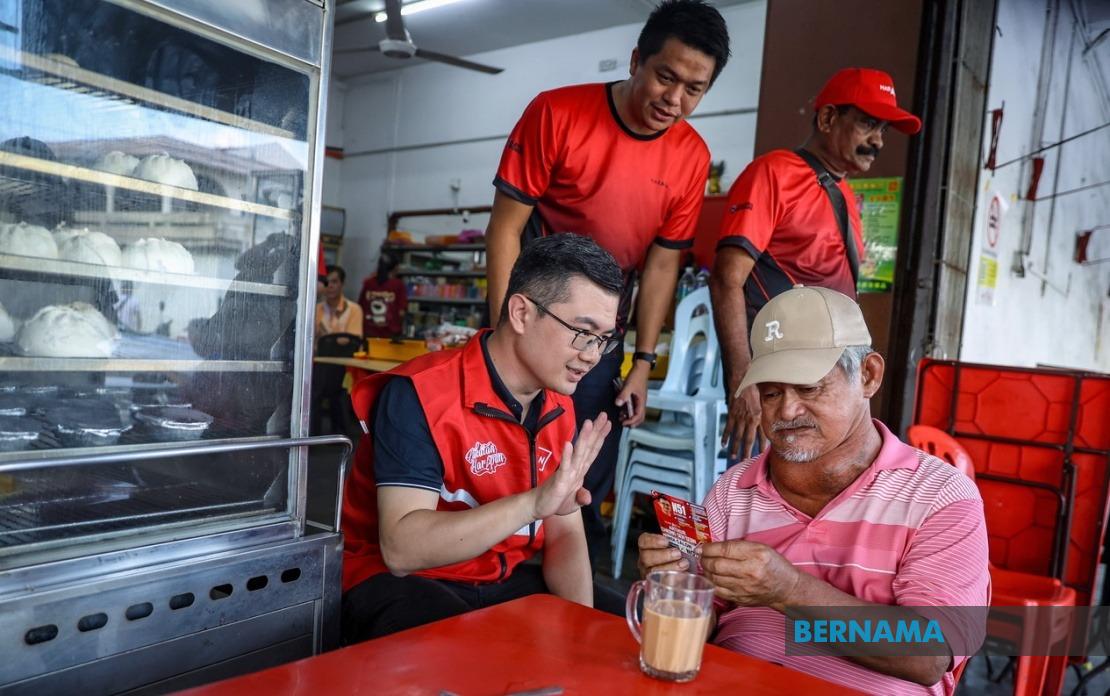
Arthur Chiong Sen Sern, the Pakatan Harapan candidate defending the Bukit Batu state seat in Johor, is pinning his re-election hopes firmly on demonstrating tangible accomplishments during his first term in office. The 36-year-old assemblyman, who narrowly retained his constituency in 2022 with a razor-thin 137-vote advantage, believes his ground-level engagement and visible service delivery have strengthened his standing sufficiently to secure a more commanding margin in the 16th Johor State Election scheduled for July 11.
Chiong's previous election victory, secured with 9,439 votes in a four-cornered contest against formidable competition, appeared vulnerable enough that few observers would have predicted his political trajectory two years on. That narrow result, however, has functioned as a catalyst rather than a setback. The assemblyman indicates he has approached his representative duties with heightened diligence, recognizing that complacency in a marginal constituency typically invites electoral punishment. His strategy rests on demonstrating that the intervening period has seen meaningful returns for residents across the Bukit Batu state seat, which encompasses 49,963 registered voters.
Infrastructure development and flood management have emerged as the centrepieces of Chiong's constituency narrative. Bukit Batu contains villages such as Kampung Rahmat and Kampung Seri Paya, which have experienced recurring flooding problems affecting agricultural livelihoods and residential stability. Chiong has positioned himself as a proactive administrator by forging collaborative relationships with the Department of Irrigation and Drainage, and critically, by establishing a visible presence during crisis episodes. This approach transforms disaster response from a bureaucratic exercise into a personalized constituent service, reinforcing the message that the assemblyman prioritizes community welfare over ceremony.
Beyond hydraulic infrastructure, Chiong has distributed financial support to local organizations with tangible community impact. His allocation of RM20,000 toward installing lighting fixtures at a futsal court exemplifies the type of granular development project that generates goodwill without requiring state-level budgetary authority. Such initiatives prove particularly resonant in constituencies with substantial youth populations, establishing the incumbent's accessibility and responsiveness beyond election cycles. The continued use of these facilities by young residents serves as ongoing validation of the investment.
Community engagement forms the methodological foundation of Chiong's electoral strategy. His regular visits to Felda settlements, which represent significant voter blocs in the Johor heartland, reflect recognition that rural constituencies demand consistent presence rather than periodic campaigning. By establishing routines of accessibility across demographic boundaries—explicitly transcending racial, religious, and political considerations—Chiong constructs an image of constituency service divorced from factional identity. This inclusive framing carries particular significance in mixed constituencies where communal sensitivities warrant careful navigation.
The competitive environment in which Chiong operates remains genuinely contested rather than a coronation exercise. The forthcoming election features four contenders beyond the incumbent: R. Kumaran representing Barisan Nasional and claiming credentials as PKR Kulai chief, M. Premanand standing for Ikatan Demokratik Malaysia-MUDA, G. Tamili representing Bersama, and independent candidate Kamaruzaman Ali. This configuration ensures that even if the incumbent consolidates his 2022 support base, vote fragmentation across opposition and splinter candidates will prove decisive. The presence of MUDA, Malaysia's youthful reformist party, suggests potential encroachment on Chiong's ground game among younger voters, while Bersama's entry indicates further ideological competition from the Pakatan periphery.
Chiong has explicitly acknowledged his indebtedness to Pakatan Harapan leadership, particularly Prime Minister Datuk Seri Anwar Ibrahim in his capacity as coalition chairman, for the endorsement permitting his re-candidacy. This public gratitude serves dual functions: affirming hierarchical party loyalty while simultaneously channeling the authority and resources of federal-level Pakatan machinery toward local consolidation. In Johor, where PH has rebuilt organizational capacity following its nadir in earlier years, such institutional backing provides tangible campaign advantages including media coordination and volunteer mobilization.
The electoral calendar compounds Chiong's strategic considerations. Early voting scheduled for July 7 creates a compressed mobilization window, particularly consequential in constituencies where irregular voters or shift-working populations require alternative voting opportunities. Momentum generated through visible community presence translates most effectively when converted into actual ballot participation before polling day proper. Chiong's strategy therefore demands not merely winning arguments about service delivery but translating conviction into electoral participation, a challenge that his service record alone cannot guarantee.
For Malaysian observers and regional analysts tracking Johor's political trajectory, the Bukit Batu contest represents a microcosm of broader coalition dynamics. Pakatan Harapan's capacity to retain marginal seats through service delivery and ground organization will substantially determine its ability to govern Johor effectively. Conversely, if opposition fragmentation—whether through BN, splinter parties, or independent candidacies—systematically erodes PH incumbents, the narrative of federal coalition stability becomes considerably compromised. Chiong's performance therefore possesses significance extending beyond his individual constituency.
The assemblyman's explicit confidence in positive community feedback and his articulation of development narratives suggest he genuinely believes he has transformed his 2022 vulnerability into latent strength. Whether Bukit Batu voters reward consistency and grassroots presence over alternative messages will be revealed on July 11, but the contest itself demonstrates that Malaysian electoral politics at the state level remains genuinely competitive, even when incumbents possess institutional advantages and demonstrable accomplishments.

