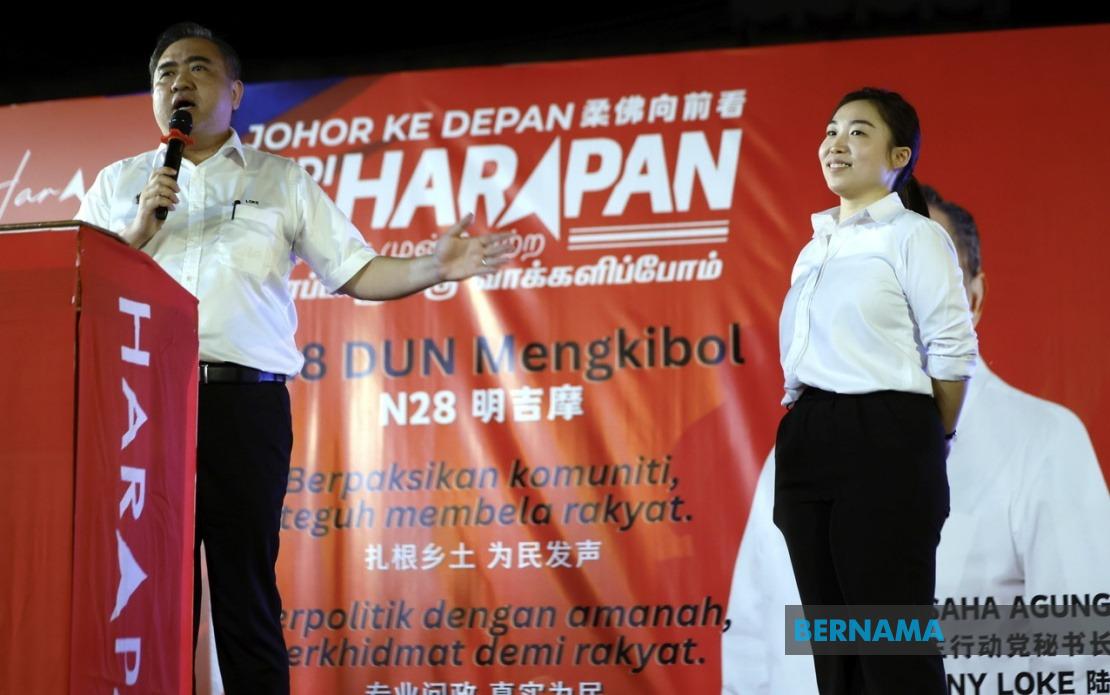
The Democratic Action Party has moved to inject fresh momentum into its Johor campaign by nominating Chu Poh Yee, a 33-year-old legal professional, as its candidate for the Mengkibol state assembly seat. The announcement, made at a ceremony in Kluang on June 18, marks a strategic transition as the party seeks to strengthen its foothold across the southern peninsula ahead of the state polls.
Chu's selection represents a departure from the seat's current representation. Chew Chong Sin, the incumbent assemblyman who has held the Mengkibol position for two consecutive terms, will step aside to pursue other political opportunities. According to party secretary-general Anthony Loke, this realignment reflects the DAP's confidence in identifying candidates with broader electoral potential. Chew is being repositioned as the party's candidate for the Labis parliamentary constituency in the next general election, following the retirement announcement of current MP Pang Hok Liong, who indicated he would not contest again.
The decision to nominate Chu underscores the DAP's deliberate strategy to expand opportunities for women candidates in prominent electoral contests. Loke emphasised that party leadership unanimously endorsed the decision, pointing to Chu's established credentials in legal assistance and community engagement. Her professional background demonstrates particular expertise in handling legal aid matters, work that has brought her into direct contact with local elected representatives and constituent grievances across the Mengkibol area.
Beyond her professional qualifications, the DAP leadership cited multiple attributes that position Chu as a viable contender. Her educational credentials meet the party's standards for parliamentary representation, while demonstrated fluency across multiple languages equips her to communicate effectively with the demographically diverse Mengkibol constituency. Critically, Loke noted her deep community connections within the area, suggesting she possesses organic links to the electorate rather than arriving as an external appointee.
The Mengkibol nomination forms part of a broader strategic deployment across Johor. The DAP has finalised its candidate list for 17 state seats, a portfolio comprising multiple categories of constituencies. Ten of these seats represent incumbencies the party currently holds and seeks to retain, including Mengkibol. An additional four seats represent previous losses that the DAP intends to contest again, suggesting confidence in recapturing ground previously conceded. The final three seats represent new territory the party believes it can contest competitively.
The announcement schedule reflects careful coordination within the opposition coalition. Loke indicated that four additional candidates—for Tiram, Johor Jaya, Senai, and Bukit Permai—would be unveiled on the following Saturday. The remaining DAP nominees would be revealed collectively alongside candidates from other Pakatan Harapan component parties, a process managed by the Prime Minister and reflecting the broader alliance's unified messaging approach for the state election.
For Malaysian readers, Chu's candidacy exemplifies broader patterns reshaping opposition politics in the country. The deliberate promotion of female candidates to competitive seats signals evolving party strategies around gender representation, particularly within the DAP, which has maintained a more progressive stance on women's political participation compared to several other Malaysian political organisations. The Mengkibol contest will test whether this advocacy translates into electoral success at the state level.
The transition from Chew to Chu also reveals calculations about candidate deployment in multi-level electoral competition. By moving Chew to pursue parliamentary ambitions, the DAP demonstrates willingness to sacrifice incumbency advantage at the state level in pursuit of federal representation gains. Such decisions reflect assessments about which political prizes offer the greatest strategic value and where particular candidates might achieve their strongest performances.
Johor remains a significant battleground in Malaysian politics, with state-level contests often indicating broader shifts in voter sentiment. The DAP's emphasis on candidate quality and institutional positioning suggests it views the forthcoming state election as consequential for shaping the political landscape in Southeast Asia's most industrialised state. Chu's emergence as a candidate exemplifies the party's belief that success requires both strong incumbency retention and strategic recruitment of new talent capable of expanding the party's appeal to constituencies where it previously underperformed.

