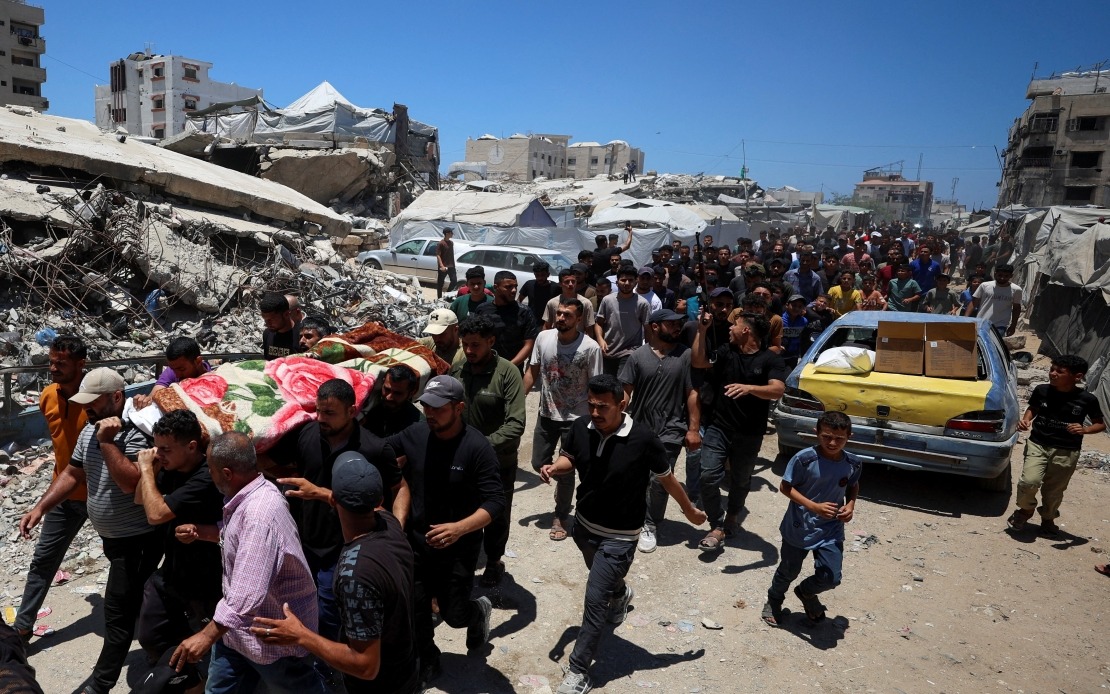
The humanitarian catastrophe unfolding in Gaza shows no signs of abating, even with a ceasefire nominally in place. According to the Palestinian Prime Minister's Office, military operations have claimed 1,021 Palestinian lives since the ceasefire's implementation, pushing the total death toll in the enclave since October 2023 to 73,032. The figures underscore the scale of destruction across the territory and highlight the severe challenges facing efforts to stabilise the region at a critical juncture in the conflict.
Conditions for those remaining in Gaza have reached a critical threshold. The Government Communication Centre reports that humanitarian circumstances continue their downward spiral as Israeli bombardments persist and restrictions on humanitarian aid delivery remain in place. Clean water shortages have become so acute that the vast majority of residents now depend entirely on whatever limited supplies humanitarian organisations can manage to distribute. This scarcity of basic necessities compounds existing health risks and threatens to precipitate additional crises independent of combat-related casualties.
The destruction of housing infrastructure has left nearly one million Palestinians living in temporary tent shelters. Israeli military operations have destroyed or damaged approximately 76.6 per cent of Gaza's housing stock, rendering entire neighbourhoods uninhabitable and displacing enormous numbers of civilians. Simultaneously, humanitarian workers face systematic impediments to their operations, unable to reach affected populations or deliver assistance effectively. This combination of physical devastation and operational restrictions has created a situation where surviving residents struggle to access even basic services and shelter.
Recent military activities have been concentrated in several population centres. Air strikes and drone operations targeting Nuseirat, Al-Mawasi, Khan Younis and Gaza City have produced waves of fresh civilian casualties whilst further degrading infrastructure and living conditions across these densely populated areas. The pattern of strikes suggests systematic operations continuing despite the ceasefire framework, complicating international diplomatic efforts and raising questions about the agreement's enforceability and actual implementation on the ground.
Children have suffered disproportionately in this conflict. United Nations Children's Fund data indicates that 265 Palestinian children have been killed and more than 400 wounded since the ceasefire announcement alone. These figures represent losses concentrated in the most vulnerable population segment and portend long-term demographic and psychological consequences for Palestinian society. International aid organisations including Oxfam have raised alarms before the United Nations Security Council, documenting how Israeli restrictions continue obstructing humanitarian access and preventing the delivery of life-saving assistance that could mitigate civilian suffering.
Disputes over heritage sites and governance structures have added another dimension to the conflict. The Palestinian Prime Minister's Office has expressed concern regarding Israeli control over planning and construction authority at the Ibrahimi Mosque in Hebron, contending that this arrangement breaches the 1997 Hebron Agreement and violates international law. Such disputes over sacred and historically significant locations compound broader political tensions and undermine arrangements designed to manage coexistence in contested territories.
The occupied West Bank faces escalating displacement pressures from multiple sources. The United Nations High Commissioner for Human Rights has documented a pronounced surge in forced Palestinian displacement across the West Bank and East Jerusalem, driven by settler violence, systematic home demolitions, movement restrictions and forced evictions. This displacement pattern represents a distinct but parallel humanitarian emergency to that unfolding in Gaza, affecting Palestinian communities across occupied territories.
Agricultural devastation compounds economic losses for Palestinian communities. The Palestinian Ministry of Agriculture has documented destruction of 7,258 trees, including 1,270 olive trees, with estimated financial losses reaching approximately US$5.17 million attributable to attacks by Israeli settlers and occupation forces. Beyond these direct agricultural losses, arson attacks have damaged religious facilities, including two mosques in Jiljilya and Mazra' al-Nubani, signifying deliberate targeting of cultural and spiritual infrastructure. These attacks often carry symbolic weight that extends beyond measurable economic damage.
Refugee camps have become particular flashpoints for displacement. Military operations conducted in Jenin, Tulkarem and Nour Shams refugee camps since January 2025 have displaced more than 33,000 Palestinians, creating secondary waves of displacement within already-vulnerable populations. Simultaneously, international monitoring bodies have raised serious concerns about conditions in Israeli detention facilities, documenting overcrowding, disease transmission risks and deteriorating treatment of Palestinian prisoners held within the system.
Despite these extraordinary circumstances, Palestinian educational institutions have persisted in delivering examinations. The Palestinian government successfully completed preparations for this year's General Secondary Education Examination, encompassing approximately 91,000 students total, with roughly 37,000 sitting examinations in Gaza. Notably, Gazan students have now completed three consecutive examination cycles through electronic delivery systems, adapting educational delivery to conflict conditions. This continuation of educational programming amid humanitarian crisis demonstrates Palestinian institutional resilience whilst simultaneously highlighting the abnormal conditions under which Palestinian youth now pursue their studies.

