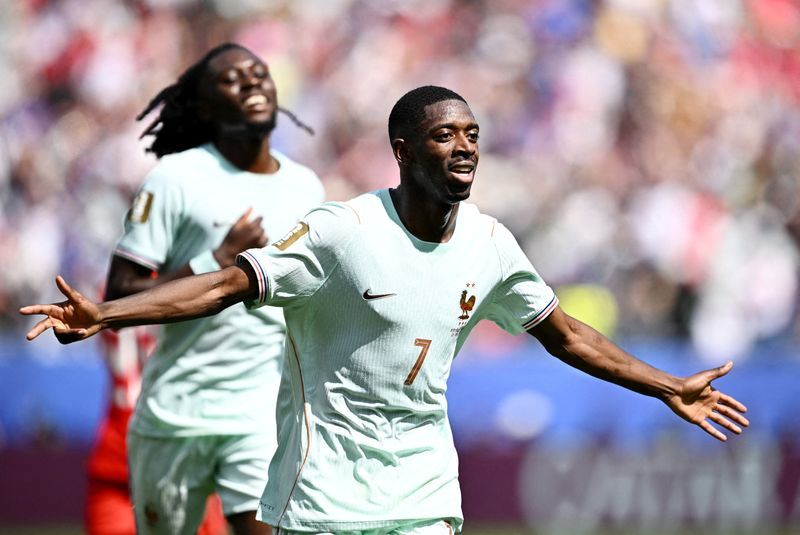
Ousmane Dembele produced one of the tournament's standout individual performances, netting three goals in just 25 minutes to spearhead France's dominant 4-1 victory over Norway in Foxborough, Massachusetts. The winger's explosive display handed the reigning World Cup runners-up pole position in Group I and momentum heading into the knockout stages, a particularly significant achievement given that France's coaching staff remained focused on honouring the commitments made before the tournament began.
Dembele's exceptional finishing was the centrepiece of a clinical French attacking display that never allowed their Scandinavian opponents any genuine opportunity to establish themselves in the contest. The speed with which he struck his three goals—completing the feat by the 32nd minute—underlined both his predatory instincts in the box and the systematic manner in which France orchestrated their assault. His achievement places him in rare historical company, becoming only the third French player to score a World Cup hat-trick, following Just Fontaine and Kylian Mbappe, a distinction that carries particular weight in a nation with such storied World Cup pedigree.
France's victory arrived with the squad operating under the shadow of personal adversity affecting their coaching setup, with head coach Didier Deschamps having departed the tournament to attend the funeral of his mother. The players responded with a commitment to excellence, promising themselves they would pursue victory as a fitting tribute to their absent leader. This blend of emotional motivation and professional execution proved particularly potent against a weakened Norwegian side that had already secured progression regardless of this match's outcome.
The match itself represented a study in contrasting preparation philosophies. While France, already assured of advancing to the Round of 32, nevertheless treated the contest with full seriousness and tactical intensity, Norway opted for significant rotation. Head coach Stale Solbakken made the strategic calculation to rest the vast majority of his starting lineup from the previous fixture against Senegal, most notably excluding goal-scoring phenomenon Erling Haaland and captain Martin Odegaard from the squad. This decision, designed presumably to preserve key personnel for the knockout phase, backfired spectacularly as France's attacking threat proved overwhelming.
The French forwards set a relentless tempo from the opening moments. Kylian Mbappe, who entered the match as a leading contender for the tournament's Golden Boot award, nearly opened the scoring within 20 seconds, his angled strike clattering against the crossbar. The Paris Saint-Germain star then orchestrated the opening goal with a measured cross-field pass that found Dembele in space on the flank, allowing the winger to cut inside, manufacture a yard of separation from his marker, and finish with conviction past goalkeeper Egil Selvik.
Dembele's second goal, arriving in the 20th minute, followed a similar pattern of clinical execution. Mbappe again demonstrated his playmaking acuity by identifying his teammate's movement, and Dembele collected the ball with composure before unleashing a dipping shot that proved beyond Selvik's reach. The Parisian's involvement in creating two of the three goals underscored the complementary nature of France's attacking partnership, with both players operating at a level that overwhelmed their opponents' defensive structures.
Norway briefly threatened to build momentum when Thelo Aasgaard converted a goal almost immediately following Dembele's second strike, suggesting the match might develop into a more competitive encounter. This optimism proved premature. Dembele extinguished any Norwegian revival by curling a low shot into the bottom corner in the 32nd minute, his third goal cementing his place in World Cup history. The speed of his hat-trick—achieved in 25 minutes—ranked as the second-fastest in tournament history, surpassed only by Austria's Erich Probst, who scored three goals against Czechoslovakia in 1954 after 24 minutes.
Norway created isolated moments of concern for the French defence in the second half, most notably when Jorgen Strand Larsen stepped up to take a penalty kick in the early stages of the restart. His soft, tentative effort proved straightforward for France goalkeeper Mike Maignan to smother, a crucial save that prevented the Scandinavians from closing the gap further. Oscar Bobb's subsequent attempt also required Maignan's intervention, indicating that despite France's commanding position, lapses in concentration could have created openings for their opponents.
France sealed their victory with a fourth goal in the dying stages, when Desire Doue powered a header past Selvik following a cross from substitute Bradley Barcola. The goal reflected France's sustained dominance, arriving when the contest had long since been decided and attention had shifted toward the structural implications of the group's final standings. By securing top spot in Group I, France positioned themselves favourably for the tournament's knockout bracket, benefiting from the reduced travel demands associated with the Group I winner's path through the North American venue configuration.
The victory's most significant consequence extends beyond the scoreline itself. By finishing as group winners rather than runners-up, France will face Sweden in the Round of 16, while Norway, as group runners-up, will confront Ivory Coast. This distinction carries tactical and logistical weight, as the tournament's routing meant that topping the group offered advantages in managing the considerable distances between fixtures across North American host cities. For Southeast Asian observers tracking the tournament's development, France's clinical performance demonstrated the gulf in quality between the tournament's elite performers and more modest competitors, while also highlighting how squad rotation can backfire when elite opposition exploits the vulnerability created by wholesale personnel changes.

