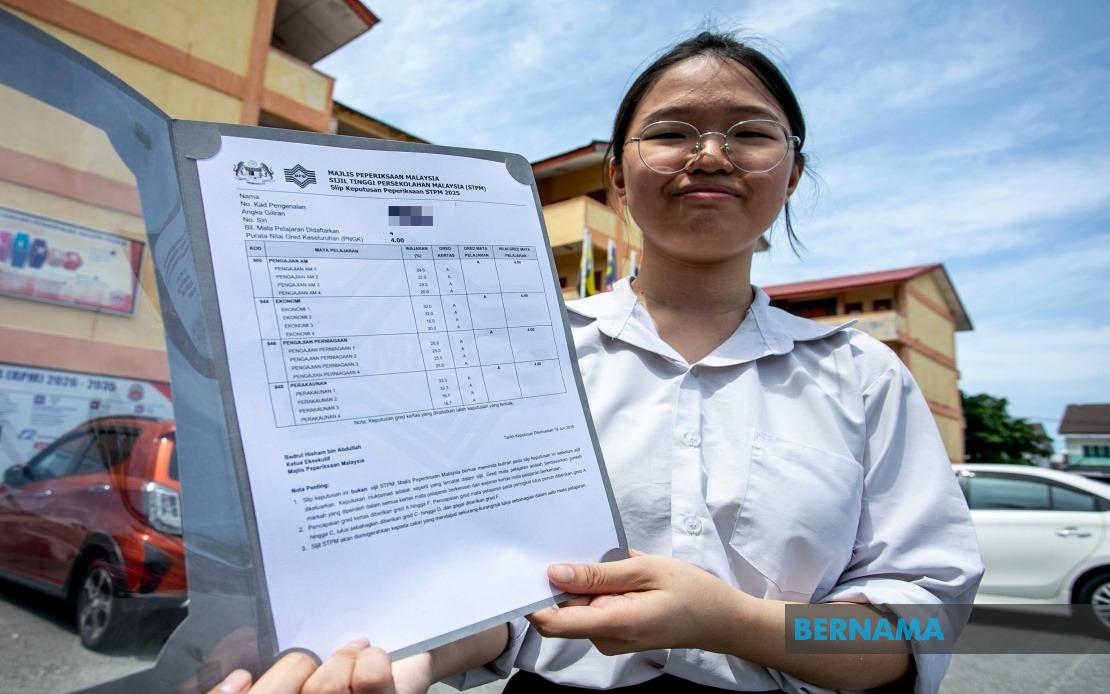
Yong Xin Yi, a twenty-year-old student at SMK Jalan Tasek in Ipoh, has demonstrated that academic excellence emerges from consistency rather than intensity. Her achievement of 4As in the 2025 Sijil Tinggi Persekolahan Malaysia (STPM) examination—securing Grade A in General Studies, Principles of Accounting, and Economics with a perfect Cumulative Grade Point Average of 4.00—reflects a methodical approach to secondary education that prioritises sustained engagement over sporadic cramming sessions.
The Ipoh-born student, who is an only child, structured her academic day with precise intention. Each afternoon, immediately after school concludes, Xin Yi dedicates a five-hour window from 5:00 pm to 10:00 pm exclusively to revising her course material. This regimented schedule represents not a last-minute intervention but rather the culmination of year-long habits established alongside her regular classroom attendance. For Malaysian students navigating the increasingly competitive landscape of upper-secondary education, such structured approaches offer a practical blueprint that avoids the burnout associated with excessive late-night studying.
Central to Xin Yi's success is her philosophy that classroom engagement supersedes later revision efforts. She emphasises that absorbing the teacher's explanations directly during lessons substantially reduces the cognitive load required during home study sessions. This observation carries particular relevance for Malaysian schools, where the teacher-student relationship remains foundational to learning outcomes. By investing full concentration during teaching periods, she minimised confusion and conceptual gaps that would otherwise demand disproportionate revision time. This approach transforms the classroom from a passive reception space into an active learning environment where understanding takes priority over note-taking.
Beyond attendance and attention, Xin Yi maintained rigorous completion of all assigned homework. She views this exercise not as administrative obligation but as mastery-building activity that reinforces topical understanding. For Malaysian educators and parents concerned about homework efficacy, her experience validates the pedagogical argument that homework serves as a bridge between classroom concepts and independent problem-solving. The combination of classroom focus, homework completion, and structured revision created a comprehensive learning ecosystem rather than isolated study moments.
Among her three subjects, General Studies emerged as the most formidable challenge. Xin Yi recognised that this discipline demanded not merely content knowledge but sophisticated writing ability and precise alignment with examination format and marking criteria. Rather than avoiding this weakness, she deliberately channelled additional attention toward it, ensuring early identification and systematic remediation. This proactive response to academic difficulty—rather than passive acceptance—reflects a growth mindset that Malaysian secondary students would benefit from cultivating. Her willingness to confront challenging material distinguishes high achievers from those who pursue easier paths.
Xin Yi's accomplishments extend beyond individual achievement within her school. She represented one of five SMK Jalan Tasek students who attained 4As in the 2025 STPM cycle, suggesting that her school's academic culture and teaching methodologies supported multiple pathways to excellence. This clustering of high achievement indicates institutional strength rather than isolated student brilliance, offering valuable insights for school administrators across Malaysia examining factors that foster collective student success.
The student's motivation transcends personal ambition. As the daughter of a clerk mother and phone salesman father, she frames her academic success as an investment in family welfare. She explicitly states her intention to leverage her achievements to improve family circumstances and honour her parents' sacrifices through future accomplishments. This articulation of filial responsibility and familial orientation reflects deeply rooted Malaysian values that education serves not merely individual advancement but family elevation. Such intrinsic motivation, rooted in family connection rather than external competition, often sustains students through demanding study periods.
Xin Yi's career aspirations align logically with her examined subjects. Her ambition to become an economist emerged from deliberate assessment of personal interests and career trajectory potential within the field. She selected Universiti Putra Malaysia (UPM) to pursue further economics studies, having conducted considered evaluation of educational opportunities and professional prospects. This thoughtful decision-making process—rather than subject selection driven purely by examination scores or parental expectation—reflects educational maturity that Malaysian guidance counsellors increasingly emphasise.
The economics sector holds particular relevance for Malaysian graduates seeking professional pathways with substantial market demand. As Malaysia's economy increasingly emphasises data-driven policy-making, skilled economists occupy valued positions across government agencies, financial institutions, research organisations, and multinational corporations. Xin Yi's decision to specialise in this field positions her favourably within emerging employment landscapes, particularly as Southeast Asian economies navigate post-pandemic structural adjustments and digital transformation.
For the broader Malaysian education community, Xin Yi's trajectory offers multiple insights applicable beyond individual case study. Her success demonstrates that academic excellence does not require extraordinary resources or exceptional natural talent but rather disciplined execution of foundational study practices. The five-hour daily revision routine she maintains remains achievable for committed students regardless of socioeconomic background. Her emphasis on classroom attentiveness challenges the cultural tendency in some Malaysian schools to valorise after-school tuition as the primary pathway to examination success. Institutional commitment to teaching quality, combined with student discipline and family support, creates conditions for outstanding results.
The recognition of family support within her achievement narrative also warrants emphasis. Xin Yi explicitly credits her parents' encouragement throughout her study period, acknowledging that academic success emerges from ecosystems rather than isolated individual effort. Malaysian parents often question optimal involvement in secondary children's studies—whether to provide direct academic assistance, emotional support, or structured opportunity. Xin Yi's example suggests that encouragement and facilitation of study conditions, rather than directive intervention, enables mature students to develop autonomous learning capacities while maintaining motivational support.
As Malaysian education systems continue evolving in response to economic demands and technological change, students like Yong Xin Yi exemplify how traditional virtues—discipline, focus, consistency, and family commitment—remain powerful engines of achievement. Her 4As in STPM serve not as exceptional aberration but as reproducible outcome available to students who commit to systematic effort and maintain clarity about aspirational futures.

