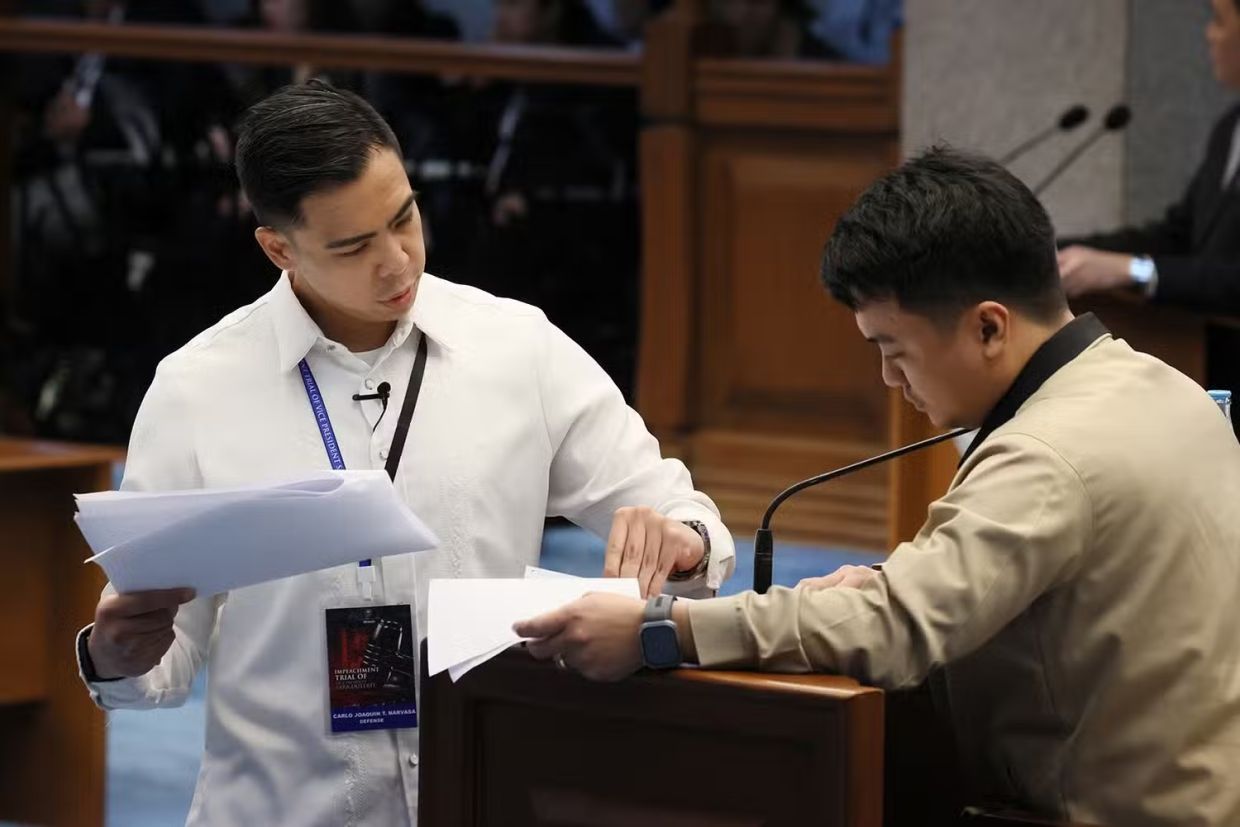
The impeachment trial of Philippine Vice President Sara Duterte entered a crucial phase when her defence counsel began dismantling the prosecution's case on the third day of proceedings before the Senate impeachment court. Rather than directly denying the remarks she made in November 2024, Duterte's legal team adopted a two-pronged strategy: first, arguing that even if the threatening statements occurred, they do not qualify as impeachable offences under the 1987 Constitution; and second, presenting an alternative narrative that frames her words as desperate responses to alleged government persecution of her family and staff.
The centrepiece of the defence examination focused on National Bureau of Investigation senior agent John Mark Calilung, who had presented the prosecution's initial evidence regarding the online press briefing on November 23, 2024, when Duterte allegedly issued grave threats against President Ferdinand Marcos, first lady Liza Araneta-Marcos, and former Speaker Martin Romualdez. Defence counsel Mark Vinluan seized on a critical admission made during Tuesday's questioning: the prosecution itself acknowledged that video recordings of Duterte's statements did not constitute conclusive proof that she had contracted an assassin. This concession became the foundation for the defence's legal argument that threats alone, without evidence of an actual assassination plot being commissioned, cannot satisfy the threshold for impeachment under Article XI, Section 2 of the Philippine Constitution.
The constitutional question at issue reflects a longstanding debate about the scope of impeachable offences. The Constitution lists specific grounds for removal: culpable violation of the Constitution, treason, bribery, graft and corruption, betrayal of public trust, and the catch-all phrase "other high crimes." Vinluan argued strenuously that Duterte's utterances, however inflammatory or unconventional, do not rise to the level of "high crimes" as the framers intended. The defence maintained that prosecutors had fundamentally failed to bridge the gap between words spoken at a press conference and the criminal act of soliciting murder. Without evidence that Duterte had actually attempted to hire a hit man or taken concrete steps to arrange the killing of the three individuals, the defence contended, the impeachment court should dismiss the charge as failing to meet constitutional requirements.
Central to the defence strategy was the presentation of contextual evidence suggesting that Duterte's remarks emerged from what her team characterised as systematic government persecution. When Duterte made her controversial statements, her chief of staff Zuleika Lopez was simultaneously being held in contempt by a House committee investigating confidential funds of the Office of the Vice President. The defence team presented video footage showing Lopez breaking down emotionally as she resisted transfer to the Correctional Institution for Women, expressing fear for her personal safety. Defence lawyer Carlo Narvasa argued that this parallel crisis triggered Duterte's defensive response, positioning her not as a would-be orchestrator of murder but as a family protector reacting to what she perceived as an authoritarian crackdown. This reframing sought to shift the court's attention from the literal meaning of her words to the political and personal circumstances that generated them.
The challenge to the NBI investigation exposed significant evidentiary weaknesses in the prosecution's case. Calilung conceded that neither Marcos, the first lady, nor Romualdez had personally filed criminal complaints against Duterte or appeared before the bureau to provide sworn statements. Instead, the NBI had launched its investigation motu proprio, or on its own initiative, without a formal complainant driving the process. This procedural gap troubled the defence, which questioned whether the investigation had been thorough or whether it suffered from investigative biases. Narvasa noted that the revised affidavit submitted on February 10, 2025, notably lacked affidavits from the three alleged targets of the threats or from journalists who attended the November 23 press briefing. The defence suggested that if the threats were as grave and consequential as prosecutors maintained, surely the purported victims would have rushed to provide their own accounts to investigators.
Vinluan pressed further on the precise wording of Duterte's statements, asserting that the term "assassin" had been interpolated by third parties rather than explicitly used by the Vice President herself. This linguistic distinction became important in the defence narrative: Duterte, in this telling, had made intemperate remarks about protecting herself and her family, but did not specifically propose hiring someone to commit murder. By emphasising that prosecutors were inferring intent from words that did not directly confess to criminal conspiracy, the defence argued that the impeachment court risked punishing a politician for imprecise language rather than prosecuting clear criminality. The defence insisted on viewing Duterte's statements within their proper context—a moment of acute family stress triggered by perceived injustice—rather than as premeditated threats demonstrating a calculated intent to eliminate political rivals.
The proceedings revealed tensions within the Senate impeachment court itself regarding the scope of questioning permitted. When Senator Risa Hontiveros posed a hypothetical question asking whether grave threats could ever be justified by legitimate underlying grievances, presiding officer Senator Francis Escudero intervened to redirect the discussion. Escudero cautioned that senator-judges should avoid formulating questions requiring counsel to draw legal conclusions, as such matters belonged in closing arguments. Hontiveros respectfully noted that previous impeachment trials in the Philippines had permitted broader questioning, suggesting that the current court was applying more restrictive standards. This procedural disagreement underscored the broader difficulty facing the impeachment proceedings: determining how much contextual and political information the court should consider when evaluating whether specific constitutional thresholds have been met.
The defence narrative of persecution extended beyond Lopez's detention to encompass broader allegations of government surveillance and harassment. Vinluan contended that Duterte and her family had been subjected to "unauthorised intelligence and surveillance operations by government agents" that had created security threats and psychological trauma. He referenced classified intelligence reports allegedly documenting surveillance of Duterte's residences in both Davao and Manila, and claimed that trusted security personnel had been removed from her protective detail. These allegations, presented without independent corroboration in the courtroom, were designed to establish that Duterte faced genuine security concerns that justified her fortified emotional response. The defence thus shifted the narrative from one centred on Duterte's alleged criminal intent to one portraying her as a victim of institutional abuse who lashed out defensively.
Defence lawyer Carlo Narvasa attacked the House committee's conduct as constituting systematic oppression, particularly targeting Representative Joel Chua, who chairs the committee investigating confidential funds and now serves as a House prosecutor. Narvasa highlighted that Lopez had been cited in contempt, transferred to detention facilities, and denied her lawyer's accompaniment during the transfer process. This concatenation of allegedly harsh treatment, according to the defence, created the conditions from which Duterte's statements emerged. However, when pressed by Hontiveros on whether the defence was arguing that grave threats could be justified by legitimate grievances, Narvasa retreated, insisting that the defence did not endorse such a principle. This apparent contradiction—arguing that context justifies Duterte's conduct while simultaneously denying that threats can ever be justified—revealed an inherent tension in the defence strategy.
The cross-examination of Calilung also highlighted the NBI's procedural irregularities and potential gaps in investigative rigour. Calilung confirmed that he executed an affidavit attesting to the minutes of investigators' interviews rather than securing direct statements from investigators themselves. The bureau had complied with Department of Justice requirements and obtained certification of sufficiency in its preliminary investigation, yet these procedural checkmarks did not address the substantive question of whether the investigation had actually uncovered evidence of criminal conspiracy. When Narvasa asked directly whether the NBI had really investigated the case—a pointed challenge implying superficial work—Calilung did not respond as the prosecution objected. This exchange captured the defence's core argument: that the prosecution, despite formal procedures, had failed to establish the factual predicates necessary to sustain an impeachment charge.
For Malaysian observers and Southeast Asian readers, the Duterte impeachment trial illustrates how constitutional systems grapple with the boundary between political speech and criminal conduct. The case demonstrates that even in democracies with established constitutional frameworks, disputes over the definition of impeachable offences remain contested and substantive. The Filipino experience suggests that impeachment proceedings become particularly contentious when they occur against a backdrop of alleged institutional abuses and inter-branch conflicts. The defence strategy—combining constitutional arguments about the requisite threshold for impeachment with contextual narratives about persecution—reflects a broader pattern in which political trials in developing democracies become venues for airing deeper systemic grievances rather than narrowly focused legal proceedings. The trial's outcome will likely establish precedent regarding how Philippine courts balance the gravity of threatening rhetoric against the requirement that impeachable conduct meet specific constitutional definitions, a question relevant to governance and rule of law across the region.

