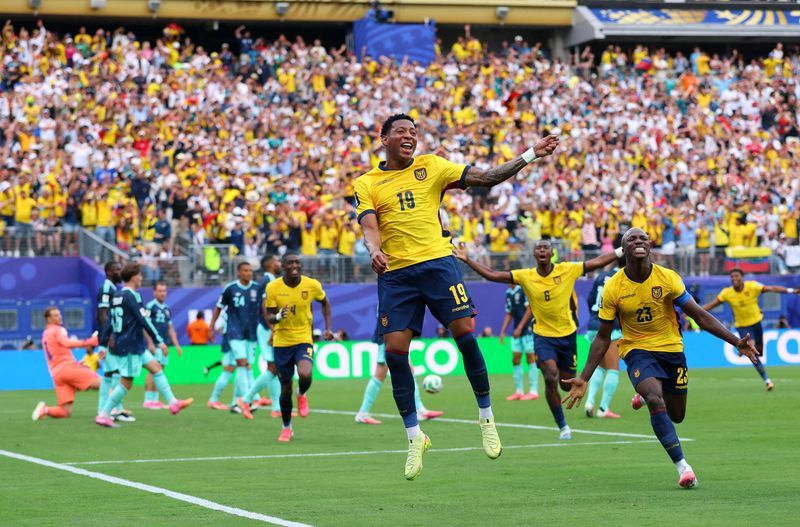
In a dramatic turn of fortune at the East Rutherford stadium in New Jersey, Ecuador produced a remarkable second-half resurgence to eliminate the threat of elimination and secure their passage to the World Cup knockout round with a 2-1 victory over Germany on Thursday. The South American side, facing the spectre of early exit after disappointing performances in their opening matches, engineered a stunning turnaround against the already-assured group leaders to claim qualification as one of the tournament's eight best third-placed teams.
The match unfolded as a tale of two halves, with Ecuador's fortunes transformed within the span of ninety minutes. The European powerhouse struck with brutal efficiency in the opening moments when Leroy Sane converted just ninety seconds into play, latching onto a cutback from Florian Wirtz following a quick throw-in down the right flank. The goal marked Sane's breakthrough moment at a major international competition, arriving in his fifteenth appearance for Germany at this level of tournament football. For Ecuador, already burdened by the pressure of their previous results, the early concession threatened to compound their mounting difficulties in a competition where they had laboured to find the back of the net.
Yet the performance would have prompted serious concerns within the German camp, as their defensive frailties remained on full display. The Ecuador goal arrived amidst protested claims from the South Americans that Aleksandar Pavlovic had committed a foul by raising his foot into the head of Pedro Vite during the build-up, though referee Tori Penso allowed the goal to stand after deeming the contact acceptable within the laws of the game.
Ecuador's response came with commendable urgency, levelling through Nilson Angulo just eight minutes after falling behind. The midfielder's curled finish from the edge of the penalty area demonstrated the precision that had eluded Ecuador throughout the tournament to that point. Remarkably, the goal represented their breakthrough effort after thirty-nine unsuccessful attempts across their first two fixtures, illustrating the desperation with which they approached this decisive contest. Goalkeeper Manuel Neuer's slow reaction to Angulo's strike suggested a momentary lapse in concentration from the German stopper, offering Ecuador the momentum shift their campaign desperately required.
The second period brought further controversy when Penso initially awarded Germany a penalty after Felix Nmecha fed Kai Havertz into the box, with the official determining that Ecuador defender Joel Ordonez had tripped the German attacker. The award appeared to restore Germany's grip on proceedings, yet the intervention of video assistant review technology reversed the decision, with officials identifying a prior infringement in the build-up by Germany that rendered the penalty invalid. The overturned decision represented a critical juncture, effectively preventing Germany from extending their lead and maintaining the narrow margin that had revived Ecuador's hopes.
Clear-cut opportunities became increasingly scarce as the match progressed toward its conclusion, yet Ecuador's intensity never wavered despite the quality of their opponents. The decisive moment arrived in the seventy-eighth minute when substitute Kevin Rodriguez flicked a corner kick toward the near post, where Gonzalo Plata reacted with alertness to stab the loose ball past Neuer. The goal unleashed scenes of euphoria within the stadium, as Ecuador's fans recognised the profound significance of the moment—their team had navigated from the brink of elimination to securing their ticket to the knockout stage.
Germany's group stage experience proved bittersweet despite their advancement as group winners. The Bundesteam finished on six points but would have aspired to claim the summit position with a victory, having come to New Jersey chasing a third consecutive group win and a twelfth successive victory across all competitions. Instead, they yielded top spot to Ivory Coast on goal difference, with the Africans securing a 2-0 triumph over Curacao in the parallel fixture. More troublingly for German tactical analysis, their defensive vulnerabilities—now evident across all three group encounters—raised questions about their structural resilience as the tournament progressed deeper into the knockout rounds.
Ecuador's qualification carries particular significance for a confederation that has often struggled to maintain consistent presence at world football's greatest tournament. Having arrived in the United States following an unconvincing draw against Curacao and a defeat to Ivory Coast, their fate had rested entirely on this final group assignment. The victory represents not merely advancement but vindication of their fighting spirit and capacity to respond when circumstances appeared darkest. Their qualification as one of the eight best third-placed finishers demonstrates how the expanded tournament format rewards competitive intensity and dramatic momentum shifts across the group stage.
For Malaysian and Southeast Asian observers, the Ecuador narrative offers instructive lessons about tournament football's unpredictability and the margins between success and failure at international level. The match illustrated how early setbacks need not prove decisive if teams maintain tactical discipline and capitalise upon opposition weaknesses, themes directly relevant to regional football aspirations. Ecuador's resurgence against a higher-ranked opponent underscores that competitive pedigree alone cannot guarantee results when concentration lapses occur or individual moments prove decisive.
The implications ripple through the tournament structure, as Ecuador's advancement as third-place qualifiers affects the broader picture of group composition and the distribution of teams across knockout pairings. Germany's inability to maintain their flawless record in the group stage similarly becomes context for their progression path, potentially influencing their trajectory toward a knockout confrontation with more formidable opposition than might have materialised had they topped their group.

