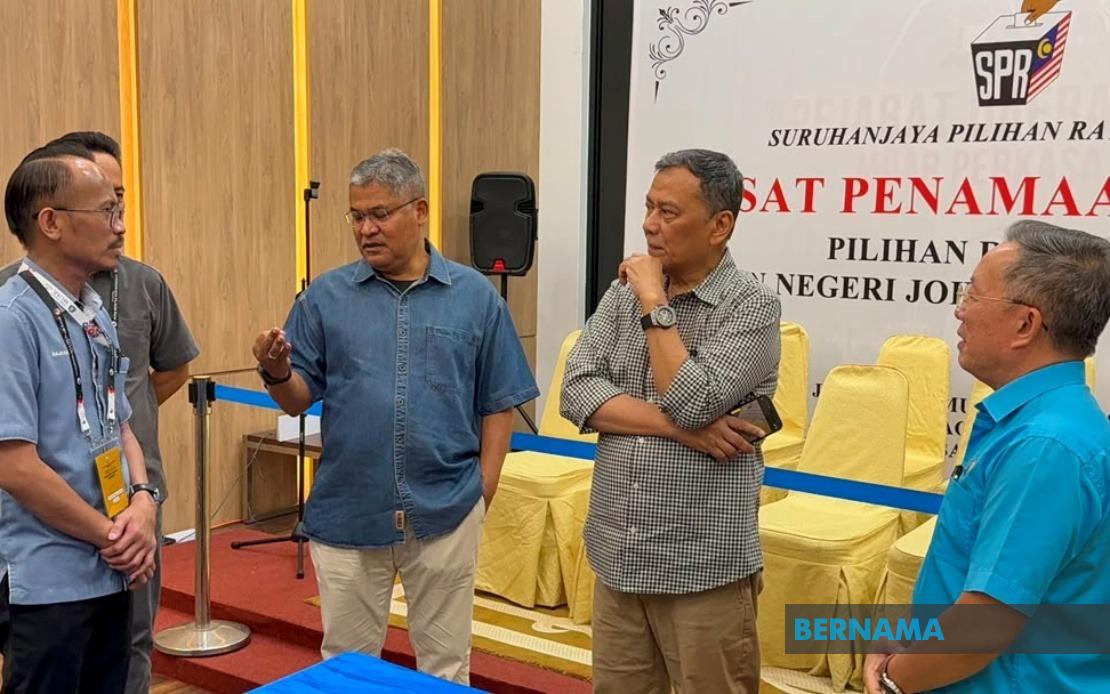
The Election Commission is in the final stages of readying the state for tomorrow's nomination day in the Johor state election, with returning officers confirming that all designated polling centres have completed their logistical and technical preparations. A visit to several Candidate Nomination Centre locations across Johor Bahru revealed that personnel are conducting only minor finishing touches as the machinery for one of Malaysia's most closely watched recent state elections winds up its preparatory phase.
At the Perling state constituency nomination centre, housed within Dewan Jubli Intan Hall, returning officer Nazatul Shima Mohamad expressed confidence that the venue is fully operational. The layout of the premises has been finalised and simulation exercises with participating agencies concluded, leaving no stone unturned in the bid to orchestrate a seamless process when prospective candidates arrive to file their nominations tomorrow. She urged all aspirants to arrive punctually, emphasising the importance of bringing complete documentation and deposits to expedite the registration procedures.
The Kota Iskandar centre, located at the Main Hall of Iskandar Puteri City Council in Medini, represents a more complex logistical challenge given the anticipated volume of party supporters who will congregate outside the nomination venue. Returning officer Shahrulizam Abdul Rashid outlined an extensive management strategy developed in coordination with police authorities to maintain order and safety throughout the day. This includes strategic road closures near the centre and the establishment of a 50-metre exclusion zone around the nomination hall itself to prevent congestion and potential confrontations between rival party supporters.
The physical infrastructure at each centre has been augmented with temporary structures designed to channel crowds efficiently. Tents have been erected outside the main halls to provide shelter for supporters, while carefully positioned barriers will clearly demarcate the spaces allocated to competing parties. These arrangements reflect lessons learned from previous state elections and underscore the commission's commitment to balancing democratic participation with public safety. Shahrulizam also cautioned supporters attending tomorrow's proceedings to exercise restraint and avoid any provocation that might compromise the atmosphere of civility expected during a democratic exercise.
The nomination process itself will operate on a compressed schedule, running from 9 to 10 am across all 56 designated polling centres throughout Johor. This concentrated timeframe means the election machinery must function with precision to process all nominations within the scheduled window, after which returning officers will formally announce which candidates have been officially cleared to contest. The tight schedule places considerable pressure on administrators but also demonstrates the commission's organisational capacity to manage complex electoral logistics.
The electoral register for this election reflects the substantial constituency that will ultimately determine Johor's next state government. Approximately 2.73 million registered voters are eligible to participate, comprising 2.70 million ordinary citizens alongside nearly 25,000 military and police personnel and their spouses. This voter base represents a cross-section of Johor's diverse population and economic interests, ranging from manufacturing heartlands to agricultural regions and urban centres. The size of the electorate underscores the significance of tomorrow's nomination proceedings and the weeks of campaigning that will follow.
The dissolution of the Johor State Legislative Assembly on June 1 set the electoral calendar in motion, establishing the sequence of events that culminates in polling day on July 11. The commission's decision to schedule early voting for July 7 reflects growing recognition that some voters may be unable to participate on the main polling date due to work commitments or other obligations. This phased approach to voting has become standard practice in Malaysian state elections, accommodating the demands of modern life while maintaining the integrity of the democratic process.
Nazatul Shima's statement that preparations are 100 per cent complete carries weight given the critical role nomination day plays in setting the parameters for the election campaign. Once nominations close tomorrow, the field of candidates will be fixed and the battle lines drawn between competing parties and individuals vying for 56 state assembly seats. Any procedural failure at this stage could invalidate candidatures or create legal complications that might undermine public confidence in the electoral process. The meticulous preparation visible across nomination centres reflects the commission's determination to avoid such scenarios.
The involvement of police in maintaining order at nomination centres reflects the charged political atmosphere that frequently characterises state elections in Malaysia. Johor's political landscape has witnessed intense competition between different coalitions, and the prospect of candidates filing nominations tends to energise party machinery and mobilise grassroots supporters. The police coordination arrangements ensure that while citizens retain their right to express political sentiment, proceedings remain orderly and free from disruption. The 50-metre restriction zone around nomination halls represents a calibrated approach that permits external political demonstration while protecting the integrity of the nomination process itself.
As the election machinery prepares for tomorrow's nominal cascade, the broader context of Johor politics provides important backdrop. The state remains economically significant within Malaysia's federal structure and politically consequential for the nation's overall trajectory. Elections here often provide early indicators of electoral sentiment that influence national political calculations. The apparent readiness of the Election Commission to conduct tomorrow's proceedings smoothly will be important in establishing confidence that the subsequent campaign and polling day will also proceed without incident. Public trust in electoral administration has become increasingly vital in Malaysia's evolving political environment.

