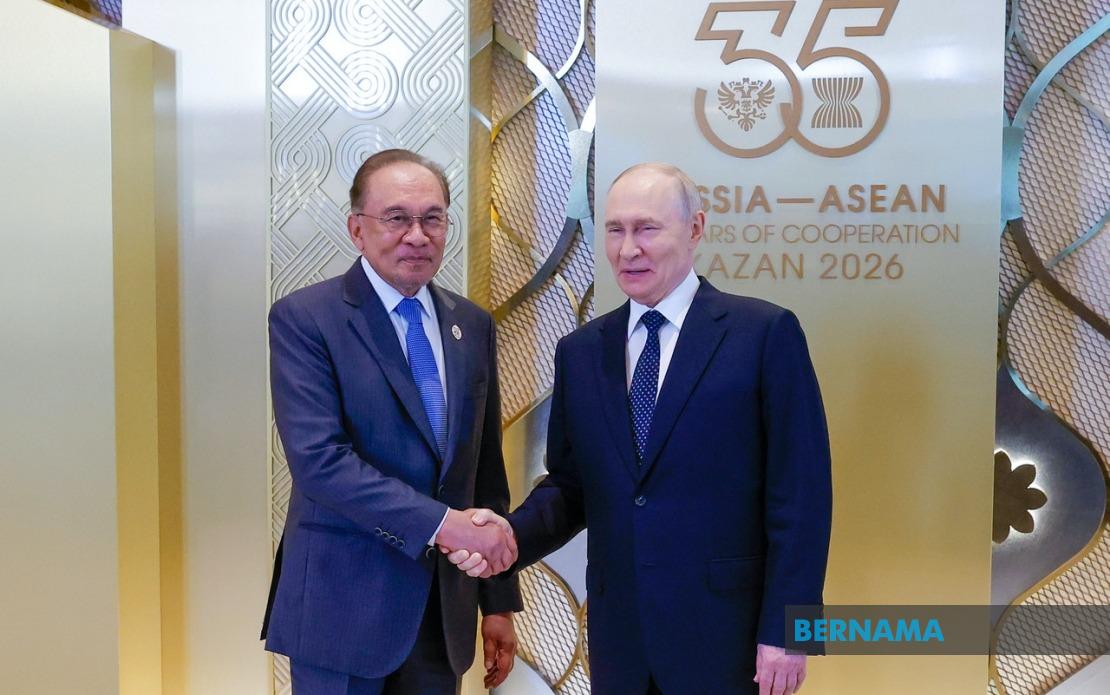
Prime Minister Datuk Seri Anwar Ibrahim has underscored the vital importance of structured diplomatic engagement in an increasingly complex global landscape, emphasising that multilateral forums and bilateral exchanges serve as essential mechanisms for strengthening relationships among nations. Speaking at the ASEAN-Russia Commemorative Summit in Kazan, the capital of Tatarstan, Anwar articulated a vision of dialogue-driven diplomacy as a counterweight to the mounting challenges and uncertainties confronting the international community, positioning such platforms as indispensable tools for building lasting partnerships.
The Prime Minister, who is also Malaysia's Finance Minister, attended the summit from June 17 to 18, where he participated in a gala dinner hosted by Russian President Vladimir Putin. The event provided an opportunity to engage directly with other participating leaders and discuss matters of mutual concern. For Malaysia and other ASEAN members, such high-level summits represent rare occasions to interact with major powers outside the usual channels of formal state visits and routine diplomatic missions.
Anwar's remarks reflect a strategic appreciation for the role that cultural and historical exchanges play in international relations. He noted that the summit succeeded not only in facilitating substantive discussions about cooperation but also in showcasing Russia's cultural heritage and historical significance to the assembled delegations. This broader context matters considerably for Southeast Asian nations seeking to diversify their international partnerships and deepen understanding with countries beyond their immediate region.
The emphasis on mutual understanding carries particular weight in contemporary geopolitics. ASEAN member states, positioned at a critical crossroads between major powers, recognise that robust dialogue mechanisms help prevent misunderstandings that could escalate into larger conflicts. The ASEAN-Russia Commemorative Summit represents a formal recognition that cooperation between the regional bloc and Moscow requires deliberate cultivation and sustained engagement at the highest political levels.
Bilateral relations were explicitly identified by Anwar as complementary to multilateral frameworks. While regional summits provide a collective platform for addressing shared challenges, bilateral interactions enable countries to address specific concerns and identify tailored areas of cooperation. For Malaysia, maintaining strong bilateral ties with Russia alongside ASEAN-level engagement offers flexibility in navigating complex regional dynamics and advancing national interests.
Trust-building emerged as a central theme in Anwar's assessment of the summit's value. In an era when suspicion and strategic rivalry increasingly characterise major power relations, creating dedicated spaces where leaders can interact informally and build personal rapport serves a crucial function. The gala dinner, in particular, provides an opportunity for leaders to step away from formal negotiating positions and develop the personal connections that often underpin successful diplomatic breakthroughs.
The identification of mutual benefits as a driving force behind cooperation signals Malaysia's pragmatic approach to foreign policy. Rather than framing engagement purely in ideological or security terms, the emphasis on mutual advantage suggests that ASEAN-Russia relations are premised on identifying concrete areas where both sides gain tangible returns. This could encompass trade and investment, cultural exchanges, educational partnerships, or technical cooperation in specific sectors.
For Malaysian readers, Anwar's statement carries implications for how Malaysia conducts its own foreign policy. As a middle power balancing relationships with major global actors, Malaysia benefits from demonstrating commitment to engagement and dialogue. The Prime Minister's participation and his public articulation of the summit's importance reflect Malaysia's intention to maintain constructive relations with a broad spectrum of international partners, including Russia, despite geopolitical tensions elsewhere.
The summit also underscores ASEAN's role as a collective diplomatic actor. Rather than member states engaging Russia individually, the bloc's coordinated approach through commemorative and regular summits enhances the region's leverage and influence. This collective posture strengthens ASEAN's hand in discussions with major powers and reinforces the centrality of the regional grouping in Asian affairs.
Anwar's characterisation of such platforms as essential reflects a broader belief that even amid significant differences, dialogue remains preferable to isolation or confrontation. This principle, central to ASEAN's founding philosophy of engagement and non-interference, continues to guide the region's interactions with external powers. The Commemorative Summit represents a concrete manifestation of this commitment to sustained diplomatic engagement as a foundation for regional stability and prosperity.

