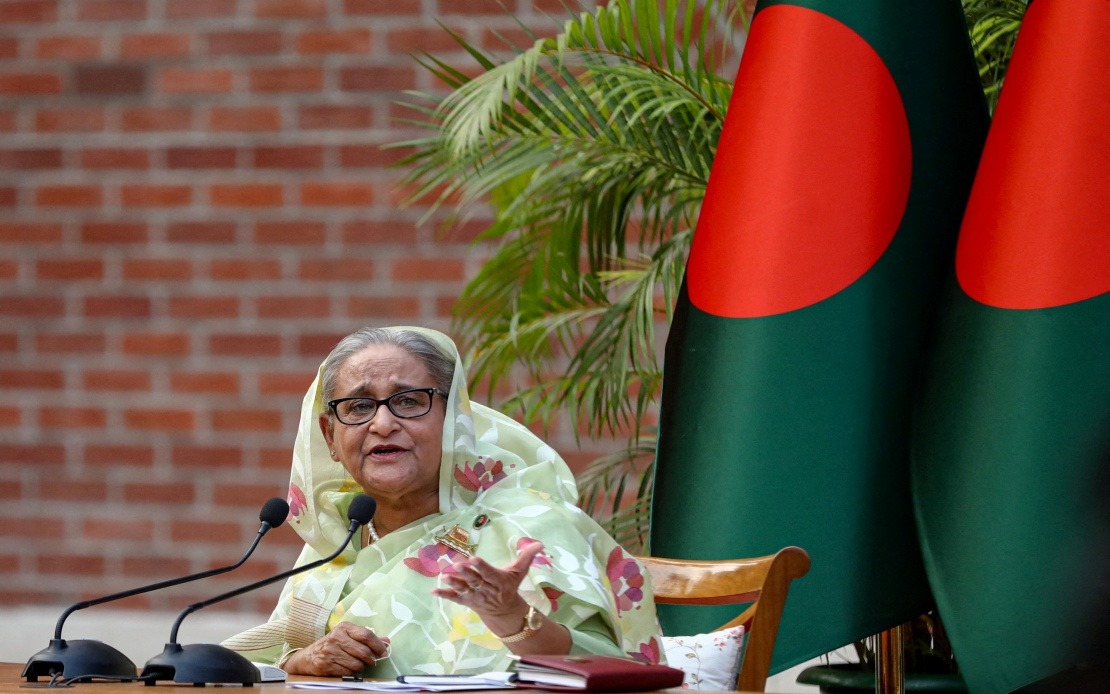
Sheikh Hasina, Bangladesh's ousted Prime Minister now living in India, has declared her determination to return to her homeland and submit to judicial proceedings despite the prospect of imprisonment or capital punishment. The 78-year-old leader, who fled the country in August 2024 as mass protests engulfed Dhaka, made the announcement through a written interview with Kyodo News, signalling defiance against the new Bangladesh government's efforts to hold her accountable for her actions during her final term in office.
The stakes surrounding Hasina's potential return are extraordinarily high. Bangladesh's war crimes tribunal sentenced her to death in November 2025 for crimes against humanity linked to the violent suppression of widespread student-led demonstrations that erupted in mid-2024. She was convicted in absentia, denied the opportunity to present her defence in person. The government in Dhaka has formally requested her extradition from India, setting the stage for a dramatic political confrontation that carries implications far beyond Bangladesh's borders.
The unrest that precipitated Hasina's downfall originated from a June 2024 court decision reinstating a 30 percent employment quota for descendants of those who fought in Bangladesh's 1971 independence war. Student activists, viewing this as an unjust privileging of one group, organised protests that rapidly evolved into a comprehensive challenge to Hasina's government. Street clashes between demonstrators and security forces intensified over weeks, with violent confrontations leaving thousands injured and destabilising the entire nation.
The human toll proved catastrophic. United Nations assessments documented approximately 1,400 deaths during the upheaval, with the vast majority resulting from gunfire by state security personnel. Hasina has consistently denied personal responsibility for these deaths, contending instead that she never issued orders to open fire on protesters. She has suggested that political opponents deliberately manipulated the demonstrations to engineer regime change, a narrative that reflects the deep polarisation within Bangladesh's political establishment.
In her recent statement, Hasina proposed an unconventional approach to establishing the truth about the killings. She called for independent international forensic specialists to examine each fatality, analyse weapon types and ballistic evidence, and reconstruct the precise circumstances surrounding individual deaths. This proposal, while potentially advancing accountability, implicitly acknowledges the gravity of allegations facing her while simultaneously questioning the legitimacy of proceedings conducted without her participation. International human rights organisations including Human Rights Watch have raised serious concerns about the trial held in her absence, noting that proper judicial process demands the accused's opportunity to confront charges and present evidence.
The extradition question has placed India in a delicate diplomatic position. New Delhi formally acknowledged receipt of Bangladesh's extradition request and indicated it was examining the matter through the lens of applicable legal frameworks and bilateral judicial protocols. India's cautious response reflects the complexity of the situation—Hasina maintains strong historical ties to India as the daughter of Bangladesh's founding father Sheikh Mujibur Rahman, yet India must weigh these historical connections against its international legal obligations and bilateral relations with the new Bangladeshi administration.
Since Hasina's departure, Bangladesh has undergone dramatic political transformation. An interim government led by Nobel Peace Prize laureate Muhammad Yunus initially assumed control following her flight. Subsequently, a general election held in February 2026 resulted in victory for the Bangladesh Nationalist Party, whose leader Tarique Rahman became Prime Minister. The interim government's information adviser, Zahed Ur Rahman, responded to reports of Hasina's potential return by asserting that Bangladesh's authorities remained committed to bringing her before the courts and guaranteeing her right to mount a defence, a statement that partially addresses concerns about judicial fairness while confirming the government's determination to proceed with prosecution.
Hashina's political legacy encompasses a complex tenure marked by both development initiatives and security challenges. Across five separate terms as Prime Minister spanning from June 1996 to August 2024, with her longest continuous period from January 2009 onward, she oversaw substantial infrastructure projects and economic policies. However, her administration also faced severe security crises, most notably the July 2016 assault on the Holey Artisan Bakery in Dhaka, where militants killed 20 individuals including nine Italians, seven Japanese nationals, two Bangladeshis, one Indian, and one American of Bangladeshi origin. This tragedy particularly affected countries like Japan that had invested considerable resources in Bangladesh's development, a dimension that complicates international perceptions of her record.
The comprehensive banning of Hasina's Awami League party since May 2025 underscores the thoroughness of the political rupture following her departure. This prohibition extends beyond individuals to the entire organisational apparatus, effectively attempting to erase institutional manifestations of her political legacy. Such sweeping measures reflect the profound animosity animating contemporary Bangladeshi politics and suggest that any return would occur within an environment fundamentally hostile to her political project.
Hashina's recent statements have emphasised reconciliation tempered with accountability. She acknowledged that Bangladesh requires healing but forcefully rejected the notion that reconciliation should entail impunity for those responsible for serious crimes. This position potentially signals a willingness to engage constructively with transitional justice mechanisms, provided such mechanisms operate with genuine impartiality rather than serving as vehicles for political persecution. Her assertion that Bangladesh's stability matters not only domestically but for South Asia broadly, the Indian Ocean region, and development partners including Japan reflects an understanding that her case has transcended local politics to acquire regional and international dimensions.
The broader implications for Southeast Asia remain substantial. Bangladesh's political turmoil, the death of over a thousand civilians during recent unrest, and the current leadership transition represent watershed moments in South Asian politics. Malaysia and other ASEAN members maintain economic and diplomatic interests in Bangladesh's stability and the region's broader political trajectory. The resolution of the Hasina question—whether she ultimately returns, faces trial, or remains in exile—will significantly shape how transitional justice mechanisms function within South Asia and potentially influence approaches adopted elsewhere in the developing world when former leaders face accountability for actions taken in office.

