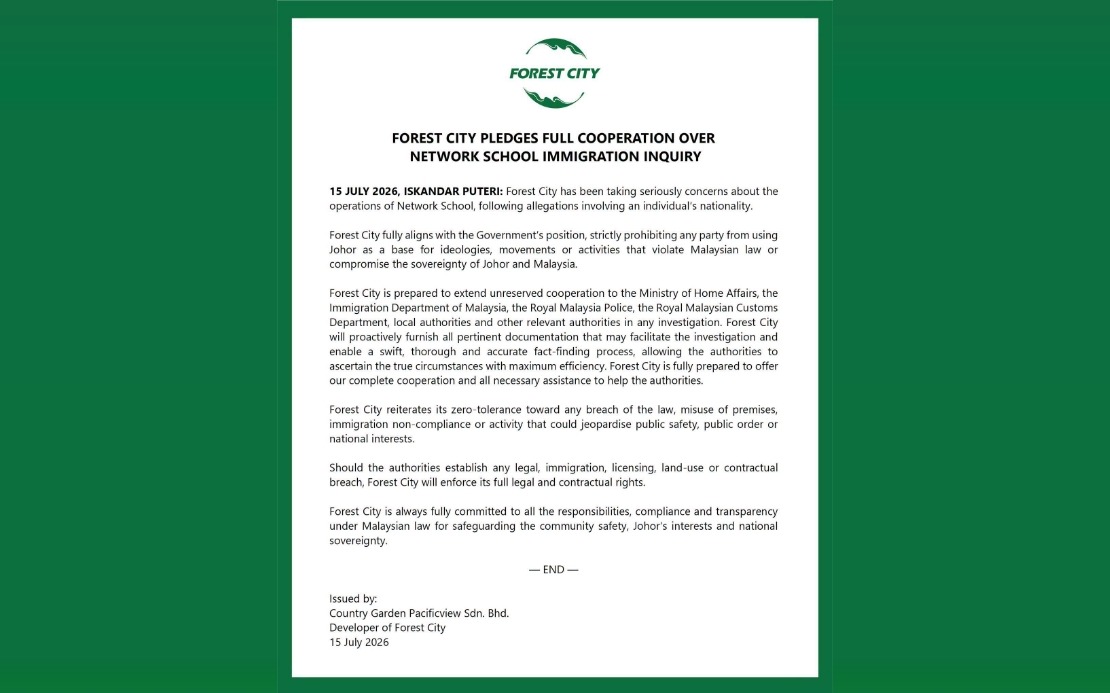
The developer of Forest City in Johor has indicated its willingness to work alongside government agencies investigating the controversial Network School operation, which authorities suspect involved Israeli nationals using alternative travel documents to enter Malaysia. Country Garden Pacificview Sdn Bhd released a statement reaffirming its commitment to assist in uncovering the facts surrounding the educational facility, positioning itself as aligned with official policy objectives concerning national sovereignty and border integrity.
The company's declaration comes after escalating official scrutiny of activities within the sprawling development. Johor's Chief Minister Datuk Onn Hafiz Ghazi previously called for a comprehensive investigation into the school's operations, expressing concern that foreign individuals may have circumvented immigration procedures by presenting passports from third countries rather than their nations of origin. This revelation triggered alarm among policymakers regarding potential security lapses within a major commercial and residential project.
Country Garden Pacificview has positioned cooperation across multiple government departments as central to its response strategy. The developer signalled readiness to engage with the Home Ministry, the Immigration Department, the Royal Malaysia Police, the Royal Malaysian Customs Department, municipal authorities, and other relevant agencies in their fact-finding efforts. This multi-departmental approach reflects the complex jurisdictional nature of the investigation, which touches on immigration law, national security, and municipal compliance.
The company committed to furnishing all documentation deemed necessary to support investigative proceedings, aiming to expedite thorough and accurate determinations regarding what occurred within its premises. By adopting a transparent stance toward information disclosure, the developer appears intent on distinguishing itself from any wrongdoing while demonstrating governance standards expected of major commercial entities operating in Malaysia.
Forest City has also articulated an explicit zero-tolerance framework addressing multiple categories of legal infractions. The developer emphasised its opposition to any violations of domestic law, misuse of its facilities, failures to comply with immigration statutes, and actions that endanger public safety or undermine civic order. This comprehensive positioning suggests awareness that its reputation and future commercial prospects depend significantly on how the investigation unfolds and public perception of the company's prior oversight.
The investigation gained momentum following Immigration Department inspections within Forest City on July 14, during which officials examined 266 foreign nationals representing 40 countries. Initial assessments indicated that all individuals carried valid immigration credentials, though more extensive investigations into their activities, sponsorship documentation, and entry protocols remain ongoing. This finding complicates the narrative, suggesting either that falsified documents passed initial scrutiny or that the irregularities involved procedural manipulation rather than forgery.
The Network School controversy intersects with broader concerns about Malaysia's regulatory environment governing foreign educational operations and residential communities. Forest City, as a major mixed-use development featuring substantial foreign populations, operates within a regulatory framework that requires balancing commercial interests with security and sovereignty considerations. The incident raises questions about the adequacy of existing oversight mechanisms and whether developers bear sufficient responsibility for monitoring activities within their premises.
For Malaysian policymakers and the business community, the episode underscores tensions between attracting foreign investment and maintaining immigration integrity. Forest City has generated significant economic activity and foreign direct investment, yet the alleged operation suggests that formal licensing and monitoring systems may not suffice to prevent unauthorised activities. The developer's cooperative stance may influence how authorities calibrate future enforcement approaches toward private commercial operators.
The controversy also carries implications for Southeast Asia's broader regulatory environment. Countries across the region host similar large-scale mixed-use developments attracting international residents and visitors. How Malaysian authorities conclude this investigation and what sanctions or corrective measures emerge could establish precedents affecting developer accountability standards throughout the region, particularly concerning activities involving Israeli nationals, a geopolitically sensitive dimension given Malaysia's historical positions.
Country Garden Pacificview's response strategy emphasises distinction between corporate responsibility and individual culpability. By framing cooperation and zero tolerance as organisational principles, the developer seeks to position itself as a victim of misuse rather than an enabler. However, this characterisation will likely face scrutiny during investigations into what oversight mechanisms existed, whether management exercised due diligence, and how the Network School operation obtained facility access.
The investigation represents a significant test of Malaysia's capacity to enforce immigration regulations within private commercial spaces while preserving investor confidence. How swiftly authorities conclude their inquiries, what findings they release, and whether consequences include penalties for the developer will influence perceptions of regulatory consistency and predictability among foreign investors. The coming weeks will clarify whether the incident constitutes an isolated breach or reflects systemic vulnerabilities within Malaysia's frameworks governing foreign activities in major private developments.

